


祇園祭:宵山 – Gion Festival: Yoiyama

This time I am here in Kyoto to experience the Gion Festival, which is largely acclaimed to be one (if not the) most famous festivals in all of Japan. It takes place over the entire month of July, but the highlights are the (procession of parade floats), and the festive evenings immediately preceding the procession, known as Yoi-yama.
This festival originated as part of a purification ritual to appease the gods thought to cause all manner of disasters such as fire and earthquake. In 869, the people were suffering from plague and pestilence which was attributed to a rampaging deity. So the Emperor ordered that the people pray to the god of the Yasaka Shrine, . Sixty-six decorated halberds, one for each province in old Japan, were prepared along with the (portable shrines) from Yasaka Shrine.
This practice was repeated whenever an outbreak occurred. In 970, it was declared an annual event. And since then it has seldom been interrupted. Even today, the festival continues the practice of selecting a local boy to be a divine messenger. The child cannot set foot on the ground from the 13th until after he has been paraded through town on the 17th. In 1533, however, the Ashikaga shogunate halted all religious events, but the people protested, stating that they could do without the rituals, but not the procession.
This marks the progression into the festival’s current form. Smaller floats that were lost or damaged over the centuries have been restored, and the weavers of the Nishijin area offer new tapestries to replace destroyed ones. When not in use, the floats and regalia are kept in special storehouses throughout the central merchant district of Kyoto in the care of the local people.
Strangely, the highlight events of Gion Matsuri do not actually take place in the Gion district, but on the opposite side of the Kamo River. From the 14th to the 16th of July, all of the floats used in the parade (32 in total) are put on display.

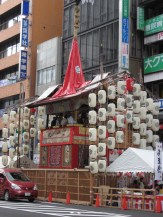

As I walked along, I also got to see all these people start to unload trucks and begin unloading stuff for their respective stalls. It was pretty cool seeing them in different stages of being set up, it sort of felt like I was watching the festival itself unfold. I also stopped by another kimono store. Just to look! I think I’m becoming a bit of a fanatic. Afterward I went back to the hotel to drop off some things and change into one of my yukata. I then headed out to experience the Yoi-yama of Gion Festival.
I first headed out to Gion itself and visited Yasaka Shrine, where Iwami Kagura, a kind of ceremonial dance, was being performed. The walk up to the shrine through Gion was quite nice, and seeing the temple all lit up at night was very pretty. They also had their mikoshi (portable shrines) on display, which were wonderful to get a close look at. I passed by a stall selling used kimono for really cheap… And I got her to give me a further discount on two of them. Okay. I’m a freak. Moving on. On my way back to the station, I caught a dance performance by three maiko accompanied by shamisen and singing. There were so many people it was almost impossible to get a clear view. I had to watch by looking at the display on my camera, which I held high over my head and tilted at an angle over the people in front of me.


It made me understand why the Shinsengumi were so worried about the Choshu’s plot during the Ikedaya Incident… there are so many people who come for Gion Festival. The way out of the station was a human parking lot.

When I (finally) made it outside, I got to see some of the parade floats lit up.

Like most festivals, a large part of enjoying Gion Festival is the atmosphere with all the stalls, etc. BE WARNED, on the actual day of the main procession, many of these stalls are taken down, so staying for Yoiyama as well as the parade day is recommended. The place is very crowded and can be hard to see anything performance-wise, so if you really want to get a good view of those kinds of things, you best get there early.
Vital Information:
Takes place every July (Yoiyama 14-16th, Yamaboko Junko 17th)
Free Admission (Additional costs for food/wares)
Somewhat English Friendly
Accessible via Shijo or Karasuma Station, Kawaramachi Station, and Keihin Shijo Station.

Comments