


Women in the Victorian era

Victorian era was full of contrasts; while the privileged minority enjoyed prosperity and luxury that came along, the poor ones had to carry the burden of development and industrialization of Great Britain. Women had no political rights, but rich aristocratic ladies spent their days in leisure and idleness; going to tea parties, dancing on balls or simply discussing the newest fashion with her friends.

Women’s virtues
Whether married or not, Victorian women were expected to be fragile, innocent, modest, polite, obedient, chaste, submissive, delicate flower incapable of deciding anything except menu and her evening attire.
In order to find a suitable (rich, noble and accepted in the society) husband girls were polished head to toe. Victorian women’s knowledge consisted of singing, painting/drawing and embroidery skills, playing an instrument and dancing. Besides all this it was also good for a girl to know a little bit of French or Italian, but her most valued skills were the domestic ones. Women were expected to be ”Household Angels”; taking care of their children and learning them proper values but also keeping eyes on the servants and arranging a menu for the day. The ideal Victorian women were tirelessly patient and sacrificing. Tough job, right ?

Marriage
In Victorian era marriage was not romantic and fairytale affair as shown in many novels. Love played a minor role in choosing a spouse. Good-breeding and huge dowry were, on the other hand, much more important. Engagement was something like a business contract and Victorians were encouraged to marry within their social class or higher, but never lower rank. Poor nobles often married wealthy bourgeoiswomen; they got their fortune and ladies got a title – perfect match.

A woman who was getting married had to provide a large dowry and her future husband had to prove he can provide her a luxurious life she’s used to. Marriage was carefully planed and financial aspects of both families were openly discussed.

Afterthebusinessaspectswere secured, engagement followed.The husbandgavehis wifea ring, and the woman’smother wasresponsiblefor organizing engagement dinnerfor thebridalcouple. Engagementlastedroughlysix months totwo years.Aftertheofficialengaged, couple was allowedmoreintimacy: they couldhold handsin public,take a walktogether, ride alonein the open carriage, and evenspend sometime alonebehind closed doors, but only at daytime.
Family life
Women had toensurethat the home isa placeof comfortand peace forher husband andfamilyfrom the stress ofindustrialBritain. To ensurea respectablehousehold, happiness, comfort andwell-being oftheirfamilies women had to bethe mistress ofthe household andwork off her job wiselyand effectively.She had to supervise theirmaidsand organizetheirwork,which was not easybecause they aremost oftenunreliable.
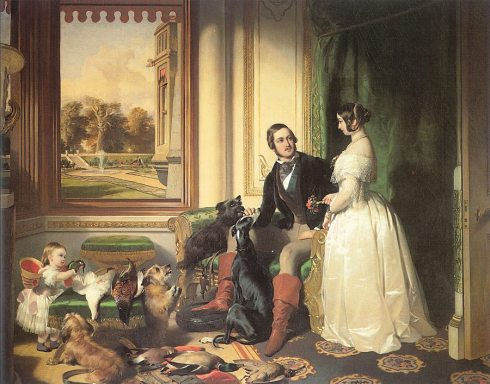
Popular poem The Angel in the House, written in 1854., shows the ideal wife; patient and willing to sacrifice for her family.
Man must be pleased; but him to please
Is woman’s pleasure; down the gulf Of his condoled necessities She casts her best, she flings her breast […]
She loves with love that cannot tire; And when, ah woe, she loves alone, Through passionate duty love springs higher, As grass grows taller round a stone.
The womanwas supposed tobe an angelin the house,alwayssacrificingfor others,alwayscheerful, charming, nice…but above allchaste. Her chastity was supposed to be her chief beauty.
Free time
Aristocratic ladies spent their days embroidering, reading, painting, writing letters, sipping tea or coffee and chatting with their friends. Lady should be her husbands pride, always looking presentable dresses in fashionable apparel. Rich ladies also had a lot of social obligations. They were obliged to organize and attend balls, dinners, dances or tea parties. Theater was also a place of amusement to nineteenth century ladies.

At least once a week lady should visit her tailor in order to keep up with the fashion. The biggest shame in ladies life was for sure to be seen in last seasons dress. Unforgivable!
Victorian morality
Sex was a taboo in Victorian era and women had to save themselves for the marriage. If women had sexual contacts with anyone except their husbands they were considered fallen women. Victorian literature and art is full of examples of women paying dearly for straying from moral expectations. Adulteresses met tragic ends in novels such as Anna Karenina by Tolstoy or Madame Bovary by Flaubert.

Education
Women hadthe opportunity tostudy refinedsubjects likehistory, geographyand literature. These subjects were to provide them withinteresting, butundeniabletopics for discussion. Despite the limitationsandstigmatization, somewomen havesucceededinmalesubjects suchas law,physics, engineering,science and art.These womenwerepioneersin the struggle forequal educationin England.Womenrarely hadthe opportunity toattenduniversities.It was evensaidthat studying is against women’s nature. Womenwere to stay moreorless an ornamentof society.

Women today have more privileges but they are indeed denied a privilege to wear such fine dresses.

Comments