


Why “The Greatest Showman” is the Biggest Piece of Crap

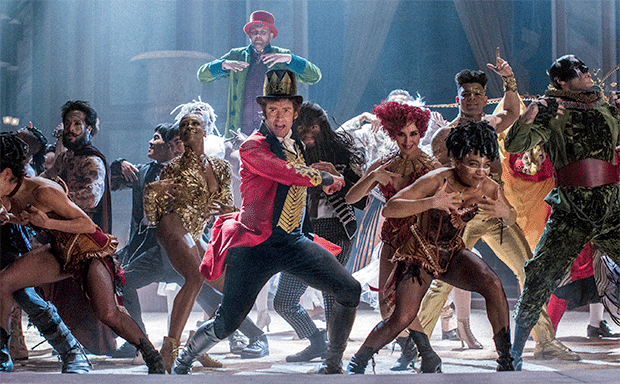
I shouldn’t have said “yes”, when a friend asked to take to me see The Greatest Showman. It was a nice gesture on his part and it was an opportunity to socialize with my friend, those were my only motivations for attending. I was predisposed to dislike it not a little but a lot: I don’t like contemporary musicals or musical theatre culture or the contemporary movie theatre going experience with its shoving of ten other movies down your throat, followed by instructions about what you can and cannot do while you’re privileged to sit in some corporation’s theatre. And I’m guessing others might feel the same way about modern cinema chains, for we were subjected to no less than two PSAs thanking us for attending a movie in a cinema, which reminded me a great deal of the prerecorded messages you used to get in the final days of pay phones (i.e. phone booth phones): “Thank you for choosing [whatever the service was]”, a clear sign that this formerly preeminent force was now in fear for its life.
But mostly my trepidation rested on the fact that I know something about P.T. Barnum, he’s a kind of hero to me, I’ve written about him many times here and elsewhere, he’s a distant relative of mine (we’re both descended from Thomas Barnum, 1625-1695), I’ve played him on stage, and I’ve spoken about him (twice in the Barnum Museum, located in the town Barnum built, Bridgeport, Connecticut). Ironically this was the reason my friend had asked me to attend. But my friend doesn’t know me that well. I walk out of plays and movies all the time. If I feel betrayed by an experience I see no compunction to remain and be tortured, and what is being forced to watch something you don’t want to watch but mind rape? (For a very similar experience, see my earlier review of the James Franco Oz movie, entitled “The New Oz Movie is a Piece of Crap”). In such cases, I thank God I have a pair of working legs, and use them.
So I only made it fifteen or twenty minutes into The Greatest Showman. I had been ready to leave after the first minute. The opening musical number, which does nothing to evoke or honor Barnum or his times musically, was all I needed to know that I would hate the movie with every fiber of my being. Yet I felt obligated to stay, as my friend had bought the ticket, and we were seated in the center of our row, surrounded on both sides by kids who, judging by their conversation, were extras in the film, I guess. So I sat and suffered for a few minutes.
Now, know this: I was actually ready to cut the film a good bit of slack. As I wrote in this multi part series, the bio-pic, especially the musical bio-pic, is the hardest of all dramatic forms to get right. In fact, I’m not sure anyone has ever gotten it completely right. I know the challenges of trying to wrestle reality into an aesthetic shape. I’ve done it several times myself. One of the great geniuses of biographical drama, Shakespeare, made masterpieces because he wisely placed drama above facts, for he was a playwright, not a historian. So I don’t require a slavish devotion to reality. But I do require it be within shouting distance of the ballpark. And The Greatest Showman is several hundred miles outside the city that contains the ballpark.
The opening scenes of The Greatest Showman present us with the spectacle of P.T. Barnum as a penniless, homeless orphan boy on the streets of New York, with dirt on his face and holes in his shoes. (Except he may have a father or an uncle, the relationship with the man is unclear). The actual Barnum was raised in a solid middle class family in small town Connecticut. He had a large, close knit family. Barnum was indeed a hustler with class aspirations. He was entrepreneurial. He had years of struggle. But when quite a young man he had successes under his belt that would have held anyone aloft — he had been a storekeeper (i.e. he owned a store), he had published a newspaper, he had run a successful lottery operation. He was a kind of hero and definitely a leader in his hometown of Bethel, Connecticut. Not some loser with no apparent future, as his father-in-law is depicted as casting him as here. Why the film takes this tack is unclear except perhaps they are trying to make the Barnum story into a Horatio Alger one. It’s a great idea to do a Horatio Alger story, but that is not Barnum’s. Change the character’s name to Ragged Dick if that’s the story you want to tell.
Then they go on to depict the adult Barnum as some sort of drudge (book-keeper, printing stock certificates or something?) at some large concern that goes bankrupt and lets everyone go. This never happened. Barnum was always an independent operator. His own boss. That is the whole point of P.T. Barnum. Why is that even in there?
But whether or not you care about Barnum, the film contains colossal, unbearable stupidities about history in general within its first few minutes. Barnum moved to New York City in the 1830s. But in the background the film shows the Brooklyn Bridge being built, which was started in 1869 and completed in 1883, and the Flatiron Building being constructed, which was completed in 1902. Further, the Barnums are depicted as living in a tenement building of the sort that were not common until Barnum was a wealthy, substantial man. These liberties are so egregious, such a palpable unnecessary outrage, I needed to leave immediately. This is stuff a teenage intern could have told you. So if the filmmakers didn’t know, it’s unforgivable, and if they didn’t care, it’s doubly unforgivable. Either way, I’m getting the fuck out of here.
As I was struggling with the dilemma, the screenwriters had Charity Barnum say, “Look who just moseyed into the old corral!” when her husband comes home. Why is a woman in 1830 uttering a cliche from Hollywood western films a hundred years in the future? I don’t know, I don’t want to know, I don’t need to know. I fled into the glorious world outside the theatre where The Greatest Showman was not happening and walked all the way from Times Square to the 2nd Avenue F stop to sweat the movie out of my system. If all goes well, I’ll never see another frame of it ever again. Judging from the all-important opening beats of the film, the movie has nothing to do with P.T. Barnum or 19th century New York. Those are what I had hoped to see depicted, and they weren’t. Feel free to watch and enjoy the movie if you have some other agenda, but don’t let me know about it.
Oh, and for the record: there’s already a terrific musical about P.T. Barnum that sticks to the facts and has much better songs (by Cy Coleman and Michael Stewart). It’s called Barnum. It premiered on Broadway in 1980 and ran for over two years starring Jim Dale and Glenn Close. Knowing of the existence of this musical makes the unforgivability of The Greatest Showman even more unforgivable.

Comments