


Who Were The Best Performing Players Statistically at the Commonwealth Games Selection Tournament?

tl;dr
See the table below for the short answer.

Introduction
Volleyball England recently held a tournament in Crystal Palace, London to determine which beach volleyball pairing would go on to represent Team England at the Birmingham 2022 Commonwealth Games. Six top men’s and women’s pairings battled it out over the four days for this honour. Congratulations to Javier Bello/ Joaquin Bello and Jess Grimson/ Daisy Mumby for winning the whole thing. Commiserations to the other five teams, especially the two runners-up Issa Batrane/ Alex Bialokoz and Anaya Evans/ Ellena Austin who really pushed the winners and gave us an exciting final, which was contested over a best of three matches.
I was present to stat every single match. This was really in an effort to be a part of Team England’s Performance Analyst for the event. Just being there to show my face to the teams and I could have a good chunk of data on the winning players. The other advantage is I have a large dataset to answer some broader questions, e.g. who were the best performing players statistically in each technical skill? Well, I collated the data to find out.
If you wanted all the match stats, click on this Dropbox link.
Statistician’s Notes
I will use a performance indicator rather than total counts to compare players. This is because players played a varying number of sets (from 8 to 20) so it would be unfair to use total counts to compare players. A performance indicator does normalise the data into percentages or averages so it creates a better level playing field to compare players. Of course, it won’t be perfect, as I will note in the relevant sections.
The resulting charts will highlight the winners in orange and their tournament placings next to their names.
Best Point Scorer
The chart below shows who was the best point scorer, as measured by point-scoring efficiency %. It is calculated as:
PEff% = (Points Scored – Errors)/ Total Point Scoring Attempts Points Scored = Attack Kills + Serve Aces + Block Kills + Free Ball Kills Errors = Attack Errors + Serve Errors + Block Errors + Free Ball Errors + Setting Errors Total Point Scoring Attempts = Total Attack Attempts + Total Serve Attempts + Total Block Touches + Free Ball Attempts + Setting Errors
A kill is basically an earned point won.
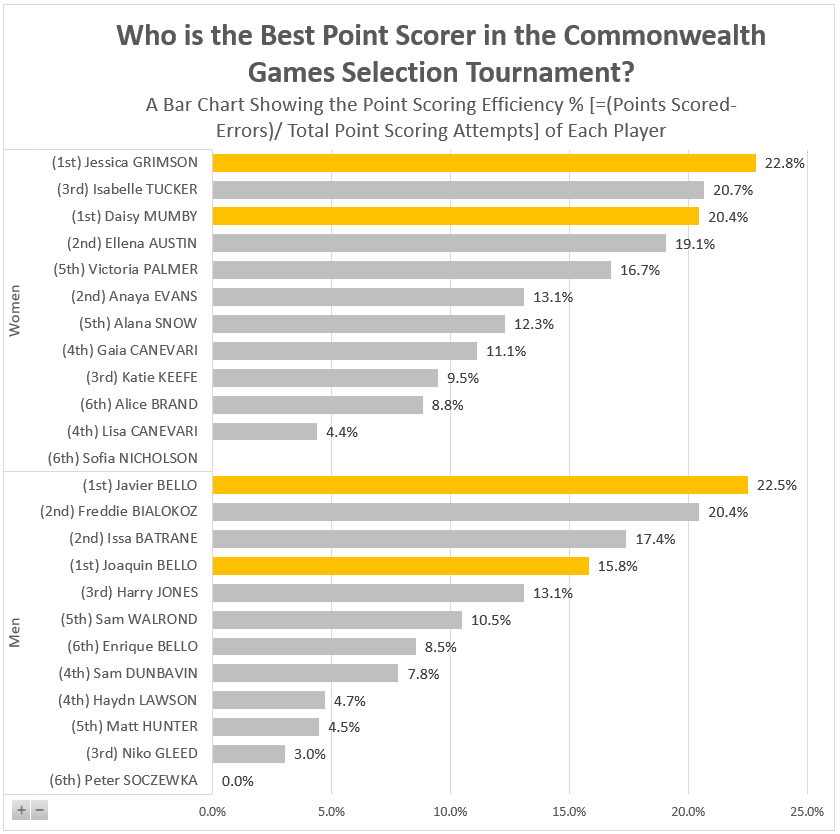
You can see that Jess Grimson (22.8%) and Javier Bello (22.5%) were the best women’s and men’s point scorers, respectively. Around 2 in 9 attempts resulted in a net point won. A big surprise was seeing Enrique Bello as the 7th best point scorer at 8.5%. He was placed 6th in the tournament but he is amongst most of the more experienced players in the tournament. He’s young so he is someone to watch out for. Perhaps another surprise is seeing Isabelle Tucker wedged in second place between the winning pair at 20.7% point-scoring. However, looking at the stats of the Commonwealth Games Funding Tournament in 2021, she had a point-scoring efficiency % of 19%.
Best Attacker
The chart below shows who was the best attacker, measured by hitting %. It is calculated as:
H% = (Attack Kills – Attack Errors)/ Total Attack Attempts).

Freddie Bialokoz was by far the best attacker in the tournament with 58.0% hitting. This means around 3 in 5 attack attempts resulted in a point won. Javier Bello was further behind with 45.7% hitting (almost 1 in 2) and Issa Batrane on 33.7% hitting (1 in 3).
On the women’s side, Alana Snow had a monster attacking performance of 51.0%. This means more than 1 in 2 attack attempts resulted in a point won. Daisy Mumby comes in a close second with 48.5% hitting.
Best Server
The chart below shows who was the best server, as measured by a serve average. It is calculated as:
Serve Average = ((Ace*4)+(Serve Overpass*3.5)+(Positive Serve*3)+(Neutral Serve*2)+(Negative Serve*1)/Total Serve Attempts
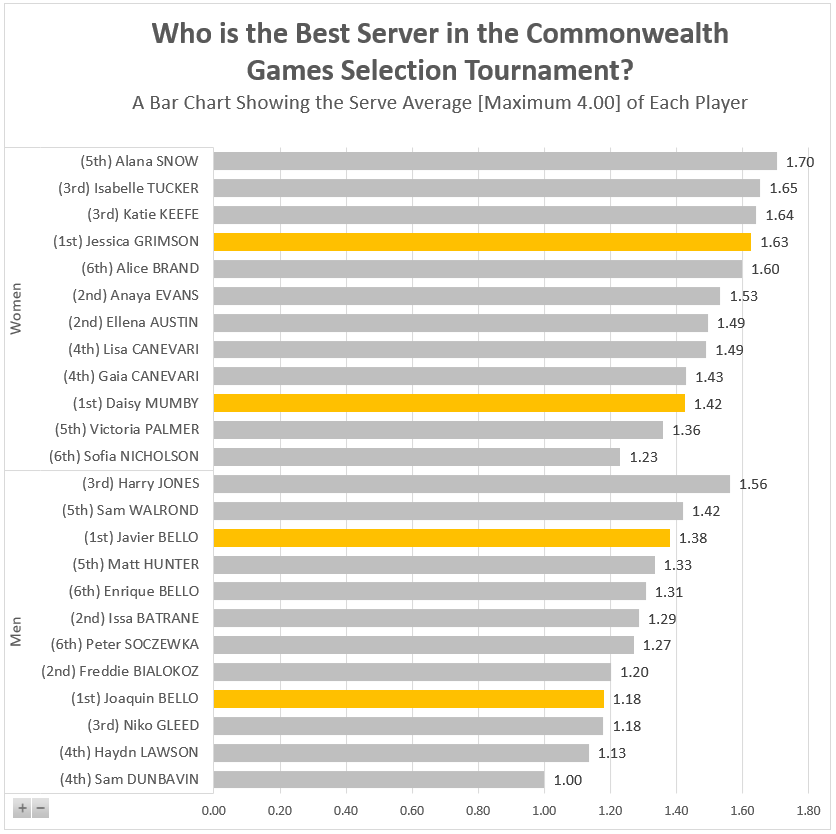
Alana Snow has topped another chart and is ranked as the best server with 1.70 serving average. Harry Jones tops the men’s chart as the best server with 1.56 serving.
Best Passer
The chart below shows who was the best passer, as measured by a pass average. It is calculated as:
Pass Average = ((Perfect Pass*4)+(Positive Pass*3)+(Neutral Pass*2)+(Negative Pass*1)+(Overpass*0.5)/Total Passing Attempts
Passing and receiving are terms used interchangeably. Passing is the first ball touch from an opposition serve.

A big surprise was that Enrique Bello came out on top as the best passer with 3.24 passing average.
Ellena Austin came out as the best passer on the women’s side with 3.06 passing. This means her passing was pretty much a positive pass on average. This is a surprise because she was targeted on serve. She had the most reception attempts by far (250), about 50% more than the player with the second most passing attempts (Lisa Canevari, 166 reception attempts).
Best Blocker
The chart below shows who was the best blocker, as measured by a block kill per set average. It is calculated as:
Block Kill per Set Average = Block Kills/ Sets Played

You can see that Daisy Mumby was by far the best women’s blocker with an average of 1.18 block kills per set. Freddie Bialokoz was the clear best men’s blocker with an average of 2.71 block kills per set. Joaquin Bello was fairly close behind with 2.00 block kills per set.
The block per set average is not the best performance indicator to use (see link why I don’t like per set average) because it is unfair to the four teams with a split blocker-defender duties as they would have fewer opportunities to block. it is unfair to the four teams with a split blocker-defender duties as they would have fewer opportunities to block.
Best Defender
The chart below shows who is the best defender, measured by dig %. It is calculated as:
Dig % = Digs/ Total Dig Attempts
A dig is a defended ball from an opposition attack.

I decided to organise the players according to whether they were a defender, blocker or split. This is because blockers tend to have a higher dig % (similar to indoor volleyball too). This is because most of their dig attempts come after their own block touch, which is a lot easier compared to the defender’s dig attempt when the opposition attack goes past the block. So they will get a missed dig even if they are nowhere near to defending the ball.
So as it stands, the best defenders for a defender and blocker are actually the winning pairs that won the tournament. Javier Bello (40.8%) and Jess Grimson (58.6%) are the best defenders for defenders and Joaquin Bello (72.3%) and Daisy Mumby (58.6%) are the best defenders for blockers. Sam Walrond and Ellena Austin get that title for the split players.
Overall
So who is the overall best player? I decided to put all of the players’ stats together and rank them whether they are in the top 3 (highlighted in yellow) or the top 1 (highlighted in green).

So for the women, I would say Daisy Mumby was the best overall women’s player statistically. She was the best blocker and defender and in the top three best point scorer and attacker. Alana Snow was probably the second best player as she was the best attacker and server of all the players plus a top three passer.
On the men’s side, Freddie Bialokoz is probably the best overall men’s player statistically. He was the best men’s attacker and blocker in addition to being a top 3 point scorer and defender. Javier Bello was probably the second best player being the best point scorer and top 3 attacker, server and passer.

Comments