


Which is the Best Zone to Serve To and Serve From?

Introduction
The serve is the only action where the success and failure is determined solely on the player. The aim of the server is to score an outright ace or put the receiving team out of system so they are unable to mount an effective attack. Without knowing the opposition team or having stats on them, are there certain zones you can serve to and/ or serve from that will yield you greater success? Let’s compile some data and find out.
Statistician’s Notes
There are nine service destination zones or passing zones, where the ball is served to. Zones 1 to 6 relate to their volleyball position. Zones 7 to 9 covers the mid-section of the court. There are five serve origin zones, where the player serves from. Zones 5, 6 and 1 relate to their normal volleyball zones. Zone 9 is in between 1 and 6 and zone 7 is in between 5 and 6. A diagram can be seen below.

I rate the serve on a five point scale that ranges from 4 for an ace to 0 for an service error. The service rating is an weighted average where you multiply each pass by its designated weight and then divide by the total service attempts. You can read more on how it is defined on this link. The weights I have given each serve quality can be seen below:
Serve | Weight |
Ace | 4 points |
Serve Overpass | 3.5 Points |
Positive Serve | 3 Points |
Neutral Serve | 2 Points |
Negative Serve | 1 Point |
Service Error | 0 Point |
I used match data from the Women’s Super League (WSL) 2019-20. I didn’t look into other competitions because either I didn’t stat service directions or there wasn’t enough data to draw upon. Just to note I did not stat serve directions for every match in the WSL. This is because I do not really use serve directions in the analysis process so when it was not needed (e.g. matches I statted after the league suspension) and when it didn’t slow me down (e.g. poor quality video makes it hard to see shirt numbers so I need that extra bit of time to work out who passed the ball), then I did not stat serve directions.
The service rating ranges from 4.00 (every serve was an ace) to 0.00 (every serve was an error). Obviously, the service rating for player is somewhere in the middle. For a reference point for what a good service rating is, the average service rating is 2.20 for the whole league. The top five servers in the Women’s Super League will serve above 2.51 and the bottom five servers will serve below 1.88 (minimum of 50 service attempts required to make the list). The service rating will be slightly different to what appears in the Top 15 List, as the serve overpass is given a weight of 3.5 instead of 3.
Rank | Player | Team | Sets Statted | Total Service Attempts | Aces | Service Error | Service Rating |
Georgia McGovern | Bristol VC 1 | 24 | 90 | 18 | 9 | 2.67 | |
Nina VOGRIC | London Inter Orcas | 27 | 103 | 18 | 6 | 2.57 | |
Katerina BOLETOU | Malory Eagles UEL | 13 | 53 | 6 | 3 | 2.55 | |
Suzanne HORNER | TeamBU Wessex | 36 | 206 | 44 | 24 | 2.52 | |
Abby BECKER | Durham Palatinates | 47 | 187 | 17 | 7 | 2.51 | |
. | . | . | . | . | . | . | . |
Total | Super League | 175 | 7444 | 766 | 818 | 2.20 | |
. | . | . | . | . | . | . | . |
Chiara RANZUGLIA | London Inter Orcas | 20 | 50 | 2 | 6 | 1.88 | |
Shona FRASER | Durham Palatinates | 37 | 55 | 2 | 12 | 1.87 | |
Marzia DI BELLA-NEGI | Bristol VC 1 | 18 | 50 | 2 | 2 | 1.78 | |
Ebonie HICKS | TeamBU Wessex | 32 | 65 | 5 | 14 | 1.75 | |
Petra LINDOVSKA | Cambridge & ARU | 21 | 50 | 1 | 5 | 1.73 |
Serve Destination – Where to Serve To
With all things being equal, is there a general zone where the serve is most effective? Below is a chart showing the total service attempts and service rating for the serve destination zones (or passing zones). It appears the most effective zone to serve to is deep into the corners of passing zone 1 (2.22) and passing zone 5 (2.21). The next most effective is passing zones zones 6 (2.13), 9 (2.17) and 8 (2.15). While there is a gap between the top 2 and the next 3, the gap is pretty small to be noticeable.

It looks like serving short (zones 2 to 4) are the least effective serves (service rating of 1.50 to 2.09). I would have thought that this would have been the best zone to serve to because I remember in one match that Polonia really struggled in the pass when the opposition would purposely served very short to stretch out the receivers. The stats show this is not the case. It would be useful to watch those attempts on video to see why is the case. It could simply be that the execution is poor (perhaps due to not practicing short serves in training). For example, 5 out of the 13 total attempts to zone 2 were due to service errors.
Zone 7 also looks to be not a good zone to serve to (1.97). This is probably because this is the zone where the front row outside hitter is usually starting closer to the net so those mid-court serves lands straight into their mid-section for an easier pass.
Serve Origin – Where to Serve From
Players tend to stick to a certain zones when serving. However, can certain spots provide a better outcome on service? Below is a chart showing the service rating and total attempts for the service origin zones. It looks like the best zone to serve from is zone 1 (2.24) followed by zone 9 (2.14). Zone 7 and 5 are close behind (both 2.09) with zone 6 (2.02) being the worst zone. I would have expected zone 1 to be the worst zone to serve from. This is because since most serves come from zone 1 (42% in fact, 1149 out of 2767 serves), players will have more experience, or a larger mental database, of passing from that zone. This appears not to be the case as zone 1 is the best service origin zone and the nearby zone 9 the second best.

Serve Origin and Destination Zones – Where to Serve From and Serve To
Are there any seams which are the most effective serves? Below is a chart showing the total service attempts and service rating organised by service origin and destination zones. It looks like it is best to serve from zone 1 and basically serve it cross court. Aim for zone 1 (2.35) and if is lands mid-court in zone 8 (2.36) then that’s good too. If it goes shorter to zone 3, then that’s even better (2.45). If it goes sharp to zone 9 (2.27) then that’s not bad either. You should also have the odd serve to zone 5 (2.27) to change things up. Just make sure that you serve it deep as serving it mid-court to zone 7 results in a 1.88 service rating. I would avoid serving from zone 9, 6 and 7 as there’s not many good spots to serve to. If I was to serve from zone 5, I would serve line. Aim for zone 1 (2.28) and if it lands mid-court to zone 9 (2.24), then again, that’s not bad either.

What About Individual Players
If serving from zone 1 is the best zone to serve from, where do the best servers actually serve from. Below is a chart showing the service origin zones of the Top 15 servers in the Women’s Super League. Minimum of 50 service attempts is required to make the list. You can see that 11 players in the Top 15 best servers serve from zone 1. If you incldue the two players that serve from zone 9, this would mean 13 out of 15 players serve from the right side. Only two players serve from zone 5. No top 15 server has served from zone 7 or 6. This would support the trends seen above.

Will Serving From Zone 1 Improve Your Service Quality?
It could be the case that the best servers just happen to serve from zone 1 and that’s why we get the values above. A player may not necessarily get better results if they switched and started to serve from zone 1. To test this idea out, I looked at players who served from several service origin zones and see where they served best. The players I included are those who has at least 10 service attempts in two different service origin zones that are not next to each other. For example, if a players has 10+ service attempts in zone 1 and 9 then they are not included because the two zones are next to each other. If they served 10+ times from zone 1 and 6 then they are included in the sample. Below is a chart showing the the service rating and total service attempts from each service origin zones. You can see that there’s only five players met the minimum requirements and that they all came from Polonia SideOut London. This is where not statting serve directions for every match comes into play. I code serve directions for Polonia SideOut London but not for every match involving opposition teams, especially the bulk of matches I statted after the league suspension due to Covid-19.
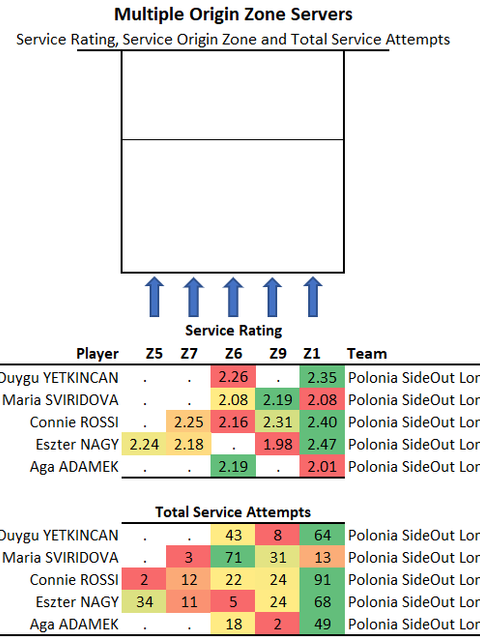
Three of the five players who have served from multiple origin zones served best from zone 1. It does show some support that if you switched to serve from zone 1 then you could get a better outcome. However, I would take this with a pinch of salt. It is only based on five players. Also, the minimum requirements of 10 service attempts is quite low and it probably won’t truly reflect a player’s service rating from that zone.
Final Thoughts
Of course, there are other factors at play when deciding where to serve to and to serve from. For me, my main strategy is to serve on the weakest passer statistically to put the team out of system more often so they can’t mount an effective attack. See the table below in how the first ball sideout efficiency percentage lowers with every downgrade in pass quality. You can identify the weakest passer from live stats and/ or scouting reports.
If we are facing a team for the very first time then I would probably recommend this strategy of serving cross court from zone 1 with the odd serve to deep in zone 5 as a starting strategy. You can modify the serving strategy as the match unfolds depending on what you see and if you have live stats to back up any changes.
I would also recommend avoid serving from zone 6 in general. This is the definitely one thing I will implement at City University London next season. This will be a change from last season when I coached my players to serve from the zone they will defend in, i.e. setters and opposites serve from zone 1, outside hitters in zone 6 and middles in zone 5. I did this so the transition into defence is a lot quicker. So instead of outside hitters serving from zone 6 (worst service origin zone), I will make them serve in zone 1 (best service origin zone). The transition to defence in deep zone 6 isn’t too far either so I can live with that.


Comments