


Vincent Price: Villain of Imposing Stature


Tribute today to a man esteemed for his stature both literal and figurative Vincent Price (1911-1993). (A cinematic giant, he was also 6’ 4” tall).
Given Price’s aura of grace, class, and sophistication it probably won’t surprise you to learn that he came from a background of privilege. His American roots go back nearly as far as the Mayflower on both sides (which added a certain verve to his performances on the several occasions when he enacted Hawthorne roles); his grandfather became a multimillionaire after inventing baking powder; his father was CEO of the National Candy Company. Price’s first love from childhood was fine art, but more as a collector and critic than a painter. This is what he majored in at Yale. It was while Price was doing graduate study in London that he became a professional actor. (Price was a lifelong Anglophile, so much so that newbies often assume that he is English. I certainly thought he was when I was a child. But Price was born and raised in St. Louis, and you can hear that in his accent as well).
Price’s privilege opened a lot of doors for him socially, allowing him to start out at the very top, though I love him so much I find it hard to hate him for this. He was inspired to act by seeing John Geilgud’s Hamlet in 1934. He went backstage and talked to the actor, who encouraged him. By the next year Price appeared in two West End plays Chicago and Victoria Regina, got terrific notices, and it looked like he was going to be a phenomenon of the British stage. (In the latter he played Prince Albert to Helen Hayes’ Queen Victoria in a play by Laurence Houseman, A.E. Houseman’s brother. This is what I mean by “at the top”). But this promising start was cut short when it emerged that Price had no work permit. Forced to return home, he became a member of Orson Welles’ Mercury Theatre, acting in The Shoemakers Holiday and Heartbreak House.

From there it was out to Hollywood in the late thirties. Naturally, given the populist nature of American cinema, any actor who is vaguely European, polished or posh is immediately suspect. Though on the stage Price was roughly being cultivated for matinee idol status (hence the pencil thin mustache), on screen almost from the beginning he got cast as oily villains and monsters, although it wasn’t until 1953’s (one of my favorite movies) that the iconic “Vincent Price” image clicked in a big way. Yet prior to that, he had been in (1939), (1940)(1940)(1944, a noir, but he’s still a creep in it(1946, a sadly neglected gothic drama, the Duchess and I watched it a few weeks ago),Abbott and Costello meet Frankenstein(1948), (1948, as the villainous Richelieu),and (1950, a hilarious B movie western in which Price’s character wants to set up his own dictatorship in the American southwest—his first starring role ).

is a tour de force of high drama (tragedy really), grand guignol, and perhaps for the first time, intentional camp. There is a gleam in Price’s eye—several comical takes, that are meant for us all to enjoy at whatever level. He followed that role up with the following year, then played the disgusting procurer Baka in DeMille’s (1956), the Devil in Irwin Allen’s (1957), the unspeakably awesome 1958 and its sequel (1959).

Then he really hits his stride with the William Castle pictures (1959), and (1959), and then his pictures with Roger Corman, (most of them Edgar Allan Poe adaptations) such as (1959), (1961), (1962), (1962), (1963), (1963), (1963), (1964), (1964).
Along the way there were choice odds and ends by other producers that also fit into his oeuvre such as (1959), (1963), (1963), (1964—later remade as and ), (1968), (1970)
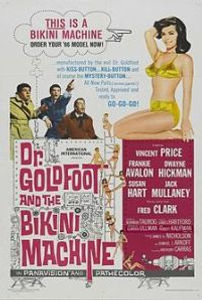
His relationship with American International Pictures (the Corman movies) also resulted in full-on camp parts: (1963), Dr. Goldfoot and the Bikini Machine (or as I like to call it “the worst comedy ever made, 1965), and Dr. Goldfoot and the Girl Bombs (1966).

Price was able to work his extremely old school thing an amazingly long time, well into the 1970s. There was (1971), (1972), (1973), and (1974). By now though horror was changing – a lot. Think, for example of Brian de Palma’s, which came out in 1975. What role could Price, with his huge melodramatic baggage, play in the universe of graphic realism? Over the next couple of decades, he mostly confined himself to campy roles on television (like his memorable guest appearance on , animated cartoons, and even rock and pop projects like Alice Cooper’s (1975) and Michael Jackson’s (1982). And thankfully, there was his relationship with Tim Burton, who sent him off with appropriate fanfare with two loving encomia (1982) and (1990).

This is sort of the tip of the iceberg of price’s output, really. I’ve cleaved to mentioning his cinematic work (he also did plenty of television work in the same Gothic vein, although I’ve seen very little of it). And he did lots of roles that were less monstrous, that strayed a bit farther from the “Vincent Price” brand. (One of these occurred , occurred quite late in his life).

One last plug: THE definitive book on Price is Vincent Price: A Daughter’s Biography, by his daughter Victoria, not just an excellent read, not just a loving appreciation, but clear-eyed and factual, and not skimming over her father’s faults by any means (including some juicy revelations I won’t spill here, in the hopes you will actually read the book).
For a post with more detail about Vincent Price’s horror movies go here.

Comments