


Updated Attack Combination Codes for Beach Volleyball

Attack Combination Codes Introduction
Attack combination codes in DataVolley are specific codes that enable specific attack types to be coded. They are made up with two alphanumeric characters. The first character usually denotes the type of attack from a certain kind of set and the second character usually denotes the attack origin zone, i.e. where the attack started from. Together, they give you the specific attack type. This is important because you want to know the frequency, direction tendency and effectiveness of each separate type of attack for any analysis you want to perform.
In my first summer of statting beach volleyball matches (read my final reflection here), I went simple; I coded everything as a high ball (V code) and used the same origin zones as in indoor (1-6 for front row, 7-9 for back row). I used the same codes for second touch (mainly setter attacks) and first touch attacks (mainly overpass attacks) as for indoor. I did eventually create a separate code for “On 2” attacks (G code), where players would spike the ball on the second ball contact. However, there were other different types of attack that I wanted to record, e.g. attack from a back set, but the current attack combination codes were too simplified. I wanted to expand the list to include more types of attacks.
Updated Attack Combination Codes for Beach Volleyball
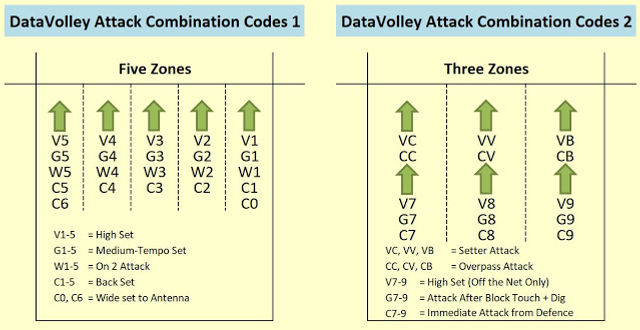
My set of new set of attack combination codes for beach volleyball can be seen below. A major change is I have five attack origin zones for the front row instead of six. I’ve seen scouts by three different scoutman and all three used five attack origin zones. It just makes a lot more sense this way because I never really used the two widest zones (1 and 6) and the attack down the middle is a lot clearer now.
I’ve also included five new attack types. They are: 1) Attack from a medium-tempo set 2) Attack from a back set 3) Attack from a wide set to the antenna 4) Attack after a block touch and dig, i.e. attack not after a set 5) A dig/ defence attack, i.e. the dig/ defended ball is intentionally dug straight over the net into the empty court.
You can see that these attacks are all different and you would want to know the frequency, direction tendency and effectiveness of each type of attack for analysis purposes. There will be something in there that a team could exploit to enhance future performances.
Evolution
Like with my indoor attack combination codes, things will likely evolve. I already know the attack from a medium-tempo back set is missing so I may be able to fit it in the list in the future. These attack combination codes are also untested in a live setting so there could be a host of issues that pop up (e.g. with so many attack combination codes, creating the worksheets and charts could be tough). But as of right now, it does look like a pretty comprehensive set of attack combination codes for beach volleyball. It just needs to be field-tested and practiced.

Comments