


The Waldorf Bar with an Albert Crockett Chaser

I’m working this week on a presentation about our History of the American Cocktail Collection. Well, in theory. I can be a bit of a procrasinator at times and it’s been a busy week. After all, next Thursday (when I’m actually presenting) is a whole week away. But to help myself get beyond the bullet list of talking points (and create some scans I might be able to use), I thought this week we’d look at The Waldorf Bar (the original one, that is). Truth be told, I’m going to let Albert Stevens Crockett do most of the work. You see, he knew a LOT about the place and he wrote two books to tell everyone else: The Old Waldorf-Astoria Bar Book, 1931 (reissued in 1934, following the repeal of Prohibition) and Days, 1931.
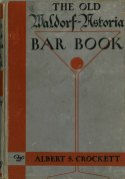
The Old Waldorf-Astoria Bar Book, 1934

Title page 1

Title page 2

Cocktails by base spirit

More cocktails by base spirit

Sample recipes, “Pre-Prohibition Cocktails”

Sample cocktails, hot and flaming drinks

Cuban rum drinks

Title page

Bar illustration

A previous owner of this volume actually colored the drinks in this section by base spirit: black for gin, blue for brandy, green for rum, and red for whiskey.

In this case, the previous owner even noted WHEN they tried a particular drink.
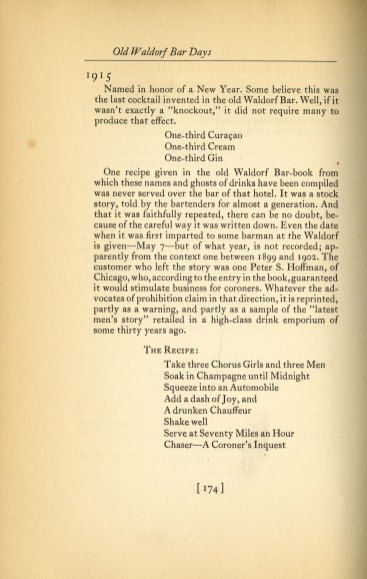
The “1915,” a drink with a recipe, a history, and a warning…

Sample “Fancy Potations,” with the required serving glass.

Pages from the glossary. “Rum” didn’t always just mean rum. Sometimes, it was more general term!
These are not simply cocktail recipe books. In fact, even though they are chock full of recipes, I suspect Crockett had another goal. His books document cocktail culture in American society in the days before Prohibition. The amendment would give birth to a new kind of bars and cocktail scene (aka the speakeasy), but the bartending tradition depicted in figures like Jerry Thomas (who bartended almost until his death in 1885) or Harry Craddock (who moved to London to escape Prohibition in the United States and continue his trade), for example, disappeared in 1919.
Albert Crockett had likely seen something of those early days (he was born in 1873). And in fact, he would live into the mid-20th century cocktail revival (he died in 1969). His career was as a newspaperman, but looking at few pages of either book, we could easily describe him as a avid observer of people, too. He’s a bit wordy, but his stories and histories alternate between the amusing and the pointed. He may drop a few names (that probably meant more in his time), but he seemed clued in to the idea of what a bar meant for those who frequented them, whatever their reason.
I think Crockett would be pleased by the current trend toward craft cocktails, handmade ingredients, and old classics returning to bars. Our rediscovered attention to detail, as well as the idea of bar as “place,” hearkens back to what he was lamenting. So next time you’re visiting your favorite spot, be adventurous and try something new, even if it’s old (“Goat’s Delight,” anyone?). Albert would approve. Cheers!

Comments