


The Unattainable Circus


With less than a week left to see Ringling Brothers Barnum & Bailey’s latest tented show Coney Island Illuscination, it would seem a propitious time to continue my ongoing circus rant previously enjoined here, here and here.
One reason I think I am a rather poor circus fan is that I privilege theatrical values over the so-called “spectacle of actuality”. In this respect I am an idealist in the grand old circus tradition of Plato, Kant and the Transcendentalists. Mere “feats” are uninteresting to me; I am after the supernatural. (This also explains my antipathy to sports). In other words, I don’t care what the hell is ACTUALLY happening. If my MIND’s eye isn’t excited, the event doesn’t register, it doesn’t rate. Theatre is not a noun, it is a verb. It is not about being (that’s for museum exhibitions), but about becoming. As Shakespeare knew (a lesson he gleaned from Ovid), theatre is above all about transformation. An actor transforms into a character. The character himself transforms over the course of the play. And the audience transforms from watching the experience. That is, they do if their imaginations are sufficiently engaged by the magic of the event. And this must be made to happen through certain techniques.
For example, I’ve always hated the way many circus p.r. writers will talk about the way jugglers “seem to defy gravity”. They do nothing of the kind. Their exertions are all too apparent. They are strenuously and obviously throwing things into the air. (This is not to disparage this remarkable art form. I am speaking here about presentation). If the juggler were defying gravity, his balls would hover in the air and spontaneously change direction at right angles, like a U.F.O. (This would be an excellent act, by the way.) W.C. Fields once faced a similar conundrum. At the height of his juggling career he introduced an unbelievably hard feat (I forget what it was), something other jugglers would probably recognize at once as the greatest thing that was ever done. It scarcely got any applause, yet several of his lesser stunts went over like gangbusters. Similarly, I’ve always hated the way contemporary whippersnappers do the straight-jacket escape, in and out in less than five minutes, when the great Houdini would do the same trick in five hours. It’s the same trick, but how can someone be impressed by a feat so easily done in less time than it takes to tie your shoes? It doesn’t matter what the thing IS. It matters what the audience THINKS it is. All theatre artists (including variety artists) are, or should be, magicians rather than strong men. Our job is to hypnotize the audience. They must be sold on the action at hand…from the print ads and press releases, to the posters, to the decorations in the lobby, to the decor in the house, to the set, to the actor/performer.
Here’s a study in contrasts to show what I mean. My first two circus experiences occurred within months of each other in the mid-1970s. One, a trip to Ringling Bros. etc at the Providence Civic Center, left me cold with its impersonal, soulless environment, and its aggressive overkill. It didn’t reach out to include me in the slightest. It merely attempted to steamroll over me like Top 40 radio. I was a child and I still couldn’t care less about what I was looking at. On the other hand, around the same time, a little student circus called Circus Kirk came and put up a tent in a field next to our local middle school. Unlike the Ringling Bros show, this outfit had no world class talent. The tricks were not only rudimentary, but lame. (I remember being particularly appalled by the concept of a clown juggling sheer, floaty handkerchiefs). But what was amazing — thrilling, in fact — was the transformation of our local football field into a circus. It’s just the same feeling of the high school gym becoming the site of the school dance. It isn’t even the same physical location any more. Something alchemical has happened.
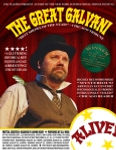
I had another revelation recently that goes even further however. At the terrific show The Great Galvani in the New York International Fringe Festival, a truth I’ve both practiced and preached was brought home to me, and that’s that the verbal art can trump all the others. When you have an expert storyteller or monologist painting a compelling aural picture, it’s all done for you. In fact, you can have a far greater circus than will actually exist in real space. If the Ringling Bros. Circus features a trapeze artist that turns four somersaults, great. But my storyteller can make you see a trained chicken trapeze artist that turns 100 somersaults before bursting into flame and landing on your plate as a full course meal. I’d rather spend a half hour with that actor in The Great Galvani (his name is H.B. Ward) than a thousand three ring circuses. Because, if need be, that actor can conjure TEN THOUSAND three ring circuses. How you gonna compete with that? Unfortunately, Ward and his company The Magpies have headed back to Chicago.

And? And the Ringling Bros. tented show is as good as it gets for live circus in 2010, I think. A muddy lot in Coney Island is transformed into a playing space. And if the name of their current show is off-puttingly pretentious, at least it hints at the kind of “circus of the mind” I am describing. Whether they have achieved it (or even need to) is up to you. Info and tickets are here.
And while I’m at it, a short list of favorite circus films you may enjoy:
* Billy Rose’sJumbo (1962, based on 1935 stage play, with Jimmy Durante, Poodles Hanneford and many others)
* At the Circus (the Marx Brothers, 1939)
* You Can’t Cheat an Honest Man (W.C. Fields and Edgar Bergen, 1939)
* The Greatest Show on Earth (1952, by Cecil B. Demille and a cast of thousands)
To learn more about the roots of variety entertainment, consult No Applause, Just Throw Money: The Book That Made Vaudeville Famous, available at Amazon, Barnes and Noble, and wherever nutty books are sold.

Comments