


The Samuel Foote Tricentennial: Props for a One-Legged Cornish Comedian

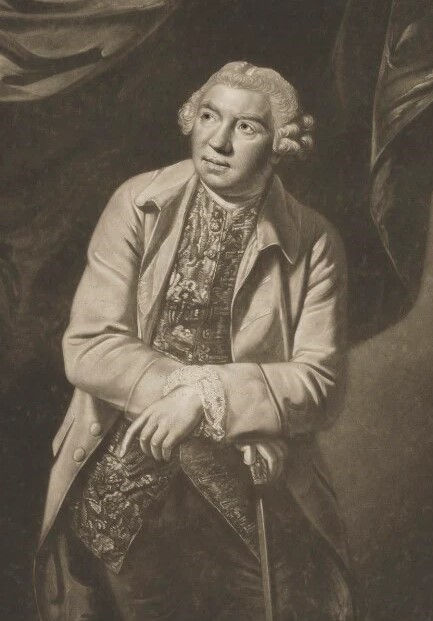
Yes, it’s quite true, a man named Samuel Foote (1720-1777) lost his leg in a riding accent, and later made lemonade out of lemons by writing and starring in a play called The Lame Lover (1770). This would be reason enough to cherish his memory, but he is also well known for composing one of the great pieces of literary response, written as a challenge to his friend and mentor Charles Macklin, who had claimed that he could instantly memorize any speech recited to him. Foote’s ran as follows:
So she went into the garden to cut a cabbage-leaf to make an apple-pie; and at the same time a great she-bear, coming up the street, pops its head into the shop. “What! No soap?” So he died, and she very imprudently married the barber; and there were present the Picninnies, and the Joblillies, and the Garyulies, and the grand Panjandrum himself, with the little round button at top, and they all fell to playing the game of catch-as-catch-can till the gunpowder ran out at the heels of their boots.
Foote was thereby the man who coined the English phrase “the Grand Panjandrum”. It’s not a common expression exactly, but my late ex-father-in-law did use it in the title of his biography of Oliver Wendell Holmes.
Foote was a rake from a family of rakes. Born into the Cornish aristocracy, he inherited his first fortune when one of his uncles killed another of his uncles. After he spent of that down, he married a woman for her money, used that up, then left her as soon as get some more dough of his own. He was expelled from Oxford, and practiced law for a time, although the only thing he seems to have taken away from the experience was a knack for satirizing the lingo of lawyers. He was a clown and a cut-up throughout his life. Only a hitch in debtor’s prison in 1742 inspired him to give the theatre a try, and there he was successful. He was a flop as Othello to Macklin’s Iago, but much more successful in the farces of Farquhar and Vanbrugh. Comedy was his forte.
In 1747 Foote began producing his own plays and theatricals, beginning with the revue The Diversions of the Morning or, A Dish of Chocolate, at which he very cleverly gave out free cups of hot cocoa in order to circumvent the nation’s theatre laws. Some 30 more works for the stage followed. Generally, his humor skewered fads and trends, as well as scandals involving particular individuals. The Minor (1760) took on George Whitefield and the Methodists, for example. While delighting audiences, Foote’s style of comedy often had the consequence of antagonizing the targets of wit. An Auction of Pictures (1748) took on Henry Fielding, which prompted a friendly public battle between the two. Around the same time, he engaged in a lengthy feud with actor Henry Woodward, in which the two men took turns ridiculing each others’ acting and literary styles over a two year period. The last such feud happed in 1776, when a supporter of the bigamist Elizabeth Chudleigh, widow of the Duke of Kingston, objected to his portrayal of her in his play A Trip to Callais (later known as The Capuchin). The critic as much as called Foote a homosexual in print. Around the same time, a footman of Foote’s (a Foote man, if you will) charged the playwright with what we now call “sexual assault”. After a messy trial, Foote was acquitted. He died a year later while en route to France.
Three quarters of a century later Thackeray gave Foote a shout-out in his novel Barry Lyndon.
In 2012 Ian Kelly wrote his biography Mr. Foote’s Other Leg, which was then adapted into a play by the author in 2015.

Comments