
.png)


The Rocky Horror Picture Show Turns 50
- goldenstateservicesj
- Sep 26, 2025
- 6 min read

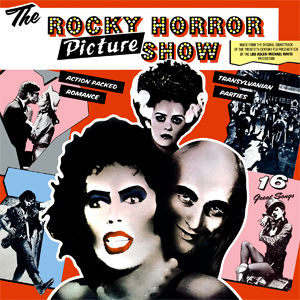
September 26, 1975 was the date of the American release of that singular cinematic specimen, The Rocky Horror Picture Show.
Is Rocky Horror the hub of the universe? For a theatre-maker of my vintage, it can feel that way. Though not a huge hit upon its initial release it soon became what many think of as the ultimate cult movie, back when that phrase had literal meaning. Weekly midnight screenings replete with cosplay and ritualistic interaction with the onscreen shenanigans became a regular thing in cities like New York and San Francisco, then rapidly spread throughout the country. In short, it came damn close to mimicking some of the key characteristics of an actual cult. I didn’t know about it until a live screening at the University of Rhode Island circa 1981, when I was a teenager. I attended two or three showings at around that time, and purchased the soundtrack album, which I listened to as much as any rock record. The songs (basically a fifties pastiche in the manner of Grease) are brilliant, catchy, witty, and surely a major key to the fanatical longevity of Rocky Horror.

Most importantly, Rocky Horror was a gateway drug, which led to further appreciation of the B movie horror, science fiction, and exploitation films it parodied, as well as exploration of the glam rock, camp, and experimental theatre wave that led up to it, which I had been too young to grok at the time (yes, I use the word grok. Sometimes it is only the word that will do). Rocky Horror‘s exploration of the pop culture past colored me and many cohorts of my generation, and we later reflected it back out yet again. We may have been among the last in that line, though. The internet and social media have young people plugged into the present 24/7. They seem to have very little interest in the past, lacking both pathways in, or guides to take them there. One encounters exceptions to that generalization, of course, but they only prove the rule.
In earlier pieces (here and here and here, for example), I wrote about the thread of nostalgia in the ’60s and ’70s and ’80s for the ’20s, ’30s, ’40s, and ’50s. It manifested in a zillion ways, in cinema, theatre, in pop music, on television. The phenomenon seems related to pop art. Almost parasitically, artists raided vintage culture as material for their own work, summoning memories, pirating the charm of the past, while sometimes simultaneously puncturing it as a means of legitimizing the new statement with a veneer of cleverness, or a political or sexual dimension. Gay culture played a big role in this movement, though not exclusively. Boundaries were pushed. The latency of squares was ridiculed; kinks and quirks were celebrated. Figures as wide ranging as Bette Midler, John Waters, Alice Cooper, Peter Bogdanovich, Paul Reubens, Charles Busch, and about 500 others I could name came out of this crucible. I would say this postmodern trend spanned at least three generations: the tail end of the so-called Silent Generation, plus Baby Boomers, and Generation X.

Among the artists of this period was British stage actor Richard O’Brien, whose track record included English productions of Hair and Jesus Christ Superstar, as well as things like Sam Shepard’s The Unseen Hand and The Tooth of Crime. O’Brien has been trans since before the term was in common usage. This is anecdotal, but O’Brien’s matter of fact injection of trans identities and all manner of sexual behavior permutations throughout Rocky Horror seem like they must have been a huge factor in normalizing bedroom antics that once got people sent to mental asylums. (To be clear, this is to be celebrated, and happens to be under threat at the moment. The people in charge of America at present would love to throw two-thirds of the country in camps, based on what they’ve said and done over the past decade.) At any rate, with camp very much in vogue at the time, O’Brien collaborated with stage director Jim Sharman on the original 1973 stage production of The Rocky Horror Show.

The plot draws from classic horror and sci-fi of the ’30s to the ’50s, especial Universal pictures like the Frankenstein cycle, and U.F.O. flicks from the drive-in era . A young couple of just-married normals, Brad and Janet, experience car trouble on a dark and stormy night. They walk to the nearest house, which happens to be a haunted castle presided over by a sexually ambiguous mad scientist named Dr. Frank-n-furter, along with his unwholesome servants Riff Raff (a hunchback), Magenta, Columbia, etc, all of whom are from some distant star system. Also unveiled is Frank-N-Furter’s creation, Rocky Horror, a man designed to be physically “perfect”, as in old bodybuilding advertisements and Steve Reeves movies. Over the course of the story, both Brad and Janet are seduced by Frank-N-Furter as in some farce or Restoration comedy. It all leads to a blissful Busby Berkley style orgy scene, which is interrupted by death and destruction wrought by the servants, who are irate that their planetary mission is compromised due to Frank’s corrupt, pleasure-loving leadership. Something like that, anyway.

The show premiered in a small 63-seat house above the Royal Court Theatre in London and was an immediate long running hit. It transferred to a 250 seat house, and then a 500 seat one, and continued to run until 1980. Meantime, music producer Lou Adler opened an L.A. production in 1974, which ran for nine months. This became the basis for the 1975 film, which mixed cast members from the original British production, and newcomers. It’s basically what put Tim Curry on the map. I saw him as a sort of ultra-queer version of Mick Jagger (who was already wearing make-up himself during this period). Bands like Queen and Kiss had meanwhile exploded in popularity, providing some context for the costumed outrageousness. The film also featured Charles Gray as the narrator, Barry Bostwick and Susan Sarandon as Brad and Janet, O’Brien himself as Riff Raff, along with Little Nell, Meat Loaf,Patricia Quinn, Peter Hinwood, et al.

It surely seemed natural to bring Rocky Horror to the screen. After all, Brian De Palma’s The Phantom of the Paradise had come out the year previous. And it seems logical to bring a movie that owes so much to cinephilia…to the cinema. On the other hand, this movie is not for everybody. Still isn’t for everybody. My kids watched it when they were teenagers and were every bit as appalled as my parents probably would be. But it is very much THE movie for some people. J. Hoberman’s book on Midnight Movies gives a very good account at how Rocky Horror became a phenomenon in New York City. Its shadow is incalculable. Two good (married) friends of mine with whom I used to collaborate back in the day, MET as actors in a production of Rocky Horror. Much more mainstream things like the musical versions of Little Shop of Horrors or Hairspray, likely wouldn’t have occurred without the Rocky Horror template.

I wish more producers would heed the lesson of the Rocky Horror business model. The movie has earned $166 million at this writing. During the first year of its release, it earned a mere $1 million. You can’t game it, of course, but by the same token, there are such things as sleepers. Rocky Horror cost only a million and a half to make. Isn’t that better than flops that cost hundreds of millions to produce and never make it back? Yet, John Waters hasn’t been able to get a movie funded in over 20 years. I tell you forthrightly: that shit ain’t right.
And now here’s some news you can use:

Today is opening day in movie theatres for a new chapter in the Rocky Horror saga, a new documentary entitled Strange Journey: The Story of Rocky Horror. It is directed by Linus O’Brien, son of the musical’s creator, Richard. I’ve not seen it yet, but am very much looking forward to doing so!


Comments