


The John E. Owens Bicentennial


Yes, 19th century actor John E. Owens (1823-1886) was born 200 years ago on this day.
Never heard of him? That’s alright, neither had I until a few weeks ago when a good friend to this blog sent me a copy of his biography, which I’ve now read and which satisfactorily convinced me that Owens was indeed a major figure of the 19th century America stage. Owens was one of the leading stage comedians of his day. Yet, out of over 7,000 posts on Travalanche, I’ve not had occasion to mention him here even once. There’s no lesson to be drawn from this. Owen died before the age of audio and visual recording, and I’m not someone who spends a lot time (any, actually) in libraries looking at old programs and press clippings. Most contemporaries of Owens’ whom I’ve written about were people I’d become aware of because of some external historical factor that somehow made them notorious. Edwin Forrest sparked a famous riot in New York City; Laura Keene was in the play Lincoln was watching the night he was shot; Adah Isaacs Mencken was known for her simulated nudity and other scandals. Knowing a little, one wants to know more and so one investigates.
Owens became rich as the American theatre’s principal stage Yankee, playing the lead character of Solon Shingle in The People’s Lawyer by Boston playwright J.S. (Joseph Steven) Jones over 2,000 times. Born in Liverpool, he was three years old when his family moved to America, growing up in Baltimore and Philadelphia. His theatrical apprenticeship was under actor, manager, playwright and publisher William Evans Burton, best remembered today for putting out Gentleman’s Magazine, which employed Edgar Allan Poe for a time. Owens became an actor-manager himself, starting a company in Baltimore, and later touring the entire nation including far west states like California and Nevada, back when that was a major (though often lucrative) ordeal. In addition to his Yankee characters he was also notable for playing Caleb Plummer in a stage adaptation of Dickens’ The Cricket on the Hearth. His memory as a leading comedian was largely eclipsed by the advent of Joseph Jefferson, long identified with character of Rip Van Winkle.
Today, Owens best known legacy (if only locally) has to do with real estate. In 1853 he purchased a 200 acre parcel of land in Towson, Maryland (15 miles outside Baltimore) and built a mansion on it. He named the estate Aigburth Vale after the region of his birth. After his death it became a private mental hospital and remained one through the mid 20th-century, with most of the surrounding lands becomes nurseries. Today the property has been largely absorbed by the surrounding suburbs.
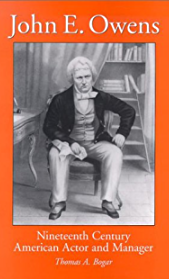
Those desiring to know more are directed to that book I mentioned, John E. Owens, Nineteenth Century American Actor and Manager by Thomas A. Bogar. And you would do well to check out his site for he has written other books of similar interest I know I will be exploring including ones on Thomas Hamblin and the Bowery Theatre, and one on Maggie Mitchell (aunt of Julian Mitchell, director of the original stage production of The Wizard of Oz, several editions of the Ziegfeld Follies, and several Weber and Fields shows, among other things).

Comments