


The Great Gatsby Turns 100

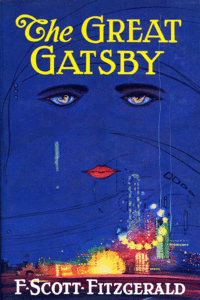
Originally published 2013; spruced up and repurposed for the 100th anniversary of the book’s publishing, which occurred on April 10, 1925.
I risked the fate of Myrtle Wilson this morning as I walked down the street re-reading The Great Gatsby on the way to work. At 182 pages the paperback edition is an easy thing to re-read, and I periodically do so (in contrast with, say, the last novel I read, Dickens’ 900 some odd page Our Mutual Friend). We’ll return to the subject of the book’s compact spareness presently. At any rate, as I walked down the street reading the novel, I passed another man about my age, walking down the street in the opposite direction playing the ukulele. Something is in the air; has been for a long time now. People are nostalgic for the time of their great grandparents and their great-great grandparents. (At least the people I surround myself with are).
What’s remarkable I think is the extent to which F. Scott Fitzgerald causes us to permanently identify decadence, glamour, wealth and so forth with the 1920s. In reality, what was notable about the phenomenon in Fitzgerald’s time was that it was unprecedented. But aside from the years of the Great Depression, it’s not like the party has ever really stopped. If you try to tell me there was more wealth or hedonism or senseless folly in the 1920s than there is now, I’ll scream. (In all truth, the so-called Jazz Age was more like this). Today, America is a nation so rich that our poor live like the wealthy of a century ago, even as they worship the super-wealthy. Here in New York, people walk down the street with the universe at their beck and call, looking at photo albums, listening to symphonies, chatting with friends on the telephone…and yes, reading novels. A fitting time as always to contemplate Gatsby. But before we get to his, let’s look at the road that leads to West Egg.

As it happens, I presently reside a scant ten minute walk from where Fitzgerald wrote most of the novel, in the area that inspired the book, Great Neck, New York, on the North Shore of Long Island. I took this snap of his house not long after moving here. Great Neck is West Egg. The next peninsula over was East Egg. Most of the great mansions that the Fitzgeralds socialized at are gone. The remaining ones are best seen from the water. My friend Kevin Fitzpatrick gives seasonal boat tours that allow you to do that.

A few months after the book was released, it was adapted into a play at the behest of impresario William Brady, an indication of how it was received. (It was moderately successful though not yet regarded as a modern masterpiece). Playwright Owen Davis did the adaptation. Its tryout run was at the Great Neck Playhouse, literally around the corner from where Fitzgerald wrote the novel. It moved to Broadway in February, 1926, with George Cukor directing, and James Rennie (husband of Dorothy Gish) in the title role and Florence Eldridge (wife of Fredric March) in the part of Daisy. March and Eldridge also lived in Great Neck. The script of the play was published in book form last year. Anyway, the fact that there is currently a musical version of the tale on Broadway which opened last year has now buried the original stage version on the internet!
The original (silent) cinematic version of The Great Gatsby was released in late ’26. It’s generally said that Fitzgerald died in 1940 feeling that Gatsby was a disappointment. On the other hand, it WAS turned into a Hollywood film almost immediately. And not a shabby one; it’s full of stars, major actors we still know like Warner Baxter,William Powell,Georgia Hale (fresh off The Gold Rush) and Eric Blore. And the director was the well regarded Herbert Brenon.
Unfortunately, it is a lost film, and it’s a shame because I get the feeling that in some ways it might be the best screen version, though Fitzgerald disliked it. Certainly the decor and atmosphere would be right in a way that subsequent versions can hardly hope to compete with. But there’s also this. Fitzgerald’s novel is written in a vague, almost sketchy style. It’s fragmentary and poetic, gossamer. The 1974 and 2000 screen versions seem to miss the boat by being overly literal and realistic. Pantomime might be one way to get back to that quality of simplicity; another might be opera. (There have been a couple of ballets. The Metropolitan commissioned an original opera version by John Harbison, which premiered in 1999 to mixed reviews.)
At any rate, here is the only known existing footage of the 1926 film, the original trailer:

23 years later came the 1949 version. This one still exists. The trailer below gives clues to the tone. It plays up the gangster angle, even depicting Gatsby (Alan Ladd) as participating in Al Capone style shoot-outs with a tommy gun. This was in keeping with the noir spirit of the movie’s own time. I think it’s hilarious that Shelley Wintersplayed Myrtle — it’s virtually the same thankless, doomed working class “other woman” she played in A Place in the Sun a couple of years later. Since an entire generation had passed since 1925, the film also treats us to a history lesson on the Roaring Twenties, a technique Baz Luhrmann would revive for his later version:
In 1950 there was CBS radio version starring Kirk Douglas as Gatsby that sounds intriguing. Next came two truncated tv versions: one starring Robert Montgomery for Robert Montgomery Presents (1955), and one for Playhouse 90 with Robert Ryan, Jeanne Crain, and Rod Taylor in 1958.

Then there is the formerly best known version, the soporific, forgettable 1974 adaptation, as sleepy as a summer day. It’s visually stunning. (A good chunk of it was shot in the mansions of Newport; one of the teachers from my high school is in it as a very prominent extra). Mostly the film suffers from gross miscasting. Robert Redford doesn’t have the depth for Gatsby. Mia Farrow doesn’t have the shallowness for Daisy. Bruce Dern is bad for Tom: though he is certainly capable of being boorish. But he doesn’t seem like an aristocrat. I’d sooner cast him as the car mechanic George Wilson (though Scott Wilson is already pretty perfect in the role). Sam Waterston is Nick and Karen Black is Myrtle, also pretty well cast.
At any rate, here’s the trailer for that one.

The 2000 A & E television version is a minor thing, as all such productions are, and completely forgettable (as in, I think I saw this, or some of it, and I struggle to remember much about it). Though this version is much better cast, at least in terms of type. Martin Donovan is an excellent Tom, with those brooding, blazing eyes, and Mira Sorvino with her frivolous prettiness is an apt Daisy. A very young Paul Rudd is a great choice for Nick (better in fact than the goofy-looking Tobey Maguire who plays him in the current version. The black hole in the middle of the tv version is Toby Stephens. An enigma? I’ll say! A phantom, who has left nothing behind!

Next we come to Baz Luhrmann’s 2013 Gatsby (the precipitating cause of this post when it was originally published back in 2013). Encountering mixed reviews back then prior to seeing it, my pre-formed opinion going into it was that updating the music as Luhrmann does is a valid idea. It worked wonderfully well in Moulin Rouge. And also visual style is what Luhrmann’s all about, surely that’s a good match for that glittering time period the Roaring Twenties.
What I did not anticipate is that I would not take to even the visual style of the movie. If I were going to be doing a highly visual, CGI-drenched, subjectively-told version of The Great Gatsby I’d go right to that famous cover of the novel designed by Francis Cugat (brother of Xavier). The painting was finished before Gatsby’s last drafts; Fitzgerald was said to have loved the image so much, he wrote the book to match the COVER. Barring that…Cubism, Expressionism, Art Deco were in the air. I don’t feel like I saw any of that in the movie. Mysteriously, the sensibility reminded me like a sort of exhausted retread of ideas expended in Moulin Rouge. A fast pace, a blur of color, these are thematically appropriate. But somehow the whole thing comes off more like a Warner Brothers cartoon. This is The Great Gatsby as directed by Tex Avery.
To be fair, this may be a work for people who like Baz Luhrrman, but for lovers of Fitzgerald and his writing, not so much. Which is ironic because Luhrmann seems to love writers. He adapted Shakespeare. A writer had been the hero of his previous movie. And in this one, he makes Nick Carraway into a stand-in for Fitzgerald. But for someone who seems to love writers so much, he doesn’t seem to trust them or their craft a great deal. In Gatsby, he does everything in his power to undermine, drown, overwhelm, dump salad dressing on, and compete with Fitzgerald’s language. The experience is like sitting in an auditorium listening to Fitzgerald read aloud from his novel, while Luhrmann sits next to him playing a trombone solo. Luhrmann’s sensibility is graphic and aural, as though he were pre-lingual. So much so that he can’t resist the temptation to send graphic representations of Fitzgerald’s text crawling across the screen, much like musical notes in a cheesy bio-pic about a composer. I feel like I have seen something that was inspired by, is in dialogue with, is a noisy, adolescent love poem to, The Great Gatsby. But not quite an adaptation of the thing itself.
Furthermore, every moment in the film is dialed up to eleven. Yes, it is a movie about excess. Even so, he hits every note too hard, there is too much of everything. If you take scenes and characters and moments from the novel and inject it with steroids it is NOT the same story. A gentle summer breeze wafting in the window in Fitzgerald’s book becomes a virtual hurricane in Luhrmann’s hands. A forlorn stretch of road between West Egg and New York becomes a bizarre Martian landscape of smoldering mountains of coke and refuse, dotted with belching smokestacks as if we were in the coalfields of Western Pennsylvania. (Where the hell did he get that from?). This is what that stretch of road ACTUALLY looked like. This is an actual photo of the Long Island Motor Parkway from around that time (note NYC on distant horizon):

Gatsby’s house looks like the Enchanted Castle at Disneyland. His big yellow car zooms through the streets of Gotham City like it was the Batmobile. The same with the people. Gatsby’s fake accent is too fake. Nervous upon seeing Daisy again, he is a Jerry Lewis level of nervous. And Tom, who ought to be sort of inscrutable (to the best he is able with his limited intelligence), becomes as obvious as a melodrama villain.
Luhrmann doesn’t understand the value of negative space, a pause, a rest. He can’t leave any moment alone. Gatsby and Daisy’s first kiss was ruined for me; I was distracted because it was staged in front of a green-screen tree. “What is this,” I thought to myself, “Bedknobs and Broomsticks? ” The climactic moment where Myrtle gets hit by Gatsby’s car is spoiled with cheesy pop music on the soundtrack. Just leave it alone!
It’s mostly a shame because there are some fine performances buried underneath all the garbage and tinsel. If I were DiCaprio I would be beside myself with anger. He turns in a really great performance. He’s so well cast, and you can see it in his best scene, the best scene in the movie, because Luhrmann leaves it alone. The crucial scene in the Plaza where he and Tom (Joel Edgerton) have their climactic showdown. DiCaprio loses his shit and you see the murderer that Gatsby is capable of being. Some of the best acting he’s ever done. This contrasts with his apparent coolness throughout. He deserves an Oscar nomination, if anyone can find his performance under the gaudy curtain that obscures it. Also impressive was newcomer Elizabeth Debicki as the ice cool golf-pro Jordan Baker, the superficial spirit of the age.
As I said above, Tobey Maguire is wrong for Nick Carraway. Looking at the book this morning, it’s clear in the character’s voice that he is of the same class as Tom and Daisy, he shares a lot of the same attitudes and assumptions. He is man enough to take some interest in, to see some worth in, Gatsby, but that doesn’t mean he shouldn’t come off as privileged and glib and so forth. In fact, he absolutely MUST in order for his self-loathing to make any sense. And THIS is the quality that has been lacking in all of the existing adaptations of Gatsby I have seen so far. It is palpable in ALL of Fitzgerald’s writing, and I’ve never seen any director put it across. That is to say, the identity crisis such a non-stop party would cause to an essentially Puritan people. Few moderns perceive that psychic trauma because the big party in effect hasn’t stopped since then; we’re used to it. But in the twenties, this was a people just coming off Victorianism. Yes, there was an excitement, a release. But that was accompanied by constant doubt and guilt and turmoil, a feeling of sickness and corruption. Read The Rise of Silas Lapham. Or Henry James. Excess was once thought to be un-American, even among the wealthy.
Thus, Luhrmann gets the crucial party scenes all wrong as well. He seems to be trying to recapture Moulin Rouge. But American decadence was and is not the Parisian sort, although it attempted to emulate it in the early twentieth century. Jazz Age America was characterized by the wildness of an essentially conservative people, tempered by ancient Puritanical reservations and qualms, by such speed bumps as “taste” and “style” . Tuxedos, gowns, potted palms, yes. Drunkenness and adulterous sex in corners, yes. But the Limelightcirca 1980s with a pulsing, throbbing techno beat–no. That’s the wrong vibe. So I think the haters in large part were right. This movie needs to drastically slow down, open up, take a breather, because though it does take place during modernism’s first heated flush, that era happened a CENTURY AGO. And if you say to me, like Nick Carraway, that you cannot re-live the past, my reply will be Gatsby’s: “Why, Old Sport! Of COURSE you can!”
Another option occurred to me more recently, and ultimately I think this would have been the best option for Luhrmann, given the way he wanted to tell it. Update it. The stories of contemporary excess surrounding figures like R. Kelly and P. Diddy and so forth speak volumes about American culture. Tell THAT with your hip-hop soundtrack. It’d be flipping amazing!
Anyway, to my mind, the definitive screen version of The Great Gatsby has yet to emerge. Maybe it’s just yet another unattainable American Dream.

Comments