


The Fate of Florence Deshon

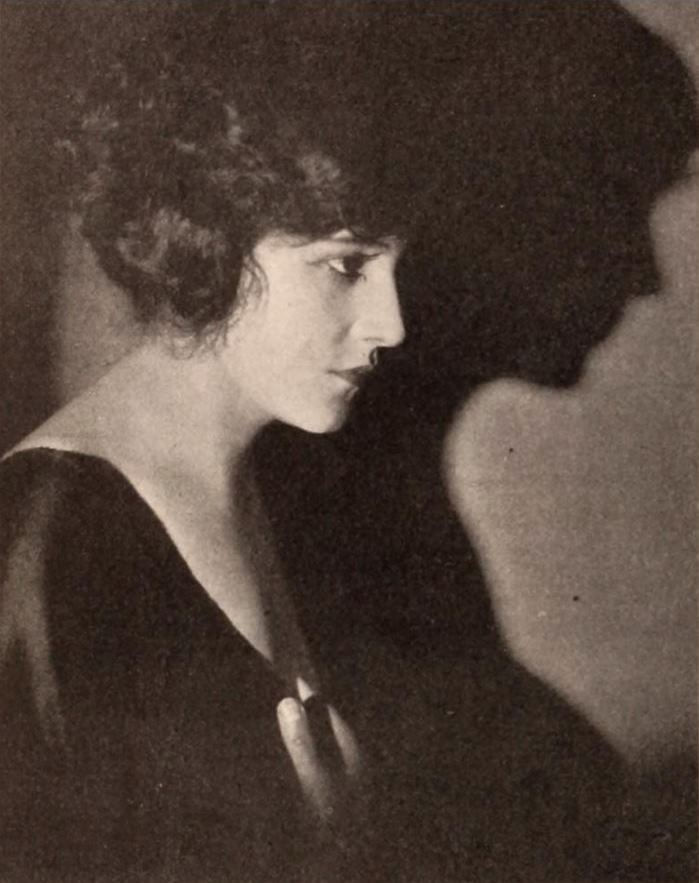
The first of a couple of grim posts scheduled for today, this one on silent screen actress Florence Deshon (Florence Danks, 1893-1922).
Deshon was born in Tacoma, Washington to a couple of unconventional musicians. Her father was a Welsh-American labor organizer. Her piano-playing mother was of Austrian stock; her family likely immigrated to the States following the Revolutions of 1848. Around 1900 the family moved to New York to be in the thick of things in bohemian Greenwich Village.
When she got older, Florence began acting in plays. Her professional name “Deshon” is a spelling variation on such French surnames as Deschamps and Duchamp. She appeared on Broadway at least twice: in The Sunshine Girl (1913) with Vernon and Irene Castle and Joseph Cawthorn, and the original 1916 production of Seven Chances starring Frank Craven, which was later made into a Buster Keaton film.
In 1913 Deshon began a romance with the famous writer and left-wing activist Max Eastman. Eastman began editing The Masses that same year. He’s the guy who sent John Reed to Russia to report on the Revolution, later immortalized by Warren Beatty in the 1981 film Reds. This was a serious relationship that lasted for the remainder of her life, though Eastman’s devotion to work meant that he was frequently distant and unavailable.
Deshon appeared in her first film The Beloved Vagabond, produced by Pathé, in 1915. Over the next six years, she played supporting roles in two dozen films for such studios as Vitagraph, Fox, and Sam Goldwyn. Sadly the only one of these movies of of which a copy still exists is The Loves of Letty (1919) starring Pauline Frederick. She also appeared in films with Charles Ray,Eleanor Boardman,Corinne Griffith, Alice Joyce, Tom Moore, Madge Kennedy, and Louise Lovely. Most of these pictures were melodramas or crime dramas. Her largest role was her last one: a co-starring part in The Roof Tree (1921), directed by John Francis Dillon, opposite William Russell.
During her time in Hollywood, Deshon also had a clandestine relationship with Charlie Chaplin, which is chronicled in the book Love and Loss in Hollywood: Florence Deshon, Max Eastman, and Charlie Chaplin,which consists of Deshon’s and Eastman’s correspondence, edited by Cooper C. Graham and Christoph Irmscher.
In late 1921, Deshon moved back to New York, perhaps to be closer to Eastman, though she intended to continue her movie career, as several studios were still based there at this early date. In February of the following year, her friend, journalist Minnie Morris found Deshon unconscious in her apartment, with the jet for the gaslight in the open position. She was rushed to the hospital but died of asphyxiation shortly afterwards. The death was ruled an accident for many good reasons. There was a window open in the apartment when she was found. Who intends to kill herself with gas but leaves a window open? And, just as importantly, there was no suicide note or apparent motivation for doing herself in. Her career was in the best place it had ever been. And yes, she was in a rocky relationship, but that’s hardly sufficient cause to take so drastic a step. The only people who ever do it are those in the deepest and darkest wells of despair.
Yet, questions have persisted, the chief one being: why was the gas jet on at all, unburning? The apartment was wired for electric light, after all. There was no reason for a gas fixture to even be in the room anymore, but that was an era of transition. Did she use it for some reason and then forget about it? Was there foul play?
At any rate, this has always been a pretty obscure case, and didn’t even receive that much publicity at the time. The chief reason? The William Desmond Taylor murder occurred five days earlier. Here’s a New York Times item about it, though, that’s worth reading.
For today’s second grim post, go here.
For more on silent film history please check out my book: Chain of Fools: Silent Comedy and Its Legacies from Nickelodeons to Youtube — now also available on audiobook.

Comments