


The cast of Lonesome Dove (1989)

SPOILERS!
Robert Duvall as Captain Augustus “Gus” McCrae

Gus: “I walked this earth my whole life with my pride, you see. Now, if that’s lost, then let the rest be lost with it, ‘cause there’s certain things my vanity won’t abide.” Call: “Your goddamn vanity.”
Robert Duvall is marvelous in his creation of the larger-than-life Gus McCrae, a man who savors life. This is an odyssey of a performance of a completely unique character, it is truly fascinating to watch how he handles all the different situations he encounters – subtly realizing his principles, attributes and failings. He is not a simple hero, but he is infinitely likable and Duvall brings an unmatched amount of gravitas and complexity to this joking old rascal.
“Fun? What would you [Woodrow] know about fun? You never had fun in your whole life. Fun is my department.”

Gus McCrae, a retired Texas Ranger turned cattle driver, is one of many hearts of this epic miniseries. He is a man of contradictions: a loquacious philosopher with a penchant for whiskey, a fearless adventurer who flirts with danger and a deep romantic who carries a torch for a lost love while still trying to charm every woman he meets. Duvall’s portrayal captures this multifaceted character with a richness that elevates Gus beyond the archetype of the rugged cowboy – balancing humor, vulnerability and honor, making Gus both a legend and a deeply human figure.
Newt: “Jake wasn’t no killer.” Gus: “Jake wasn’t. Jake liked to joke. He didn’t like to work. I’ve got exactly those same failings myself.”

From the outset, Duvall imbues Gus with an infectious zest for life. Whether he’s bantering with Call or spinning tall tales to the young cowboys or peacefully glancing over the prairie, Gus revels in the moment. Duvall’s delivery is always pitch-perfect – his drawl dripping with mischief and wisdom, infusing a playful irony that often reveals Gus’ self-awareness. Yet, Duvall’s words and eyes often betray melancholy, hinting at the past of a life filled with loss and unfulfilled dreams, seeking purpose in the changing world. This subtle layering makes Gus’ joviality feel like a natural shield against everything, not performative in the slightest.
Gus: “When was you the happiest, Call?” Call: “The happiest about what?” Gus: “About just being a live human being free on the earth?” Call: “Well, I don’t know. It would be hard to single out any particular time.” Gus: “Well, it ain’t for me. I was the happiest right here by this little creek. Me and Clara discovered it one day when we was out for a buggy ride.” Call: “I might had knowed it had something to do with Clara.” Gus: “That was a long time ago now. Ah God, she was beautiful. I expect it was the mistake of my life…letting her slip away like I did.” Call: “Well…you’ve always got your whores.” Gus: “Yeah, I guess I do. I don’t know why you’re so down on whores. You’ve had yours, as I recall.” Call: “Yeah, and that was the worst mistake I ever made.” Gus: “It ain’t a mistake to be human once in your life, Woodrow. Poor, little, ol’ Maggie left you a fine son before she quit this world.” Call: “You don’t know that. He could be yours, Jake’s or some damn gambler’s.”

Gus’ complexity shines in his interactions with others, where Duvall navigates the character’s shifting roles (mentor, friend, lover, fighter) with effortless grace. His relationship with Call is the emotional core of the story and Duvall’s chemistry with Jones is truly special. Gus’ teasing prods at Call’s rigidity, but Duvall ensures that it feels affectionate, rooted in decades of shared history. In quieter moments, like when Gus reflects on their past or urges Call to embrace Newt, Duvall’s voice softens; similarly, with the prostitute Lorena, Gus is both a gallant rescuer and a very flawed suitor. Duvall plays these scenes with restraint and tenderness, making Gus’ affection feel genuine without glossing over his more than roguish tendencies.
“Lorie, listen to me now, pretty little thing. Life in San Francisco’s still just life. If you want only one thing too much, it’s likely to turn out disappointing. Now, the only healthy way to live, that I see, is to learn to like all the little everyday things.”

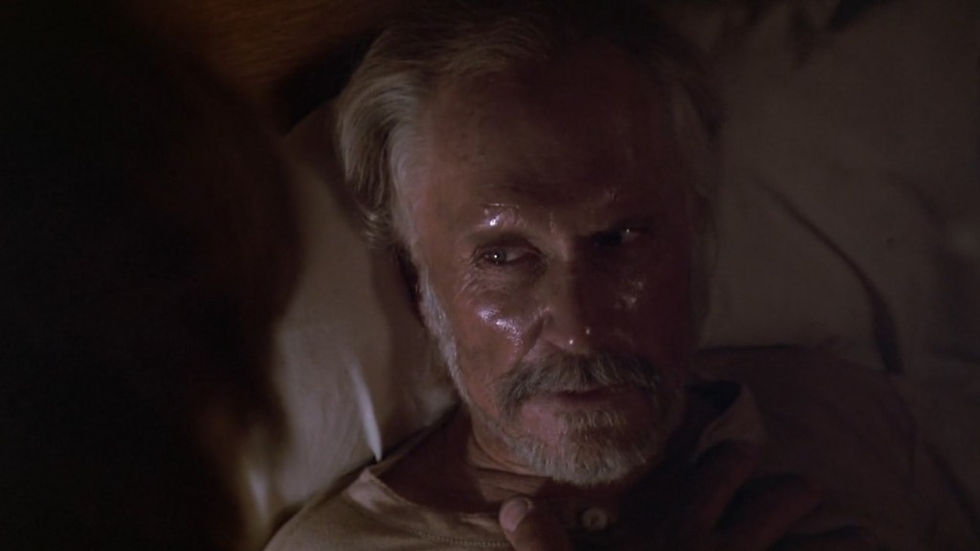
What makes Duvall’s performance truly remarkable is how he captures Gus’ philosophical side without making him preachy, but a natural fit for the grinning old-timer. Gus muses on life, love, mortality and morality. Duvall delivers his monologues and quips with a natural cadence, as if Gus is thinking aloud rather than reciting. This authenticity grounds the character, ensuring his larger-than-life persona never feels exaggerated – just a little bit every now and even then to a great effect. Especially in his final scenes, Duvall’s portrayal of Gus facing his fate is heartbreakingly grounded in the character traits he had explored in the previous episodes – blending defiance, humor and acceptance in a way that cements the status of this performance.
Gus: “I’m about half honest.” Clara: “And that’s the truth.”
Duvall inhabits Gus as rare other characters in his large oeuvre, breathing life into a character who is both a myth and a man – transforming a charming rascal into a timeless figure. Gus’ joy, pain and unyielding spirit are fully realized thanks to Duvall’s extraordinary talent and naturality. This truly is a journey and Duvall’s Gus McCrae is among the most compelling travelers in Western storytelling.
The Best Acting Moment: Gus on his deathbed E04
Verdict: 5
Tommy Lee Jones as Captain Woodrow F. Call

Tommy Lee Jones acts as a much more serious counterpoint to Duvall and is almost equally superb. He is a man of action, jaded and grumpy, but Jones also masterfully realizes the profound friendship between the two old-timers and is extremely powerful as he unveils the subtle and deeply buried emotions in the final acts of the film.
Jones delivers a riveting portrayal of Captain Woodrow Call, a stoic, duty-bound former Texas Ranger who serves as the perfect foil to Duvall’s gregarious Gus McCrae. Call is a man of few words, driven by an unyielding sense of responsibility and a very rigid moral code. Jones’ performance is a study in restraint, capturing Call’s gruff exterior and world-view, while subtly revealing the turmoil and loyalty beneath, making him far more compelling than what would initially seem.

“I hate rude behavior in a man. I won’t tolerate it.”
His weathered face and almost unintelligible dialect convey a lifetime. Unlike Gus, who savors life’s pleasures, Call is all business, focused on the cattle drive from Texas to Montana. Jones’ physicality, the very stiff posture, embodies Call’s no-nonsense demeanor. Yet, his silences are equally telling – Jones uses long, heavy pauses to suggest a man wrestling with thoughts he can’t or won’t express. This understated approach makes Call’s rare outbursts, like his frustration with the soldiers that whip Newt so much more powerful.

Jones’ chemistry with Duvall is the linchpin of the performance, grounding the story’s emotional core in Call and Gus’ strange friendship, a study in opposites, and Jones plays the straight man to Duvall’s flamboyant Gus with impeccable timing. When Gus teases, Call’s curt responses carry a grudging affection that Jones conveys through the slightest of slight choices in his expression. These moments highlight the depth of their bond, forged over decades of shared adventure. Jones ensures Call’s stoicism feels cold in certain moments, yet sometimes, instead, it’s a shield for a man who feels deeply, but struggles to show it.
Gus: “You [Woodrow] like money even less than you like fun. If that’s possible.”

Gus: “He [Woodrow] just don’t want to admit he’s human like the rest of us, Newt, that’s all.” Newt: “Well, he ain’t human like the rest of us.” Gus: “He had a chance once back then with your mama, but he turned his back on it and he ain’t about to admit that he made the wrong choice. That’s why he’s never admitted he’s your pa, ‘cause it would be admitting that he’s human, and he ain’t never gonna to admit that, not to you, not to me, not even to himself. “
Call’s relationship with Newt is fraught with tension, as Call’s paternal instincts clash with his emotional unavailability. Jones portrays this struggle with subtle gestures (especially in the scene where he gives him his watch) that hint at Call’s regret without (or almost) breaking his reserved facade. The true brilliance of Jones’ performance however, shines in the final acts, where Call’s emotional walls begin to crack. Jones navigates these scenes with heartbreaking emotional outpouring, using minimal dialogue to convey profound grief and loyalty. The trembling, the crying, the unbroken stares speak volumes about Call’s inner turmoil, rarely needing to say anything. Jones’ ability to reveal these buried emotions while staying true to Call’s stoic nature is nothing short of masterful, making the character’s arc tragic, deeply moving and even fulfilling.

Woodrow Call is a triumph of nuanced acting for Jones, transforming a seemingly one-dimensional grump into a complex, unforgettable figure. As the stoic counterpoint to Gus McCrae, he anchors the mini-series with a performance that is restrained and profoundly affecting. Jones’ Call is a man bound by duty, yet haunted by his choices and Jones’ depiction of this internal struggle ensures that Call stands as one of the greatest unlikely heroes of the West.
The Best Acting Moment: finally burying Gus E04
Verdict: 5
Diane Lane as Lorena Wood 4
Robert Urich as Jake Spoon 4
Anjelica Huston as Clara Forsythe Allen 3.5
Frederick Forrest as Blue Duck 3.5
Chris Cooper as Sheriff July Johnson 3.5
Danny Glover as Joshua Deets 3.5
Tim Scott as “Pea Eye” Parker 3.5
Barry Corbin as Deputy Roscoe Brown 3.5
Ricky Schroder as Newt Dobbs 3
D. B. Sweeney as Dishwater “Dish” Boggett 3
Steve Buscemi as Luke 3
Glenne Headley as Elmira “Ellie” Johnson 3
Frederick Coffin as “Big Zwey” 2.5
Leave a comment Cancel reply
Δdocument.getElementById( "ak_js_4" ).setAttribute( "value", ( new Date() ).getTime() );

Comments