


The Art of George Bellows


America lost the great American realist painter George Bellows (1882-1925) a century ago, and today (August 19) is one of two possible birthdays for him (August 12 is sometimes also given). I’m also a proud relation so we do him overdue homage today.
One of my great grandmothers was a Bellows. She and the artist were mutually descended from English immigrant John Bellows (1623-1683). The painter was born and raised in Columbus, Ohio, and I find the migration route of his ancestors interesting. Starting from Massachusetts, they eventually wound up in the area around New London, Connecticut, then moved across the sound to Eastern Long Island. Bellows’ father (also George Bellows) had started west to take part in the Gold Rush at the age of 20, but never got farther than Columbus. He made his home there and became a prominent local architect.
The younger George Bellows attended Ohio State then moved to New York, where he studied under Robert Henri, one of “The Eight”, two others of whom I have previously posted about, John Sloane and Everett Shinn. Bellows became associated with the the so-called Ashcan School, of which those artists were central. Never formally aligned, these were painters who were rebelling against the genteel aesthetics of Victorianism by painting scenes of city street life and other subjects outside the accepted precincts of propriety. Walt Whitman’s Leaves of Grass has been cited as an influence, and they were active during the same time period as realist writers like Mark Twain, Theodore Dreiser, Jack London, Frank Norris, and Upton Sinclair.
Bellows did several paintings of boxing matches, the best known of which is surely the remarkable Dempsey and Firpo (1924) which hangs at the Whitney, and which I’ve gazed at many a time, which is one of the privileges of living in New York:

They also have Introducing John L. Sullivan (1923):

Tennis at Newport (1919) is also of interest to this Newport-lover. Bellows did several on that subject as well. It’s at the Met:
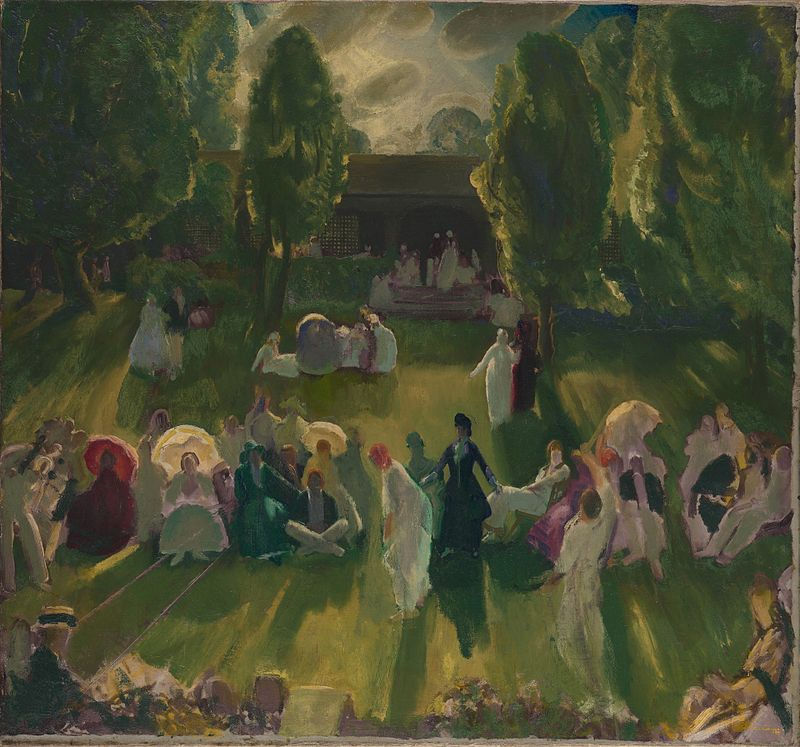
I choose these examples to showcase because they speak to me and themes of this blog, not because they are particularly representative of Bellows’ style or subject matter, which was extremely broad ranging, including proletarian themes, domestic scenes, nudes, portraits, landscapes, and even depictions of wartime atrocities. Bellows was a radical politically and served on the editorial board of The Masses, to which he also contributed, though his championship of individualism had him sometimes at odds with his cohorts on the left.
It is a pity that Bellows did not live long enough to document the Great Depression. He was only 42 when he died in early 1925. The cause was peritonitis from a ruptured appendix.

Comments