


Summer (Cooking) School, Part 4: Back to Basics

This week in our summer cooking school series, we’re taking a step back to the basics, encyclopedia-style!

But don’t worry, it’s not just for grocers! This encyclopedia is packed with dictionary-definition terms and history, multi-lingual lists of foods, and black & white and full color illustrations. While it would certainly be useful for those in the food trade, it’s just as useful for the home cook who might be encountering something new or who wants to learn more about a common ingredient.


In addition to the strictly A-Z listing of grocery-related foods, the encyclopedia also includes 7 appendices. These include a 5-language “dictionary of food names,” short foreign language-to-English dictionaries (French, German, Italian, and Swedish), a list of culinary and menu terms, and a weights and measures table.
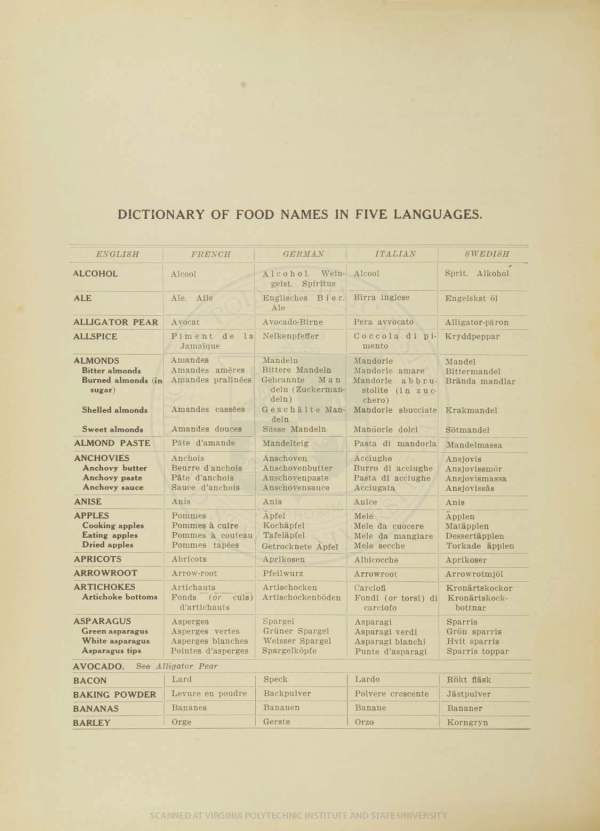
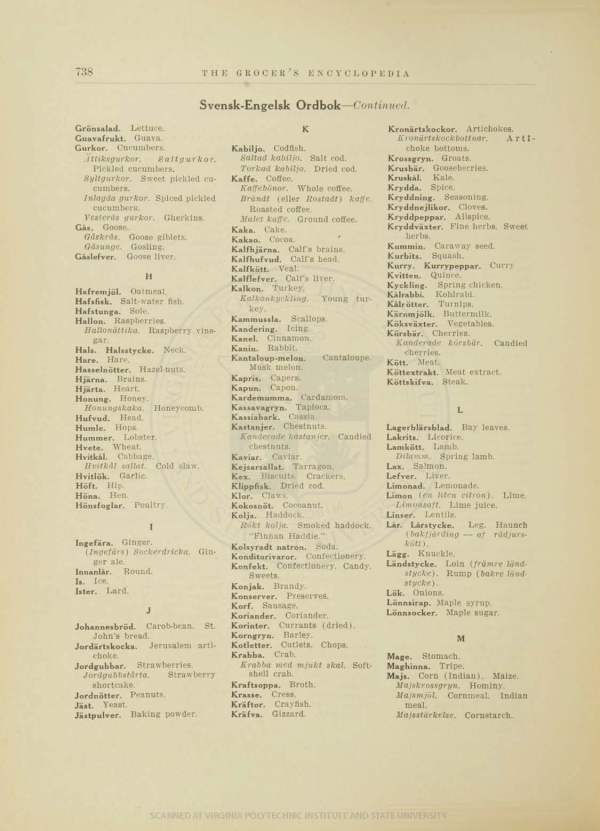
I’m still pondering the Swedish section. While I can see the common usage for the French, German, and Italian language sections, I’m curious about how much need there was for Swedish language food terms in 1911. Which sent me off to see if I could find anything out about the history of this publication. Artemas Ward, the author, first published a book in 1882 called . A desire to improve on this first work led to a nearly 30 year side project of expanding it into The Grocer’s Encyclopedia. Ward was an author of biographies, journal publisher, and advertising executive in his daily life. And, it seems, we can credit him with the idea of putting advertising on public transit vehicles. There wasn’t too much to find on Ward, though what there was suggests he was a man of many projects and occupations. But, it didn’t bring me any closer to an explanation for the Swedish-English section. Some publishing mysteries aren’t easily solved…
The entire encyclopedia is online through Special Collections–all 748 pages of it! (We could barely begin to represent it here.) Sure, it may not have EVERYTHING, but between abalone and zwetschenwasser (the German name for “slivovitz,” a European liqueur made from plums), there’s quite a bit to discover.

Comments