


Rogue One: A Star Wars Story

Directed By: Gareth EdwardsWritten By: Chris Weitz and Tony Gilroy (based on characters created by George Lucas)Starring: Felicity Jones, Diego Luna, Ben Mendelsohn, Donnie Yen, Alan Tudyk
Underneath all of the sweltering

anticipation which naturally follows a Star Wars movie, one notices a nagging reservation regarding Gareth Edwards’ first foray into the famed series. 2016’s entry into the saga is titled Rogue One, the first standalone live-action feature of the franchise and the first of the anthology sub-genre which is set to steadily expand; but it’s also a film with a central conceit that can’t help but incur a sliver of cynicism. In the year of the tangential revisitation to cinema’s most prolific wells, Rogue One inevitably raises that same question that has tugged at the credibility of so many movies all year long. Like Ghostbusters and Jason Bourne and Ben-Hur and Fantastic Beasts and an apparent cavalcade of high profile Hollywood productions from the last twelve months, Rogue One is tasked with justifying its existence. Is this a film which sturdily stands upon its own two feet? Or is this merely a cash grab coasting on the good Star Wars name? Thankfully, the short answer is the former, even if the first of the anthology series does struggle to cast its own shadow. The bone in its legs is supplied by its eye-catching universe, its muscle by its bruising action sequences, and even if comparison to the best work the franchise has to offer is unkind, Gareth Edwards’ new entrant into the Star Wars saga, crucially, does enough.
In terms of storyline, Rogue One slips in between the maligned prequel trilogy and the infinitely more revered episodes IV-VII. It shows what A New Hope’s opening crawl told, where Rebel spies hatch a plan to steal schematics for the Empire’s devastating weapon the Death Star. The heroes are led by Jyn Erso (Felicity Jones,) a young rogue maverick who is begrudgingly recruited by the Rebellion due to her family’s history with the Galactic Empire (her father, played by Mads Mikkelson, was reluctantly tasked by Ben Mendelsohn’s Orson Krennic with engineering the Empire’s weapon.) Jyn, at first, doesn’t see it as her duty to fight for good; “you can stand to see the imperial flag reign across the galaxy?” one rebel asks. “It’s not a problem if you don’t look up” she responds. Yet her arm is twisted and she is haphazardly coup

led with Cassian Andor (Diego Luna), a Rebellion captain turning callous as his hands grow increasingly bloodied and dirt stained fighting tirelessly on the front lines.
As the two lead characters, Jyn and Cassian both snapshot one of Rogue One’s great strengths and illuminate its niggling weakness. These are two heroes who, appreciably, are without that whimsy and purity of the saga’s earlier work. Out with the romance and in with a measured scrappiness. They signal a refreshing willingness to stray from the beaten path, subverting the black and white simplicities which have always been so central to the franchise. The waters are muddied as the Rebels demonstrate a readiness to cut corners, whilst other anti-Empire warriors, like Forest Whitaker’s part droid, part Colonel Kurtz resistance leader Saw Gerrera, have broken from the Rebellion and denote a fracture in the heroic faction’s unity.
On the other side of the fence, the evil Empire is troubled by do-gooders in the form of defectors and conspirators; Riz Ahmed, for example, plays an Imperial pilot turned saboteur who puts the Rebel’s hopes in motion, coupled with Mikkelson’s own attempts to bring the Empire undone from the inside.
What disappoints most about the film is its inability to parlay interesting character ideas into something more. Lacking the colour of an episode IV or VII, Rogue One’s characters struggle for greater interest. Despite their being conflicted, Jyn and Cassian are without clearer definition, sore
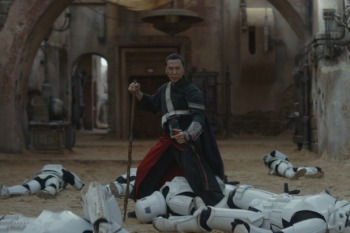
ly lacking the personality and sharp lines of a Luke and Leia or a Rey and Finn. It is only Donnie Yen’s blind martial artist Chirrut Imwe, a devout worshipper of the Force, and Alan Tudyk as the sarcastic Rebellion droid K-2SO, another character who has been recruited from the Empire by our heroes, who are allowed to define themselves into something more than a premise.
What Edwards is able to translate the scrappiness of his characters into is a brand of action which manages to both have its cake and eat it too; distinctly Star Wars, but with a sombre touch all its own. Rogue One’s elongated, climactic battle scene calls to mind the tragedy and chaos of earthy war-time epics from decades passed, unfolding on the beaches and all and signalling a gutsy tonal departure which both delineates Rogue One from its siblings, and bolsters its dramatic tension. Comparisons have been made to Aldrich’s The Dirty Dozen, however I sensed the evocation of David Lean’s thrilling third act from The Bridge on the River Kwai, a passage which wonderfully illustrates the frenzy and despair of war as we suddenly realise, in these situations, it is the disposition of life to be lost. There is a physicality to Edward’s action, a quality which served J.J Abrams well in The Force Awakens; a glamourlessness which gets under your nails and hurls you into the grind of battle.
Undoubtedly there is a vitality lacking from Rogue One, that fundamental heart-and-soul quality, typified by the characters, which allowed the best works of the franchise to transcend the limits of their simplistic storytelling. But Edwards also finds his own way into the saga. It’s not The Empire Strikes Back, or A New Hope, but Rogue One is its own film, comfortably taking its spot quality wise as it did in terms of the narrative, well beyond the prequels, just behind episodes IV to VII.
Rating:
3/4

Comments