


Robert Harron: Was It Just… “Coincidence”?

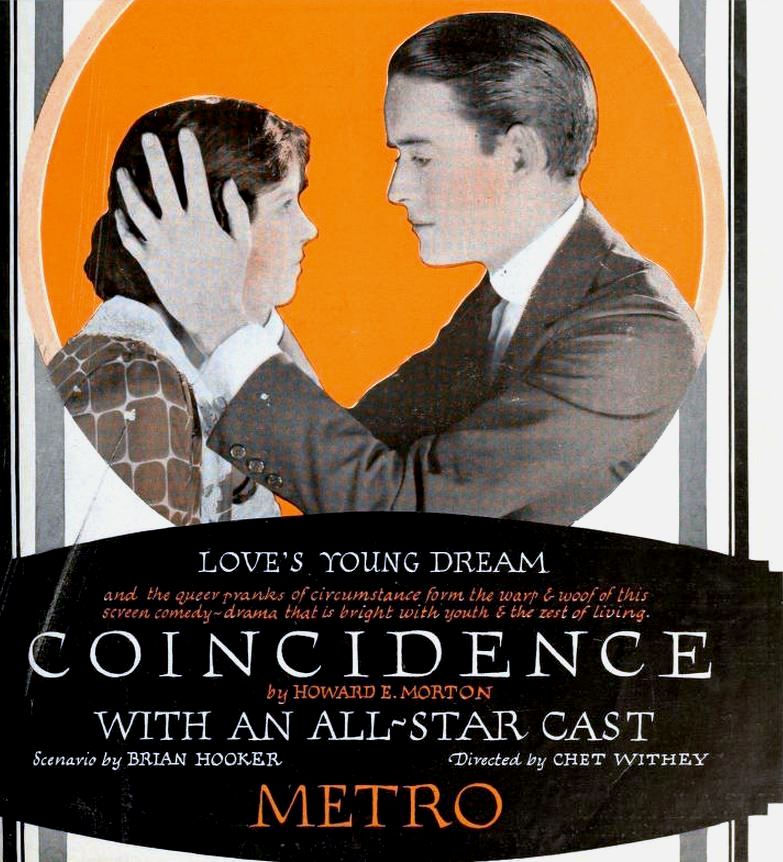
April 12 was the natal day of silent screen star Robert Harron (1893-1920).
Harron’s was an unusual trajectory. He was a local New York Irish kid who was hired to sweep up an do odd-jobs at Biograph in 1907. Since he was around, he began to work as an extra and bit player, and then, because D.W. Griffith liked his fresh-faced look, he began to get real roles. He was only 14 at the time. It was pretty common for girls that young or younger to become stars back then (e.g., Mary Pickford and the Gish Sisters) but somewhat rarer for a boy. At any rate, for much of his career, he was a key member of Griffith’s stock company, appearing in scores of his films including better remembered ones such as The Battle of Elderbush Gulch (1913), Judith of Bethulia (1914), The Birth of a Nation (1915), Intolerance (1916), Hearts of the World (1918), and True Heart Susie (1919).
Then in 1920, this sad and strange news:

Harron phoned the concierge at the hotel where he was staying to request assistance, as he had accidentally shot himself in the chest. The pistol had been in his trunk, fell out while he removing some items, and discharged. Initially it didn’t seem that bad. He made jokes about the injury, and was reluctant to treat it as an emergency. In the meantime, however, he lost a lot of blood. He died of his wound four days later.
Speculation than and now was and is unavoidable. It seems a weird and unlikely accident for all sorts of reasons, including, why have a gun in the first place? This is magnified by the circumstances leading up to the gunshot. He and pal Victor Heerman had come to New York for the premiere of Griffith new movie Way Down East, a preview screening of Harron’s new movie for Metro, Coincidence. The latter was a comedy, and apparently audience response was not ideal. At the same time, he’d been passed over in favor of Richard Barthelmess as the male lead in Way DownEast. At 27 he was aging out of the sort of roles Griffith had traditionally cast him. Did despair make him pull the trigger?
It seems unlikely. The setbacks we have just described were hardly fatal ones to his career. It’s not like he was at the end of his rope. He was a major star; in all likelihood he would have continued to be one for some time to come. Most people who knew him considered the idea that it was a suicide unthinkable. It’s just such an odd accident that a purposeful death seems to make more sense. But of course, the senseless does occur from time to time.
As though there must at all times be a Harron in Hollywood, at this point his younger brother John (1903-1939), leaped in to fill the void. Harron was a star throughout the ’20s and into the early ”30s, opposite the likes of Shirley Mason, Dorothy Mackaill,Irene Rich, Patsy Ruth Miller,Alice Day,Betty Compson, Lila Lee, and Rin Tin Tin. One of his last decent roles was in The Murder at the Museum (1934) with Henry B. Walthall. After this he was mostly a bit player. By the time of his early death by spiral meningitis he had well over 170 screen credits.
A third Harron sibling Mary, had a couple of small roles in silent pictures. She is not to be confused with contemporary film maker Mary Harron (b. 1953), of whom I am a huge fan!
For more on silent movies please read Chain of Fools: Silent Comedy and Its Legacies from Nickelodeons to Youtube.

Comments