


Remembering the Times Square Two

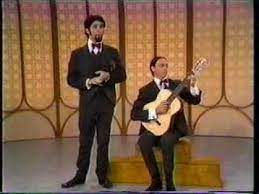
I very much hope to get a chance at a second edition ofNo Applause at some point. In addition to correcting the spelling of Bud Abbott’s name, and a small handful of other imperfections, I’d beef up the section on New Vaudeville, for I’ve learned about many acts I hadn’t known about in the years since the first edition was published. At any rate, some of them may well get a mention in my upcoming book on television variety. The Times Square Two were a comedy music duo who flourished in live performance and TV variety shows between the years 1964 and 1970.
The members of the team were Michel Choquette (b. 1938) and Peter Elbling (b. 1943), although as the Times Square Two their names were “Mycroft Partner and Andrew I” , i.e. “My Partner and I”. That dry excuse for a witticism may be a reflection of the fact that these gentleman were very Canadian. Choquette was of French stock and Elbling (who later billed himself for a time as Harold Oblong) was born in the U.K. Their shtick was to sing two-part harmonies on old novelty numbers from the 1920s, with rigidly choreographed movement, all while dressed in vintage clothes. As an act, they had things in common with the Bonzo Dog Doo-Dah Band and the Pickle Brothers, with the added aspect that they remained in character offstage as well as on, in the highly intense tradition of Alfred Jarry. (There is something mechanical and robotic in their moves that remind me of Jarry as well). They always dressed in character, and at their height, were chauffeured around in a Model A. Their act also involved other vaudeville skills like juggling, acrobatics, mock mind reading and hypnosis, and of course comical cross-talk and patter. Elbling spoke with a posh, Victorian sounding English accent; Choquette did a comical voice that reminds me of the one RichardAyoade used on The I.T. Crowd, although he often remained silent while Ebling monopolized the spoken sections.
The young men had developed their act in Vancouver, and then brought it down to the States, performing at clubs and coffee houses in Los Angeles and San Francisco, leading to TV exposure, bookings all over the U.S. and a tour of the U.K. as an opening act for Frank Zappa and the Mothers of Invention. They performed on Kraft Music Hall and the shows of Merv, Mike Douglas, Johnny Carson, Steve Allen,David Frost, Dean Martin, and of course The Smothers Brothers, whom they had known in their San Francisco days at the hungry i.
While having a very strong gimmick is extremely useful at the beginning of a show biz career, it later gets to be a bit of a straightjacket in terms of growth and sustainability. Inevitably, the team broke up at the dawn of the new decade.
Choquette went on to be an editor at the National Lampoon through the mid ’70s, then to teach screenwriting and comedy writing at McGill and Concordia in his home country. In 2011, Abrams published his book The Someday Funnies, a labor of love arising from 40 years of collecting the work of underground comics artists, originally begun as a project for Rolling Stone.

Ebling went on to co-edit one of my favorite comedy books when I was a teenager. The 80s: A Look Back at the Tumultuous Decade 1980–1989 (1979). It was a satirical “look back” at a decade that hadn’t happened yet, and I must have read it and re-read it a hundred times. I wish I still had it! I may have acquire a new comedy. In some ways, however that decade turned out was even stranger and unexpected than comedy writers could have imagined, though less funny and more horrible. For example, in the book Ted Kennedy gets elected instead of Ronald Reagan, and all four Beatles had a reunion, because who knew John Lennon was about to be assassinated? ! I’ve carried memories of comedy ideas and quotes from that book around all my life (I was 14 when I acquired it. It was a bestseller). I even wrote a song inspired by the song mentioned in the Beatles article, “Please Backwards Please”. It’s one my earliest songs — I just may have to inflict it on the public now.
Anyway, I had no idea about the Times Square Two when I got that book. Ebling also continued acting throughout the half century since the team broke up, with nearly 80 credits, sometimes in quite legendary projects. He’s in the movies Fuzz (1972), Brian Da Palma’s Phantom of the Paradise (1974), Demon Seed (1977), Gene Wilder’s The World’s Greatest Lover (1977), Steve Martin’s The Absent-Minded Waiter (1977) and The Man With Two Brains (1983), Joan Rivers’ Rabbit Test (1978), Nation Lampoon’s Disco Beaver from Outer Space (1979, which he co-wrote with JeffGreenfield), Private Lessons (1981), Dan Aykroyd’s Doctor Detroit (1983), and Some Kind of Wonderful (1987), and on TV shows likeRhoda, Phyllis, WKRP in Cincinnati,Mork and Mindy,Laverne and Shirley, Love Sidney, Police Squad!,Taxi, etc etc etc.
And now here’s something for the second edition of my second book Chain of Fools! About a decade back, Elbling made several neo-silent comedy films starring his comedy character Mr. Vinegar! (I guess it’s a condiment to go with Mr. Bean). You can check out the official Mr. Vinegar official Youtube page here.
Oh, there is much more to learn about Mr. Elbling: one may do so at his website here.
For more on vaudeville, please see No Applause, Just Throw Money: The Book That Made Vaudeville Famous,and for more on silent comedy read Chain of Fools: Silent Comedy and Its Legacies from Nickelodeons to Youtube.

Comments