
.png)


R.I.P. U.S. Constitution
- goldenstateservicesj
- Sep 17, 2025
- 4 min read


I think that’s about where we’re at, and while it is indeed catastrophic, it’s also not a reason to give up hope or to cease working for progress.
September 17 is Constitution Day in America. It celebrates the day in 1787 when the Constitutional Convention was concluded and the delegates signed off on the final result. It was officially ratified in June, 1788, and went into effect the following year. Constitution Day is not an official holiday, but more like an occasion for students to learn about it and for pointy-headed pundits to opine. America’s finest legal and philosophical minds forged it, drawing from centuries of English law, the Scottish Enlightment, French Philosophy, and ancient and modern era examples of government. It has flaws, and suffers from compromises both practical and moral, but it has proved adaptable enough to weather most crises until surpringly recently.

The entire point of the document has to do with the sharing of power. It’s not that there hadn’t been effective or humane kings and emperors before, but why rely on luck (or murder) when it came to elevating them? Better for the executive to be elected, and then checked on several fronts lest he become too powerful, which more often than not leads to abuse of that power. The Constitution was constantly tested over the last couple of centuries, and increasingly subverted. We have now reached the very state the Constitution was originally crafted to protect us from — a Unitary Executive, unanswerable to the Congress, Courts, Press, or People. The party currently in power will never voluntarily relinquish it, and the likelihood that the opposition forces will ever muster the strength or the unity to remove them seems infinitesmally small. And if they do manage it somehow? The experience of history, both here and elsewhere, is that when an opposition party attains the power illegally obtained by their opponents, they NEVER return to the limitations which previously constrained office holders. They KEEP the new powers and proceed to misuse them against their own enemies. That may or may not be better than what we have now. The odds are more likely that the change will be a lateral one, or that the cycle of oppression will worsen.
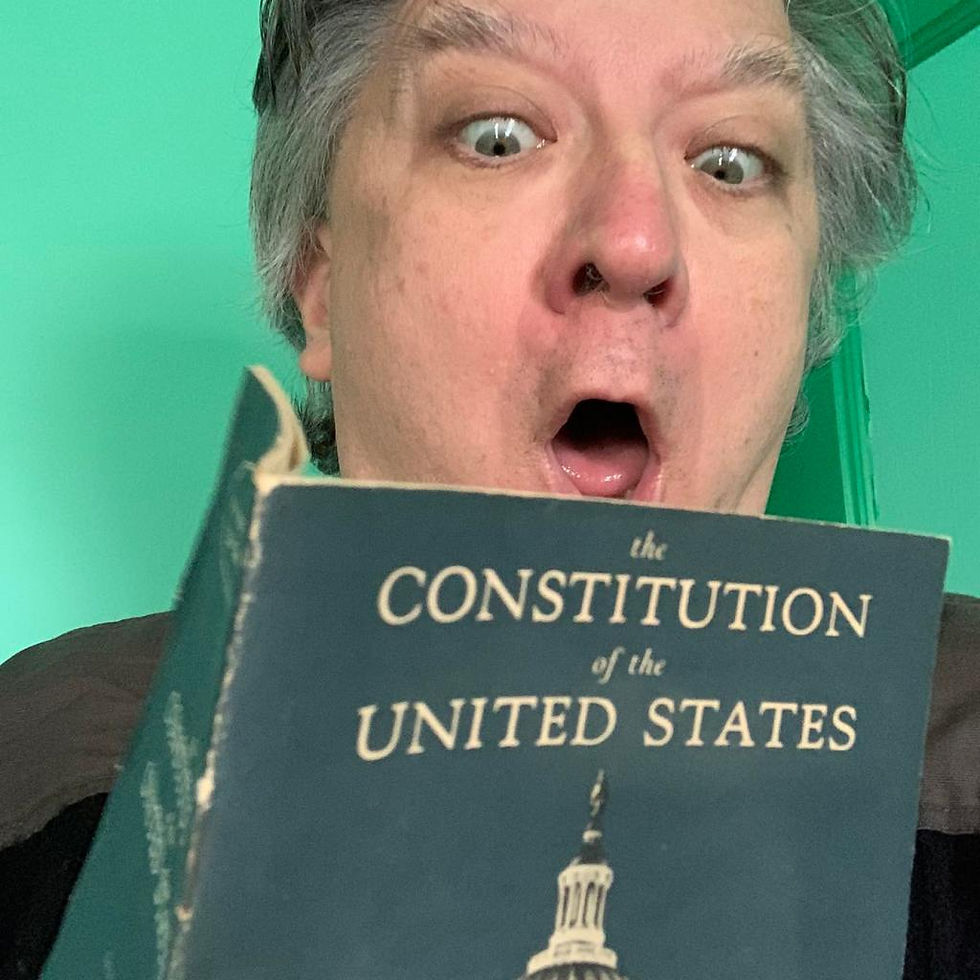
While I surely first read the Constitution all the way through when I was in high school (and had known the Preamble by heart since I was about eight, thanks to Scholastic Rock), I began to explore it more seriously when I was about 25 years old, over three decades ago. I worked at a bookstore where we were all assigned sections to master and maintain. Naturally my preference would have been the performing arts section, but someone else had already called it. So I wound up with history, political science, social science, economics, black studies, and the like. I read scores or hundreds of books on those topics, and it wound up changing my life, for which I’ll always be grateful. Just like Henry Knox, booksellers can sometimes educate themselves on their own products. The genesis of the Constitution was among the subjects I applied myself to. I only learned later of my relation to many of the signers.
A good, accessible introductory book on the topic is Miracle at Philadelphia: The Story of the Constitutional Convention (1966) by the brilliant Catherine Drinker Bowen. More scholarly books abound, as do more recent ones with a more contemporary take, but this is an excellent start. The reason I say that is reflected in the book’s title. It was a miracle that the Constitution was written at all. The men who wrote it did not possess the authority to do so. They were empowered by their state governments to convene in Philadelphia to improve the existing Articles of Confederation which America had lived under, most unsatisfactorily, since 1781. Seeing what needed to be done, they did it, asking for forgiveness rather than permission. Then they worked like hell to sell it to the states for ratification. The promise to add a Bill of Rights soon after it was ratified convinced many who were doubtful.
These leaders wrote and ratified the Constitution because they had to. I say that there is hope for the future (the long term future) because there will come a time when things have gotten so bad that the necessity of writing a new one will be acknowledged and acted upon. A necessity? Well, yes. After all, the tyrant who now occupies the Executive role got there by exploiting the weaknesses of the existing system. Those loopholes were always there. The only reason this never happened before was that no one as ignorant or ruthless (or in this case, both) ever became a national candidate for the office before. Knowing what we know, I don’t know how we don’t go back to the drawing board, and fix every broken element, and add new safeguards, and encode the rights of all the citizens (and non-citizens) into the document with more clarity, and so forth. Until then, we’re looking at a Constitutional Democratic Republic in name only. Rome had a Senate, recall. Once the Caesars were in, the significance of the Senate was negligible. It was a charade. That’s what we have in America now. A charade. And talk of elections and binding court decisions to constrain the power of the Executive sound very much like pie in the sky to me. We’re now on a path where those don’t factor in. Do we have to try to change that at the polls and in the streets? Absolutely. But by now the people who seem to be counting on those remedies actually working in the short term sound like naifs and chumps. The situation will need to bottom out and become far more drastic. Please, history, prove me wrong.
Sorry this has nothing to do with show business, but it certainly has to with American history, and with US. We’ll call this post a book review. If your way of dealing with this situation is ecapism, I hope you realize that uniformed thugs are quite capable of yanking people out of theatre seats. And if you think that’s crackpot conspiracy mongering, you either haven’t been paying attention, or your news source has very much been letting you down. People are being arrested, they’re losing their jobs, they’re either fleeing the country or being forced out. The U.S. Constitution and its Bill of Rights were supposed to prevent all of that.


Comments