


Quo Vadis? A Narrative of the Time of Nero


Henryk Sienkiewicz (1846-1916) was born this day. And you can be forgiven for asking “Quis est?” in addition to “Quo vadis?”
A century ago, this Polish author’s name was more widely known in the English-speaking world than it is today, for he was the writer of the much-translated, much-read, and much-filmed novel Quo Vadis? (1895-96) Quo Vadis? remained widely popular in the U.S. at least through the mid 20th century, though its stridently Christian themes no doubt made it distasteful to Hollywood after the 1950s. I imagine folks are apt to mix it up with such things as Ben Hur and The Sign of the Cross. (The latter, a play written in 1895 and filmed by Cecil B. De Mille, is extremely similar to Quo Vadis? in plot and setting). It’s basically a tale of early Christianity in the time of Nero. The great author Petronius, writer of Satyricon, is a character, which was one of the things that delighted me about the book when I was a teenager. His nephew falls in love with a beautiful Christian slave girl, and begins to fall under the spell of the religion even as he becomes obsessed with the girl. Because of the family’s wealth and position (Petronius holds an important place at court) it allows for a portrait of the wickedness of Rome under Nero, as well as a glimpse at Christianity in its purest form prior to the establishment of the church: a radical philosophy of non-violence and altruism. Like all the best audience crowd-pleasers, it allows for some commendable preaching, but also romance and scenes of fighting (in this case, gladiatorial spectacle). And Nero’s famous burning of Rome. “Quo Vadis?”, btw, means “Where are you going?”, which was said to have been asked by St. Peter of Christ, as the latter (or his Ghost or something) was headed to Rome to Preach the Gospel. And that’s kind of the point of the book. That historical moment when brave bearers of a philosophy of peace are headed straight into the Belly of the Beast, where they would likely be martyred.
Around the time of the book’s centennial I had a cockamamie idea about creating an environmental theatre piece based on it, using the then-moribund public swimming pools at McCarren Park in Williamsburg to stage it in. At the time, my wife was involved in local parks and activism (we lived in the neighborhood), and was part of the movement to get the pools up and running again, which did eventually come to pass. My idea was that a theatre piece there would help raise awareness of the very existence of the old pool facility, which was at the time a neglected ruin closed off to the public. I reached out to my friends at the Peculiar Works Project (who specialize in site specific theatre) with a pitch for a collaboration, but they were rightly quizzical, for my idea was much less than half-baked. I had no script, just the vaguest of notions that it might be a good idea. I also had a strong feeling that there was opportunity attached to the fact that Quo Vadis? was a classic that had not been exploited in some time, remained fairly well remembered as such, and was in the public domain. I also quite simply, genuinely, liked the book. I think it does a tremendous job of imagining the moral texture of Rome, and the limitations of what might be called “the Pagan way”. Characters like Vinicius and Petronius have plenty of benevolent instincts, but no structure or method for articulating or manifesting them, and they’re addicted to pleasure. The Greeks and Romans most certainly had their own ideas of ethics and virtue and so forth prior to Christianity, but for the most part those didn’t involve concepts like mercy and self-sacrifice, and certainly not non-violence. And naturally, it would be an act of treason to reject the official Gods of the state.
A stage adaptation had come to Broadway as early as 1900 (parodied by Weber and Fields as Quo Vass Is? the same year), and there were early French film adaptations in 1901 and 1910, the latter entitled Au temps des premiers chrétiens and directed by André Calmettes. This was in the days of one-reel films. The first blockbuster was…

1913
A major cinematic landmark, this version was directed and produced by Enrico Guazzoni in Rome. Some of my older books on cinema history used to describe this as the “first feature length film”, but such claims are always debatable. The running time was two hours, very long for 1913, and of course it pre-dates many of the innovations of shooting and editing which came later. The crowd scenes had 5,000 extras, probably a record for its time. An international hit, it was distributed in the U.S. by George Kleine.
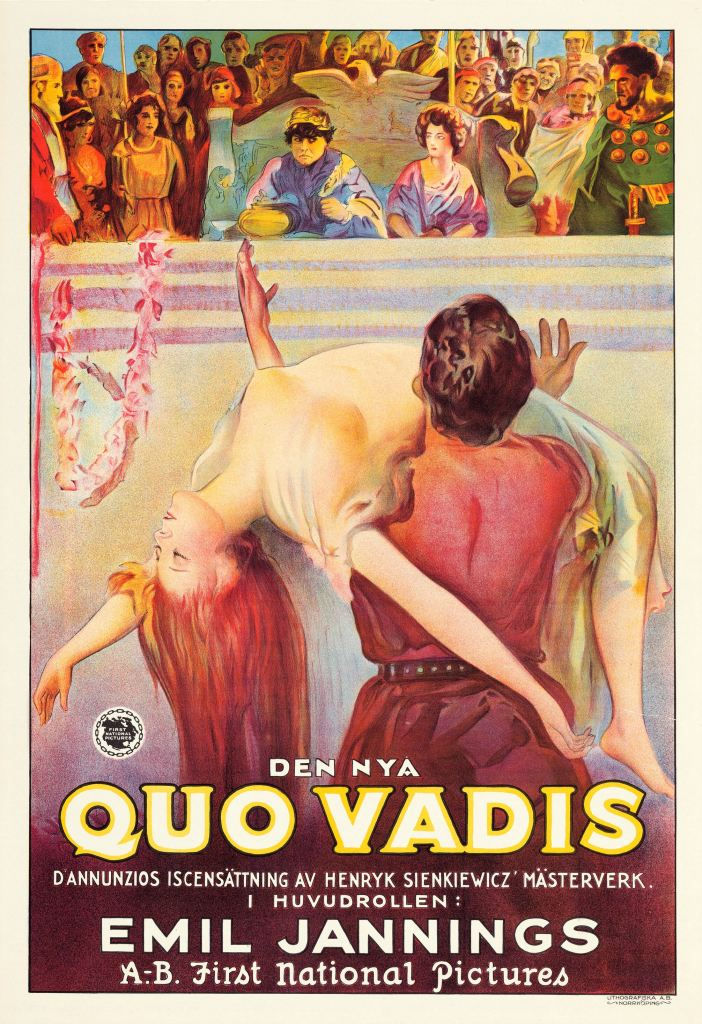
1924
A decade later there was another Italian feature, this time with an international cast that included Emil Jannings and Lillian Hall-Davis. Co-directed by then-rising director Gabriellino D’Annunzio and Georg Jacoby, it was intended to express the spirit of Roman revival promoted by the new Fascist government, which had come to power in 1922. Valentino was approached to play Vinicius but passed, so his part went to an Austrian, Alfons Fryland. Some suspect that the suicide scene in the film inspired the suicide of Max Linder and his wife, which bore some similarities. The film was a financial failure — probably seemed superfluous at the time given the success of the 1913 version.

1951
This is the version that most of us know in America, the one that launched the craze for Biblical and Roman epics in the ’50s. Without it, there likely wouldn’t have been such things as The Robe (1953), The Silver Chalice (1954), DeMille’s 1956 version of The Ten Commandments,Solomon and Sheba (1959), the 1959Ben Hur remake, or King of Kings (1961). It’s fairly amazing that it took Hollywood a half century to get around to adapting the film directly. S.N. Behrman and others wrote the script, which was directed by Mervyn Leroy for MGM. Peter Ustinov is easily the most entertaining Nero since Charles Laughton, though Robert Tayloris a boring dud (as always) as Vinicius. It’s also got Deborah Kerr, Leo Genn, and Finlay Currie, with cameos by Elizabeth Taylor, Sophia Loren, and Christopher Lee. The gladiator character Ursus played by boxer Buddy Baer was later spun off into its own series of popular Italian films. This adaptation of Quo Vadis? was filmed in Rome, was the most expensive film at the time, the highest grossing film of the year, and MGM’s second biggest grossing film after Gone with the Wind. With stats like that you’d think it would be remembered as a classic, but the fact remains that, like most of the films in this genre, it is regarded by modern audiences as a whopping bore. I bet it’s great in a cinema though.

1985
In 1985, Franco Rossi directed an international TV mini-series starring Klaus Maria Brandauer, then especially hot because of his recent appearances in the James Bond film Never Say Never (1983), and the multiple Oscar winning Out of Africa (1985). Also in the cast: Frederic Forrest, Christina Raines, and Max Von Sydow.
There have been lots of other filmed versions of the book, most of them European, but these are some key ones. The silent versions and the mini-series are available on Youtube. The MGM one is available via various streaming platforms.
For still more on silent film please read Chain of Fools: Silent Comedy and Its Legacies from Nickelodeons to Youtube.

Comments