


Phil Ochs: No More Songs

Phil Ochs (1940-1976) is often (maybe usually) spoken of in relation to Bob Dylan, and that’s unfortunate. Not because Dylan is such a giant that anyone else suffers in comparison, which is true, but that’s also true of anyone who is not Bob Dylan. The comparisons are unfortunate because Ochs was another national treasure, one deserving of high and lasting stature, and he doesn’t really need to be compared to anybody. In fact, what Ochs’ memory could use is its OWN Dylan, some starry-eyed devotee to lionize him and amplify his reach as young Dylan had done for Woody Guthrie. Major figures in the music biz continue to appreciate him and to get his work in front of audiences. His songs have been covered by Lady Gaga,Neil Young, The Clash, Cher,They Might Be Giants, Morrisey, and obviously nearly every important folk musician from the ’60s, as well as later punk and grunge bands, who often updated his lyrics. David Bowie mentioned him in a song. And lefties know who he is. But those are silos. And, believe it or not, activists don’t want their ideas to be restricted to “lanes”. The goal is to reach EVERYBODY, because that’s the only way change will happen. Ochs was a patriot, a left-wing patriot, and as Thomas Jefferson would tell you, that’s the best kind.
Ochs was born to Jewish parents in El Paso, Texas. He spent most of his childhood there, then moved with his family to Far Rockaway, Queens, then Perrysburg New York (named for my main man Oliver Hazard Perry), then Columbus, Ohio. His father was a doctor; the family kept moving to facilitate his hospital jobs.
Ochs was a musical prodigy. As a boy, he was the principal clarinet soloist with the orchestra of the Capital University Conservatory of Music. Following two years at a military academy in Virginia, he attended Ohio State, where he studied journalism, became interested in socialism, and got swept up in the folk music craze. He began performing in Columbus and Cleveland, gained a local following, and then moved to the heart of the movement, Greenwich Village in New York City.
For someone who came to the scene relatively late, Ochs’ rise to a position of leadership was relatively rapid. He carved out a niche for himself as a “singing journalist”, getting the inspiration for many of his songs from Newsweek magazine (a tactic that goes at least as far back as the Living Newspaper theatre project of the 1930s). He had a nice voice of the kind that was in vogue at the time, sweet and chirpy sounding in the Pete Seeger tradition, not dissimilar from the vocal approach of Peter Yarrow, Noel Stookey, John Phillips, etc etc). He was good looking in a tv star kind of way (Tony Perkins meets Michael Naismith meets James Farentino? Go ahead and ridicule me). Early on, he gave off a Beat energy like Kerouac’s, a little working class machismo that clicks with his boyhood idolization of movie heroes like John Wayne, Audie Murphy,Marlon Brando, and James Dean. A couple of early photos give off that vibe:


A principal difference between Ochs and many of his contemporaries (including Dylan) is that he sang little to no traditional material. He performed mostly original songs, mostly on anti-war and civil rights themes. Albert Grossman, the manager who made a star out of Dylan, and created the folk supergroup Peter, Paul and Mary began to represent him. In 1963, he played the Newport Folk Festival and hootenannies at Carnegie Hall and Town Hall.
Ochs’ debut album All The News That’s Fit to Sing (1964) was perfectly timed to take advantage of the fact that Dylan (who had made his reputation with anthems like “Blowin’ in the Wind” and “A Hard Rain’s a-Gonna Fall”) had decided to abandon politics in favor of more personal material. Those who were disgusted by “Another Side of Bob Dylan” (1964) could, and did, pivot to Ochs, whose songs, like “Talkin’ Vietnam”, “Talkin’ Cuban Crisis”, “Too many Martyrs”, and “Power and the Glory” owed more than a little to the squirt from Hibbing. Among people in the movement, it was like the passing of a baton.
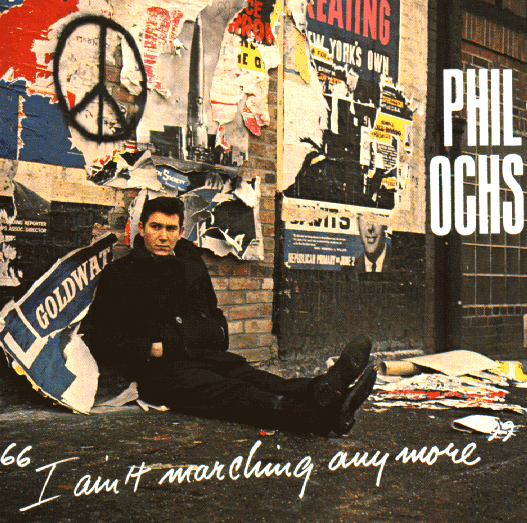
His second album I Ain’t Marching Any More (1965) continued both the themes and the acoustic arrangements of his earlier effort even as Dylan was going electric and folk rock was coming into being. Still, there are elements about it, that to my mind presage the tone of the rest of the coming decade, which is why I chose its cover as the visual head of this post. Peace signs had been around for years before this, but I just love seeing it in color and at this particular moment when things were beginning to coalesce, when The Fugs were the cutting edge and Abbie Hoffman was pulling his first pranks. Ochs music doesn’t SOUND like that, but this album cover LOOKS like that, on some nascent level. Its title track was the first of his songs I ever heard, on some FM station, probably a decade after he died, when everyone’s big worry was Ronald Reagan. I find it significant that a kid who had been to military school was so adamantly anti-war (much like John Phillips). He’d experienced the shoot-em-up mentality up close and plainly wanted it wiped off the earth.
As ’65 turned to ’66 came his famous split with Dylan. I have no idea why the story is so famous, and the two men in fact later reconciled. It’s usually recounted as a significant moment in Dylan’s narrative as opposed to Ochs. It has to do with the failure of “Can You Please Crawl Out Your Window”, Dylan’s follow-up to his smash hit “Like a Rolling Stone”. The two were sitting in back of Dylan’s limo and Ochs opined that the new record wouldn’t do nearly as well as the previous one. And Dylan threw him out of the car snarling “You’re not a folk-singer, you’re a journalist!” The anecdote is usually misunderstood — many people naturally assume that Ochs didn’t like Dylan going pop. But the opposite was the case. Like Dylan himself, and most of their generation, Ochs had grown up loving Elvis, Buddy Holly, Johnny Cash, Hank Williams, et al, and he would later take his own clumsy steps toward being a commercial musician. He was judging “Can You Please Crawl Out Your Window” strictly as a pop tune, and that’s undoubtedly what rankled Dylan, because Ochs’ gut reaction was true. Despite being pretty awesome, “Can You Please Crawl Out Your Window” only went to #58 on the pop chart.
In 1966 came Ochs third and last album on Elektra Records Phil Ochs in Concert, which included “There But For Fortune”, an anthem as strong as his earlier “Power and the Glory”, and a #8 hit for Joan Baez in the U.K., although her version only went to #50 in the U.S. Also strong on that record is “Ringing of Revolution” which contains the kind of sweeping, exhilarating poetry we associate with the Dylan of 1963 but married to the stronger, more overtly radical political language we associate with the late ’60s. Ochs’ humorous song “Love Me, I’m a Liberal” is strong satirical stuff. Like many of his songs it is somewhat a prisoner of its topicality. Many of its references are dated. But at the present moment, when the weakness and selfishness of liberals in the against oppression have brought the cause of progressivism to its lowest point in over a century, it ought to make every listener’s face burn with shame.
In 1967 Ochs moved to L.A. and signed with A & M records, belatedly attempting to take part in the folk-rock movement which had already been underway for two years. His Pleasures of the Harbor experimented with various musical styles a la The Beatles’ Sgt. Pepper. It contained a Dixie-ragtime flavored single partially inspired by the Kitty Genovese murder called “Outside of a Small Circle of Friends” that was doing well on the charts until d.j.s began to get skittish about the lyrics. More promising commercially, one would think, was the baroque pop, heavily orchestrated “Cross My Heart”, which did even worse in sales and airplay. Another of the major tracks “The Crucifixion”, which we’ll return to, had dissonant, modernist elements that must have been off-putting to many listeners. I’m not sure that Ochs’ songs, at least at this stage, went with this style of production. The bigger hurdle in terms of airplay, though, as with The Fugs, was Ochs’ uncompromising lyrics. This too is surely why he was booked for very few TV appearances. And as with the Fugs, little radio airplay and no TV presence equals lasting obscurity, no matter how widely you are respected by your peers.
In July 1968, on the heels of the MLK and RFK assassinations, Ochs released another pop-sounding album Tape from California, which contained the song “The War is Over”, inspired by Allen Ginsberg, and surely itself an inspiration for John Lennon’s Christmas song of four years later. The following month Ochs performed this song and others at the demonstrations surrounding the notorious Democratic National Convention in Chicago. He even purchased the Yippies’ pig and Presidential candidate Pigasus.
Chicago and all its violence seems to have been both a peak and a pivot for Ochs. Tens of thousands of people cheered him outside the convention — he couldn’t even finish his set. Yet, somehow, after this, all that follows is descent. There are many elements to it, and they all seem somewhat intertwined. One is genetic. His father was bipolar and was treated for depression after a breakdown while serving as an army doctor during World War Two. His inability to adjust had been the principal reason the family had moved so many times during Phil’s childhood. Phil clearly inherited this trait (and was later diagnosed as such). I have watched and listened to countless interviews with him wherein he comes off as manic, scattershot, flighty, and distracted. He also frequently seems self-deprecating to a mortifying degree. In early performances it’s part of his patter and usually humorous. As time goes on, he rambles more, and these remarks become less funny and more concerning. He was clearly unhappy and shaken by his lack of success as a pop singer. His albums sold well, but not his singles. Until his albums didn’t either.

Gradually he became more obsessed with death. Many folk singers perform gloomy songs about mortality, but Ochs began to make it his main focus. The aforementioned “The Crucifixion” merged Christ’s execution and the JFK assassination, to talk about how the public loves to build up public figures only to destroy them. The image you see above is not Ochs’ actual tombstone, it’s the cover of Och’s 1969 album Rehearsals for Retirement, a downer of such proportions that fewer than 20,000 units were sold. This moment in history seldom gets talked about, because only some seem to have seen it clearly. 1968 had meant the death of the progressive movement. Richard Nixon became President, and frankly, the path from that moment leads directly to where we are today.

How did Ochs react? Well forgive the expression, he seems to have gone a little crazy. After Rehearsals for Retirement tanked, he seems to have said “Fuck it! I’ll go the other way”. In 1970, he donned a custom gold lame suit like Elvis’s, and released a record of country-flavored, non-political songs. Getting back to roots was very much in the zeitgeist at the time, but in Ochs case the gesture seemed a little unhinged and desperate. The album’s title Greatest Hits was ironic — all of the songs were originals and none of them were destined for the charts. His quip on the record jacket “50 Phil Ochs fans can’t be wrong!” is typical of that painful self-reflexive humor he was prone to exhibiting. With audiences, that sort of thing tends to be self-fulfilling. Yet there’s an element of performance art to what he was doing in this phase, a kind of parody of the fame he was seeking, which he even sings about on the record (“Chords of Fame”). “Bach, Beethoven, Mozart and Me” offers more self-deprecation. Key messages to his fans about where he believed he was headed can be found in the titles to the songs “One Way Ticket Home” and “No More Songs”.
In support of Greatest Hits, Ochs played a concert at Carnegie Hall wherein a large portion of his very long set included medleys of songs by Buddy Holly and Elvis. Some in the audience booed and walked out, but others cheered him on. The concert was recorded and released as an album called Gunfight at Carnegie Hall in 1974, Ochs’ last album released during his lifetime. It was no Dylan going electric at Newport, or the Beatles Get Back, or Elvis’ 1968 comeback special. You have to be on top to risk alienating fans with a risk like this and pull it off.
At this stage, Ochs’ dependence on drugs and alcohol, already pretty extensive, increased dramatically. He wrote very few songs in what remained of his life.
He did have some late career high points though. John Lennon invited him to perform at the John Sinclair Freedom Rally in late 1971. In 1972 he recorded and released two singles. One was commissioned to be the theme song to the movieKanas City Bomber (though unused in the film). He also came out with a ground-breaking single in collaboration with local musicians in Kenya called “Bwatue”. In 1974, he organized and performed in a benefit concert to raise awareness about Pinochet’s coup in Chile, at which Bob Dylan performed, along with a long list of other folk greats.


In 1975 Ochs organized and starred in a major concert in Central Park celebrating the end of the Vietnam War, with Paul Simon, Joan Baez,Pete Seeger,Odetta, Harry Belafonte etc. 100,000 people attended and the climax was Ochs’ song “The War is Over”.
But what did that mean for Ochs? Like, the ENTIRETY OF HIS CAREER had been spent fighting that war, his entire career and persona had been built around it. His earlier attempts to break out of the straight-jacket of fans’ expectations had been a bust. Where was there for him to go? It’s said that he became increasingly unhinged from reality at this stage. Paranoia about the FBI and CIA is proffered as one of the symptoms, but it turns out that the FBI did keep a 500 page file on him on the pretext that he was a threat to internal security. And the fact that Ochs had been arrested while consorting with leftists in South America surely meant that the CIA had their eye on him as well. Nothing delusional about that.
BUT…shortly after the “War is Over” concert, Ochs did become delusional. He declared that he had been killed, and that he had been replaced by his assassin, a man named “John Butler Train”. He went around as this Train character for months. Meanwhile, Dylan, with whom he had been discussing a possible tour during the Chile concert, had embarked on the Rolling Thunder Revue, an all-star show, in which Ochs was not included. That had to add to the hurt.
During this period, Ochs started working on an album documenting his hallucinations. Demos of five new songs were recorded but the album was never finished (the tracks are available to hear on Youtube). Instead, Ochs became increasingly reclusive. He moved in with his sister in Rockaway and whiled away his days drinking, watching TV and playing cards. He received some psychiatric care and was prescribed some meds. In time the “Train” delusion died down, but not the depression. On April 9, 1976 he hanged himself.
Meanwhile, John Lennon retired, America celebrated its Bicentennial, Elvis died, then Lennon was assassinated, Reagan was elected President. There would have been plenty for Ochs to sing about, stuff that was right up his street. Younger generations embraced his music and gave it interesting new spins. The world kept turning. But from Phil Ochs, there were no more songs.
For more, there are two documentaries about the life and work of Phil Ochs: Chords of Fame (1984) and Phil Ochs: There But for Fortune (2010). But above all, check out his records!

Comments