


Ouija: Origin of Evil

Directed By: Mike Flanagan Written By: Mike Flanagan and Jeff Howard Starring: Elizbeth Reaser, Annalise Basso, Lulu Wilson and Henry Thomas

You could almost consider being handed the reigns to Hasbro’s fledgling horror film series a backhanded compliment. With Ouija: Origin of Evil, writer/director Mike Flanagan has inherited the keys to an inflated piece of product placement, one whose preceding film was kicked around town by pretty much everybody who saw it and whose scariest element was no doubt how supernaturally stilted the dialogue was. 2014’s Ouija was a benign enough film, but one which hardly had moviegoers clamouring for future instalments. The key is 2014’s offering made its money, and then some. It successfully transformed 5 million dollars into 100 million plus, which, via the wonders of box-office mathematics, dictates we must now have a follow up, in this case a prequel, one whose creation has fallen in the lap of a proven director, but one which was totally inconspicuous by its absence.
Despite being a precursor to Ouija, Origin of Evil’s true parental film is 1973’s The Exorcist, both beneath the surface and on it. Flanagan not only tips his hat to William Friedkin’s masterpiece, but he borrows generously from its imagery and subtext. Here, we have a similar central conceit, a precocious young girl is inhabited by a malevolent spirit, her devolution challenging the undying affection of her single mother (in this case the husband has died). There are striking visual similarities, images of oddly contorted bodies and demon possessed children scaling the walls and ceiling, and we once again have our grieving priest, brought in to confront the evil and test his faith in the process. Friedkin’s Best Picture nominee is a wonderful horror film. Ouija: Origin of Evil is a film I admire more than I like.
Specifically, it’s the work of a uniformly strong cast and a diligent Mike Flanagan that I admire; clearly they didn’t get the memo that this is a throwaway B movie cashing in on Halloween. It’s as if Flanagan said “expectations be damned, I’m making a proper film”, and so he does. Largely. The director digs deep and dredges up more drama and humanity from the film’s premise than he had any right to. One need only look at his cute period details to realise his respect for storytelling, evoking the 1960’s setting not only through the production design, but through his old-school movie buff flourishes; the Universal logo of decades passed, a cheesy title card with the copyright year stamped out in roman numerals, even artificially imposed cue marks. Not to miss the forest through the trees, Flanagan’s greatest imprint on the drama is his patience. For majority of the film, characterisation is the key dramatic vehicle. There’s a delicate rendering of the three-way relationship at the story’s core; Elizabeth Reaser as the grieving, single mother Alice, Anna
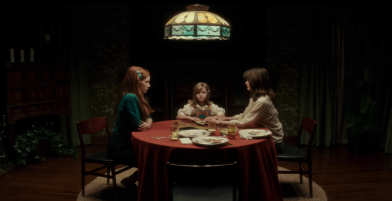
lise Basso as her eldest daughter Lina, and Lulu Wilson as the infected child Doris. Flanagan devotes much of his first two acts to capturing a recognisable family dynamic and in doing so dodges that common horror pit-trap, the economy of non-expendable faces. There’s a moment of great danger late in the film where Lina declares that splitting up, as is custom at this stage of the story, is “a really stupid idea”. Both a funny slight at the contrivances of similar films, and a suggestion of intelligence and sentience that makes a character worth caring for. But championing characterisation over easy scares by no means makes the film less fun. Rather, this approach opens the door for something more unsettling, a more atmospheric and sophisticated brand of horror, or at least it should.
Alice is a stern mother, a good mother, but she’s vulnerable too. Her daughters are her only companions; one is a testy adolescent, the other is possessed by the spirit of an evil Nazi doctor. Which is worse? There’s really no way to tell. Before things go wrong, the trio run a gimmicky fortune teller business out of their home, hosting séances for similarly grieving families and using cheap parlour tricks to create the illusion of ghostly presences within the house. It’s not until Alice decides to incorporate a Ouija board into her act that things start to become real. Doris takes a liking to the board and the spirit she inadvertently summons takes a liking to her. Lulu Wilson is tremend

ous in the villainous role, sifting from innocent youth to stealing the show as a cross between Linda Blair and the neatly groomed twins from The Shining.
It’s a great shame then, that by the film’s end, the characters have grown largely peripheral. Stephen King once said there are three tiers of fear a storyteller can elicit. At the bottom of the pile is the gross out (self-explanatory), which Origin of Evil is sure to avoid. In the middle we have horror, that sense of revulsion one experiences after the scary moment (someone jumps out from around a corner and you scream and fall down). The apex of fear however is terror, that more intangible, pit-of-your-stomach fear that something just isn’t right. King also said he has no pride as a storyteller, and will settle for any of the three if necessary. Flanagan strives for that higher brand of creepiness, that uncanny sense of dread that The Exorcist so expertly thrived upon. However, as his film progresses, the director can’t help but fall into the “horror” category, resorting to clichéd jump scares before his film eventually unravels into hokeyness and genre genericism, complete with the obligatory top-of-the-third-act information dump. In the film’s final moments, that sense of family is sadly traded in for something more one dimensional.
Fight admirably as Flanagan and co might, Ouija: Origin of Evil is destined to become a slumber party fixture; a fun film, competently eliciting scares, but ultimately lacking in something greater. Still, it’s nice to see a director not merely content to pick up the pay cheque.
Rating:
2.75/4

Comments