


Osaka Wanderings


“The grounds of Osaka Castle”
Osaka, Japan. November 2018 (18 photos)
This is part 10 of my Japan 2018-19 photo series.
So we leave the otherworldly ambience of Kyoto’s Arashiyama bamboo grove in my previous post and head toward the metropolis of Osaka. After visiting Kyoto I spent about a week touring around the countryside of Japan before arriving to Osaka, Japan’s second largest city, and arguably the foodie capital of Japan for a 3 night stay. As you may have guessed my main mission in Osaka was food, but I’ll restrict this post to my Osaka wanderings.

“Osaka Castle”
The original Osaka Castle was completed in 1583 and was attacked and damaged/destroyed several times in its history, most recently during WWII air raids. In popular culture, it was destroyed during a fight by Godzilla in the 1955 movie, Godzilla Raids Again. James Clavell featured the castle in his most famous work of historical fiction, Shōgun. It was also featured in the James Bond movie, You Only Live Twice.

“Above Osaka”
A view above Osaka from the 60th floor of the Abeno Harukas building. The 60th floor is just a perimeter around a giant atrium. You know you’re high up when the emergency exit door has an arrow that points up and is labelled “Emergency Heliport”.

“View from the 60th floor”
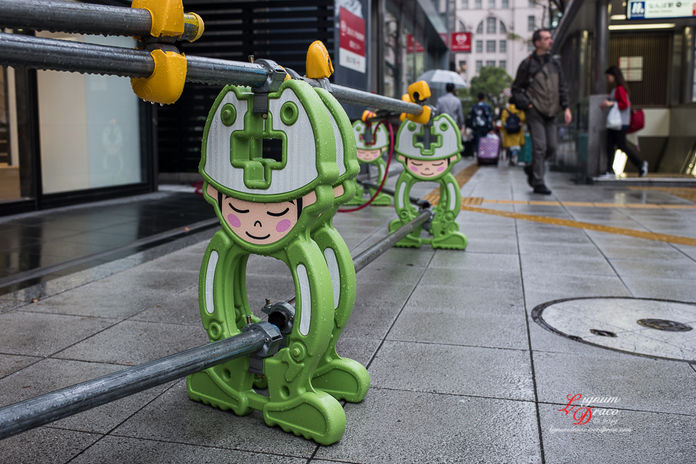
“Only in Japan”

“Not quite black rain”
The movie Black Rain was based in Osaka.

‘Mizukake-Fudo”
The small Hozen-ji temple was established in 1637. During WWII the temple was destroyed in a bombing raid. However, one temple statue survived and it has now become a famous symbol of this district. The statue was of Fudo Myo-o, a Buddhist spirit that represents discipline and firm moral character.
According to local stories, about 80 years ago a lady made a wish here by throwing water over the statue. Because the wish came true, now everybody does the same. As a result the statue is now completely covered in moss and is nicknamed “Mizukake-Fudo” or “Splashing water Fudo”. The moss gives it an incredibly calming aura, particularly at night.

“Osaka twilight”
This is the view from the observation deck on the 39th floor of the Umeda Sky building. The open air 40th floor floating garden bridges across the two component buildings that form the sky building. Unfortunately it was closed for repairs when I visited as it had been significantly damaged during a typhoon a few weeks earlier.

“Umeda Sky Building”
Interestingly there is no direct lift access to the observation decks. You must ascend in an elevator to the 38th floor. Then you take the escalator to the 39th floor. The up and down escalators actually traverse the large open space between the two buildings as you can see above.

“Capturing Osaka”
Osaka is one of those cities that comes to life at night. I’ve tried to capture the atmosphere of Osaka after dark in these next few photos.
By the way, Osaka is famous for its covered shopping streets. In the background above is Shinsaibashisuji, a 600m long covered shopping street. Another such covered shopping street, Tenjimbashisuji is 2.6km long.

“The Glico Man”
No post about Osaka is complete without a mention about the Dotombori and the Glico Man.
The Dotombori is one of the most popular tourist destinations in Osaka running along the Dotonbori canal from Dotonboribashi Bridge to Nipponbashi Bridge. It is characterized by its over-the-top atmosphere. At night, the Dotombori is ablaze with the neon lights of large billboards and TV screens. However, the most popular sign which has lasted over 70 years, is the Glico Man sign at the Ebusubashi bridge (above). It simply shows an athlete crossing a finish line in a victory pose. The Glico Man has enduring popularity amongst the locals and it is seen as an icon of Osaka within Japan.

“Tradition vs Modern”
Unlike in Kyoto, a woman in a kimono wandering around Osaka is most likely to be a local, not a tourist.

“Yokocho”
Old style alleyways or yokocho can be found all around Osaka (and Tokyo) and host tiny eateries, pubs and shops, sometimes dating back to the early postwar years. Many eateries on yokocho seat less than 10 patrons and are a cheap authentic food experience. The alleys are also ideal for discovering the less formal sides of Japanese culture.

“Hidden Osaka”
A small restaurant on a narrow yokocho lane. I ate at a similar place nearby, just a narrow shop with 6 seats at a counter. The lovely lady owner who commuted from Nara daily spoke some basic English and I enjoyed some delicious home made gyoza with an abundant serving of sake. Osaka does these hidden cozy restaurants very well.

“On the Streets of Osaka”

“Inside Osaka”

“Sake time”

“Osaka nights”
Out and about in Osaka, like moths attracted to bright lights.
…
This is part 10 of my Japan 2018-19 photo series.

Comments