


On Pete La Farge and His Illustrious Family


Today is the birthday of the late Oliver Albee “Pete” La Farge (1931-1965). With protest roiling all around it seems timely to contemplate folksinger/ songwriter La Farge’s life and works. But before I get there, I feel compelled to take a roundabout route. There’s no way for someone like me to talk about him without mentioning his lineage, for he was a member of what you might call America’s cultural aristocracy, with deep roots not only in my home state, but in my home town.

La Farge was the great-great-great grandson of Commodore Oliver Hazard Perry (1785-1818), one of America’s first notable military figures, hero of the War of 1812, and also America’s quasi-war with the French, and the naval battles with Barbary pirates. He is famous for the slogan on his battle flag: “Don’t Give Up the Ship” and for uttering the immortal phrase “We have met the enemy and they are ours…” (later parodied in the comic strip Pogo as “We have met the enemy and they are us.”) Perry was born and raised in my hometown South Kingstown, Rhode Island, so I’ve known his name since I was a school child. (It turns out that I am distantly related to him as well, through our common ancestors the Wilbores).
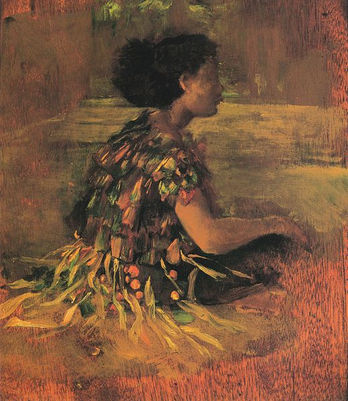
In 1860, Perry’s granddaughter Margaret Mason Perry married John La Farge (1835-1910), an influential painter, illustrator, and stained-glass artist. Of French parentage, the wealthy La Farge was born in New York and studied painting with William Morris Hunt in Newport, Rhode Island. He traveled widely in Asia with Henry Adams and brought back influences of Japan and the South Seas which he expressed through his famous work, which you can read about here.

Of John La Farge’s eight children (all born at Newport), several were distinguished. Christopher Grant La Farge (1862-1938), the oldest, became a noted Beaux-Arts architect, whose best known work includes the Cathedral of St. John the Divine and several buildings at the Bronx Zoo. There’s a good article about la Farge’s firm here. His younger brother Oliver Hazard Perry La Farge (the first) was also a notable architect, writer and real estate developer. John’s youngest son John La Farge Jr., a Jesuit priest, became a famous and influential crusader against racism and anti-semitism.
Of the next generation, several more La Farges were equally famous.

The best known is Oliver Hazard Perry La Farge(the second), Christopher’s son, a Pulitzer Prize winning novelist and anthropologist. His main field of study was Native American culture, which he wrote about in several books, both fiction and non-fiction. Laughing Boy (1929) was the one that won the Pulitzer, and remains his best known work. (This Oliver was Pete’s dad). is set among the Navaho and tells of a romance between the titular Laughing Boy and his heart’s desire, named Slim Girl.
(They made a movie out of it in 1934. Ramon Novarro was Laughing Boy, Lupe Velez was Slim Girl. Both of these actors were Latin, not Navaho, by the way, but this movie was made in Hollywood, where more often than not the creative rallying cry is “close enough”. Anyway, Laughing Boy and Slim Girl meet at a pow wow and fall for each other, but Slim Girl’s been corrupted by white men, and cavorts with them, and takes gifts from them, and has a hard time buckling down to traditional Navaho life, not to mention monogamy, since she was raised in the city, which as you know, can lead to all manner of unhappiness. Anyway, that’s the spine of the thing. Now you don’t have to read the book.)
Oliver’s older brother Christopher La Farge, was also a distinguished and prolific novelist, poet and playwright, known for writing verse novels about life in Rhode Island. Remarkably, he also worked as an architect at McKim, Mead and White. I am one degree of separation from this La Farge! For when I was in high school, his son the poet W.E.R. La Farge came to my high school class and did a writing work shop. Not for nothin’, but he actually singled out a poem of mine and showed it to the class! (In retrospect, we behaved like, well, teenagers, and didn’t give this special opportunity the respect it deserved. If only I could turn back the clock -!) W.E.R.’s daughter Annik maintains a loving web site in his honor, and has also taken up the family business of writing and love of architecture, penning an excellent book and blog about New York’s High Line. Learn all about it here.

Now we come to Pete. Pete was the son of the Pulitzer prize winning OHP. His full name was Oliver Albee La Farge. Albee – that’s the same name as the head of the big time vaudeville circuits and his adopted grandson the playwright of Both named Edward Albee. Oliver Albee Lafarge’s maternal grandmother was one of these Albees and yes it’s the same family although you have to go back to 1717 to get to their common ancestor.
Anyway, Oliver Albee La Farge, known as Pete, would also make a mark in the show business. He was born in NYC but grew up in New Mexico and Colorado. His parents split up when he was six. His dad married a Mexican senorita; his mom married a rancher and rodeo roper. When Pete was a teenager he competed in rodeos himself, and started singing cowboy songs on the radio. As a boy Pete had met the legendary Josh White, who inspired him to become a folk singer. He inherited his father’s interest in Native Americans, but then grew apart from his father and changed his name. The name Oliver must have cast a long shadow by that point so he placed his chips on the love of Pete. Pete La Farge participated in theatre plays and studied acting for a time. Served in the Navy in the Korean War.
In the late ’50s, he moved to Greenwich Village and became one of the key players in the scene I wrote about here. His western upbringing imbued him a love of both cowboy culture and the culture of Native Americans. It gave him an interesting authenticity that set him apart from many of the folk musicians of his generation, and in reality he was kind of a bridge between that older (30s and 40s) generation of folk and blues players and his contemporaries (Bob Dylan, Dave Van Ronk, etc).
La Farge co-wrote a song with Dylan called “As Long as the Grass Shall Grow”, about America’s history of broken treaties with the first nations. Dylan performerd it at Pete Seeger’s 1962 Hootenanny at Carnegie Hall.
La Farge recorded five albums of his own for Folkways records, mixing cowboy ballads, and African American blues numbers, and what came to be regarded as his specialty, original songs about the plight of the American Indian.
La Farge became most famous for penning a song called “The Ballad of Ira Hayes” — a true story about one of the guys who raised the flag at Iwo Jima in that famous WWII photo. Hayes was a Pima Indian from Arizona. After all the heroism hoopa he went back home, where there was no opportunity and he drank himself to death.
In 1964 the Man in Black Johnny Cash included it along with five of La Farge’s tunes on his concept album and this was the high water mark for La Farge. Pete thought he was part Narragansett, Johnny thought he was part Cherokee. And they bonded. Turns out both were 100% white but it seems to me that more good than harm came out of this relationship. But a third folk singer I want to mention IS part Native American, part Creek Indian from Georgia. His name is Patrick Sky, and this fact (that he’s Creek) is undoubtedly a factor in his recording a Pete La Farge song on his critically acclaimed 1965 debut album. Sky and his wife Cathy started the Post and Beam Coffee house in my hometown of South County, which is probably where I first heard the song. This song was also covered by Johnny Cash on and was also later recorded by the mutual friend of all three men, Bob Dylan on his 1973 Dylan LP. His version might be the best known one nowadays.
But old Pete never got to hear it. In October of 1965 , at the top of his game, a new record contract under his arm, out of the blue, at the young age of 34, Pete La Farge sailed off to the happy hunting grounds. It’s said that he OD’d on a drug called Thorazine, which he’d got addicted to from hanging out with Johnny Cash.
Just learned there is a Pete La Farge web site (Peterlafarge.com) and a book and a documentary about him are out. Here’s about the doc, which came out in 2010:

Comments