


Of Mermaids, The Mermaid Parade, and Gods of the Sea


Today’s the day of Coney Island’s Annual Mermaid Parade. Having attended my first one in 1989 (the same year Disney’s animated The Little Mermaid came out, coincidentally), I have been entranced with the event ever since. I even wrote a play inspired by it. I seldom have gotten to participate in the parade to the degree that I have wanted to, though. My best experiences have been in the Judges’ tent, a privilege one must pay for. And nothing will ever top that enchantment of that first encounter. But I’ve long wanted to go with a group of friends, to get wacked out of my gourd, march in the thing, and make a true Bacchanalia of it. I feel like that’s the way to take advantage of the event fully, though it’s yet to happen. So what if I’m old? I have the Allen Ginsberg philosophy: that’s the very TIME to make a fool of yourself!

The parade was less than a decade old when I first encountered it. I’d always understood it to be the brainchild of Coney Island USAs founder Dick Zigun, inspired by Philly’s annual Mummer’s Parade, and the many Mardi Gras like parades that were held in Coney Island between 1903 through 1954 (you’ll see one of those immortalized in the 1917 movie Coney Island with Fatty Arbuckle and Buster Keaton). And of course, Coney Island USA also possesses one of the numerous “genuine” Feejee Mermaids in existence. The Mermaid Parade is generally held the third Saturday of June, and symbolically celebrates a multiplicity of things, including the ocean itself (and all those who dwell within it and sail upon it), as well as the Summer Solstice, and the opening of the Coney Island amusement season (though nowadays the various Coney Island attractions tend to open much earlier in the Spring.
The Coney Island Mermaid Parade is now the nation’s largest art parade. This being NYC, some of the top artists in the world, painters, sculptors, dancers, actors, singers, puppeteers, etc, contribute to it. And tens of thousands participate in it, a true celebration of the democratic spirit. And because it exists, there are now parades for each of the four Pagan seasonal holidays: for Mardi Gras for Spring Equinox, for Summer, the Mermaid Parade, for Fall, we have the Village Halloween Parade, and for the Winter Holiday season, the Macy’s Parade (which was originally called a Christmas parade, though it’s held on Thanksgiving). Celebrities are designated as honorary marshals; they march at the head of the parade as King Neptune and Queen Mermaid. Marching groups and floats propagate every conceivable expression of nautical kitsch: participants are costumed not just as merpeople but also pirates and tattooed sailors, aquatic creatures of every conceivable description, mythological characters and even superheroes like Aquaman and Sub-Mariner. Prizes are awarded for best costumes and floats. The colors blue and green have never looked so sexy.
I’ve always been interested in the overlap between social pageantry (such as parades) and theatre (as is parade founder Zigun, clearly, he created the parade as a project of his theatre company). I thought I’d use the occasion to talk about the many traditions and things that feed into the Mermaid Parade.

Mermaid myths, many think, can be traced to Ancient Greece. Everything is about the sea on that rocky, windswept peninsula and its Thousand Islands. So naturally Poseidon was one of their main gods, and there are all manner of tricky sea folk waiting out there beyond the waves to steal the breath of careless sailors: Scylla, Charybdis, Triton, the Sirens, the Nereids, etc.

It is thought that the English word “mermaid” originated in Medieval times when some scholar was attempting to describe these older mythological characters, “mer” meaning “sea” in French. As the age of sail progressed and sailors began crisscrossing the entire globe, from time to time there would be sightings of purported mermaids, though most likely they were creatures like manatees and dolphins.

Over time, the look of a mermaid became sort of standardized, just as, in our own time, the appearance of space aliens has been somehow settled upon. Mermaids were generally beautiful topless women with fish tails, adorned with garlands of seaweed and sea shells. (Think about it: they don’t actually exist. Yet the collective unconscious has decided how they look). Like many earlier Greek mythological figures, mermaids have a bad tendency to lure sailors to their deaths. It’s a wonderful metaphor for the wanderlust that makes sea-goers both rootless and vulnerable to the elements. In 1837, Hans Christian Andersencodified the fairy tale of The Little Mermaid, so oft-adapted into films and musicals. In 1913, Copenhagen erected its seaside famous statue celebrating that story.

But mermaid kitsch seems to really have taken off just about a century ago, when all the seaside amusement parks were coming together, and resort neighborhoods like Coney Island and Atlantic City were being developed. The streets in those places have whimsical seaside names; you will find architectural features on buildings that reflect sea mythology.

Annette Kellerman was the big mermaid act in vaudeville and also silent films like The Mermaid (1911) Siren of the Sea (1911), Neptune’s Daughter (1914), Queen of the Sea (1918), Venus of the South Seas (1924). Later Esther Williams would play Kellerman in Million Dollar Mermaid (1952).

Ann Blyth played one in the Nunnally Johnson-scripted Mr. Peabody and the Mermaid (1948)
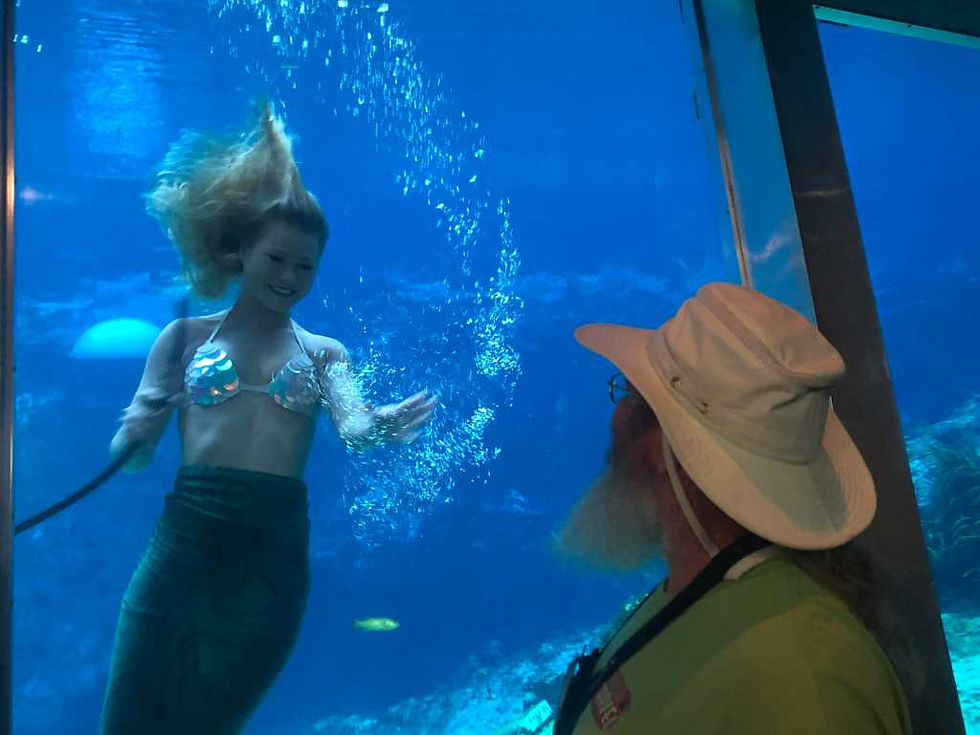
Around that same time, a resort opened in Weeki Wachee Spring, Florida that hired professional dancers dressed as mermaids to do underwater routines in large tanks for audiences. The practice spread to night clubs and theatres in places like Atlantic City and Las Vegas. And mermaids lie at the center of Curtis Harrington’sNight Tide (1961) withDennis Hopper; and one of my favorite movies The Fat Spy (1967), also shot in Florida. Watch The Fat Spyhere.
In the ’80s, at around the same time the Mermaid Parade was founded, mermaid schtick constituted a healthy strain of the neo-burlesque movement. I’ve had the honor of working with some of the pioneers of the modern era, people like Bambi the Mermaid, and Julie Atlas Muz. I was highly distressed not to see them and their cohorts represented in Netflix’s recent doc series MerPeople (2023), a rather superficial film that offers no historical context and pretends that all this started five minutes ago. But it revealed something I had not previously known: there is now a growing cult that goes beyond mermaiding as a profession. Some adapt it as a lifestyle, a new subculture not unlike the folks who decide they are vampires, werewolves, elves or Klingons. (Or flappers, for that matter.) It takes all kinds to make a world.
All I can think is, “what a waste of water!”
If you’re into mermaid stuff, I must highly recommend my friend Sarah Porter’s Lost Voices Trilogy. It’s ostensibly a YA series, but it’s full of dazzling patches of writing. You can read it as straight up fantasy. Oh and also there’s my wife the awesome illustrator Carolyn Raship who does amazing mermaid art like this:

Check out her inventory here!
And of course The Mouse has just released its new live action version of The Little Mermaid. It’s certain to warp the minds of just as many young people as the previous one from 1989, but that’s okay by me. I happen to like Mermaids.
The Summer Solstice approaches! Celebrate and make merry! It is the will of Poseidon!
For more on folk culture please check out No Applause, Just Throw Money: The Book That Made Vaudeville Famous,and for more on silent movies please read Chain of Fools: Silent Comedy and Its Legacies from Nickelodeons to Youtube.

Comments