


Odds and Ends on Ibsen


#botd Norwegian playwright Henrik Ibsen (1828-1906), who, as depicted above, could easily have been cast as a member of The Three Keatons.
Ibsen’s name is often paired with Chekhov’s but apart from some relation to realism, and Ibsen’s influence on Chekhov, the two playwrights really have very little to do with one another. Chekhov’s output was very small, and most of it of a stylistic piece: minimalist portraits, character studies of families, neighbors, and so forth. Ibsen was longer-lived, more prolific, and wrote in a wide variety of styles including verse plays, fairy tales, history plays, and melodramas. His most oft-produced works (then and now) tend to be plays that carry political and social messages, and this was the Ibsen that influenced the likes of G.B. Shaw, Harley Granville-Barker, J.B. Priestley,James A. Herne, et al.
Unlike Chekov, Ibsen wrote no light comedies that can be referred to as “vaudevilles”, but his influence was felt in vaudeville. Alla Nazimova, his foremost interpreter on the American stage, also toured the vaudeville circuits, and many of the one-act plays she toured with were eye-brow raising, Ibsenesque topical show-stoppers. She was emulated in this by the likes of Olga Petrova, Mrs. Patrick Campbell and others, and vaudeville playwrights like George Kelly showed his influence. On the legit stage, stars who inhabited his roles included Duse, Modjeska, Mrs. Fiske, Herbert Beerbaum Tree and Ellen Terry, and Eva Le Gallienne.
Given the risque subject matter of many of Ibsen’s hit stage vehicles, containing as some of them did references to such things as women’s rights, incest, venereal disease, and so forth, there were not tons of American screen adaptations in the early days, although there were some. D.W. Griffith produced a version of Ghosts in 1915, directed by George Nichols, and starring Henry B. Walthall. “The American Bernhardt” Nance O’Neil starred in a 1917 version of Hedda Gabler. Nazimova’s screen version of A Doll’s House arrived in 1922, the fourth American screen version.
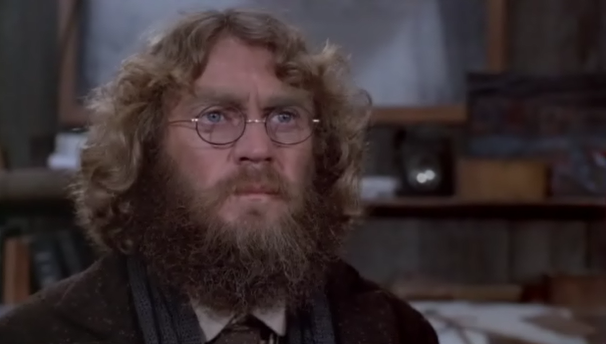
There were numerous television adaptations in the days of live TV drama. I am particularly interested in a crop of theatrical screen adaptations that emerged in the 1970s, both because I have seen several, and because the timing is intriguing. Why then? I think because Hollywood was finally “liberal” enough to deal with the content in many of these plays. In 1973 there were actually two competing versions of A Doll’s House, each of which hurt the other at the box office. Joseph Losey’s was shot on location in Norway and had Jane Fonda at her feminist height as Nora, with David Warner, Trevor Howard, and Edward Fox. Its British competitor had more star power: Claire Bloom, Anthony Hopkins, Ralph Richardson, Denholm Elliott, Anna Massey, and Edith Evans.Trevor Nunn directed a 1975 version of Hedda Gabler called simply Hedda; Glenda Jackson was nominated for an Oscar for her performance as the title character. Most surprising of all was a 1978 screen version of Arthur Miller’s adaptation of An Enemy of the People starring Steve McQueen (mostly regarded as an action star), with Charles Durning. This film was scarcely released during its own day. Most critics have been pretty arch about it, but it’s definitely worth watching as a curiosity.
In 2013 Wallace Shawn and Andre Gregory brought their production of A Master Builder to the screen, under the direction of Jonathan Demme.
Obviously, there are hundreds of stage and screen productions beyond these — these are just a few that reached American pop culture and caught my eye.
And yes, Laugh-In‘s Henry Gibson’s stage name is a play on the playwright’s. His real name was James Bateman.
For more on vaudevilleconsult No Applause, Just Throw Money: The Book That Made Vaudeville Famous, for more on early screen history please check out my book: Chain of Fools: Silent Comedy and Its Legacies from Nickelodeons to Youtube.

Comments