


Newport Redux: More on The Gilded Age, the Lost Sport of Coaching, and More


Temperatures spiked into the triple digits in NYC this week. To escape it, we did what folks from hereabouts used to do around the turn of the last century, which is spend a few days by the sea in Newport, Rhode Island. (As it turned out, we were thwarted in our quest for coolness. It was nearly as uncomfortable in Rhode Island).
Anyway, I have a personal history there, as I never tire of crowing about. You can read about that in my previous 2016 post, which was about reconnecting. We stayed there yet again in 2023 for my son’s wedding at Dragonline in nearby Jamestown. This week’s visit happened to be our first time back with a sightseeing agenda since the 2022 premiere ofJulian Fellowes’ The Gilded Age. Newport is used as a shooting location frequently on this show, both on its own account, and as a frequent substitute for New York settings (sadly, most of New York City’s Gilded Age mansions were torn down long ago). This week we returned to Rosecliff, Marble House, and The Elms (all of which I wrote about in this earlier post, along with The Breakers, Kingscote, and Vernon Court). This week we also visited Chateau-sur-Mer for the first time, a wonderful moody Victorian manse straight out of Charles Addams. Here are a few snaps I took:

One of the first of the Newport mansions, Chateau-sur-Mer was originally built in 1852 and then spruced up about a decade later by the ubiquitous architect Richard Morris Hunt. In The Gilded Age, it played Mrs. Astor’s Newport place, although IRL it belonged to a gent named George Wetmore.

The house is full of whimsical tile designs around fireplaces and such, I chose this one to snap because it had been International Fairy Day just a couple of days earlier:

And also the inhabitants were also clearly worshippers of Bacchus; his image is all over the place. (See his face in the middle?) The vibe is almost cult like.

And in the end, I was devoured by a Whomping Willow:

Most of the properties I’ve written about (The Breakers, Rosecliff, The Marble House, Kingscote, The Elms, and Chateau-sur-Mer) are managed by the Preservation Society of Newport County. The others include Vernon Court which houses the National Museum of American Illustration, and the The John N. A. Griswold House, home to the Newport Art Museum. The Preservation Society also manages Chepstow (built 1860), and The Isaac Bell House (1883), along with some other properties. BUT…contrary to what internet searches OR the Preservation Society appear inclined to tell you, these are FAR from the only historic mansions in Newport. Though, that’s not what these authorities imply with their message that these dozen or so are “THE” mansions of Newport.
And so I feel obliged, rather fiercely in fact, to tell you about as many of the other houses as I possibly can, so you don’t walk away with the false idea that there are only 12. There is also Belcourt Manor (built 1895 by Oliver Hazard Perry Belmont, presently an independent museum operating outside the Preservation Society’s auspices so naturally they wouldn’t dream of mentioning it). The Astors’ home Beechwood (built 1851), was for years a living history museum with costumed actors giving the tours. It was purchased in 2010 by a tech billionaire named Larry Ellison who has renovated it and is converting it into an art museum. As of 2019 he also owns Sea Cliff (built 1910), and Summerwind (1895), which are adjacent, and apparently intended for the same complex. There are also Ochre Court (1892) and the William Watts Sherman House (1876), which are both now part of Salve Regina University. Some of the earlier “cottages” that are still extant and we haven’t yet mentioned include Malbone (1848), Beaulieu (1859), Ocean View (1866), the William King Covell III House (1870), the Charles H. Baldwin House (1877), and Rockcliff (1887). Clarenden Court (1904), was where Claus Von Bulow killed Sunny. Miramar was built in 1911 by George D. Widener, who died the following year with his son aboard the Titanic(along with the Astors, and several others with Newport places). Sea View Terrace (built 1925) was used as Collinwood Mansion on Dark Shadows. Parts of it were sold to Salve Regina. Some of it burned in 2024. A straggler in the era of the super-mansions is Bois Doré, built in 1927. Most of these are private residences and cannot be toured. Try it and I bet you’ll get to know a Doberman quicker than you’d like.
For the culturally illiterate who’ve never read Henry James, Edith Wharton, William Dean Howells, or Mark Twain, The Gilded Age (Twain’s snarky coinage) refers to the Robber Baron era of the late 19th century, when swift fortunes were made in oil, coal, railroads, and such like. The heyday of Newport as a playground for the rich actually lasted longer than that however, beginning around the mid 19th century, and lasting into the early 20th. As we mentioned, in 1912, five key families in Newport’s summer colony lost members to the sinking of the Titanic. (Others experienced the disaster but survived.). This tragedy was a kind of symbolic foreshadowing of the arc of the twentieth century as experienced by the millionaire class. The labor movement, the establishment of the income tax, the Great Depression, the advent of two World Wars, these all affected both the culture and the economics of the richest Americans who had become accustomed to living like kings and queens in castles. Not so easy anymore. Meanwhile, Long Island was becoming ever more accessible by train, and that increasingly became a preferred destination starting in the so-called Jazz Age. It should be noted that Newport never ceased to be a playground for the rich. It’s just that the days of building and maintaining American versions of Versailles were over. Although lately that seems to be coming back.
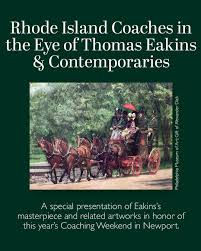
Closer to the center of town, we also revisited one of our favorite places The Redwood Library and Athenaeum, where they had a delightful exhibition called Road Island Coaches In the Eye of Thomas Eakins and His Contemporaries. No! Wait! Hear me out! It’s not what you think! This exhibition taught me all about an upper crust sport I had no idea existed! Apparently, in the 19th century it became fashionable among those who could afford it to race STAGECOACHS. This was known as coaching or four-in-one driving. It began of course when stage coaches were still a thing and then persisted purely as tradition (much like such sports as yachting, and crew, and polo) well into the 20th century. It was revived in Newport in 1968, and comes back every three years (though I don’t know that it’s a race per se any more, perhaps more like an exhibition of skill). The next such event will take place August 15-17, 2025. And the museum exhibition at the Redwood is up through September 7, so I highly recommend checking it out during the same visit if you intend to be in town. Meanwhile, I’ll return to the topic of coaching in more detail later this years, as the Coaching Club of New York turns 150 this Fall.
I think it’s important to stress that mansions of The Gilded Age are far from Newport’s sole selling point. Founded by religious dissenters in 1639, Newport was America’s fifth largest city during the colonial and Revolutionary eras. There were Quaker and Jewish communities in the town by the 1650s, among the earliest congregations in either faith in America. The oldest synagogue in the country is there. Newport is the birthplace of the U.S. Navy (more about that too later this year). Newport’s naval history made the news just a few days ago when it was finally confirmed by researchers that Captain Cook’s ship the H.M.S. Endeavor, used to explore Australia in 1770, had been positively identified at the bottom of Newport harbor (it had been sunk there by the British in 1778 in an attempt to block the French from getting their ships in). The older part of Newport is remarkably well preserved, with scores (maybe hundreds?) of buildings dating from the 17th to early 19th centuries. You could have a rich, fascinating cultural tourist experience just exploring the city’s early history without ever getting to the mansions of the Gilded Age. (More on the early history in my 2016 post).
After the time of the mansions, Newport was known as the home of America’s Cup, the great international yacht race, from 1930 through 1983. (Newport also plays an important role in tennis history; it’s the birthplace of what we now call the U.S. Open, and is the home of the Tennis Hall of Fame). And as a port town with a constant influx of sailors, Newport has always been an important populist musical center. The Newport Jazz Festival was founded in 1954 (it’s America’s first and oldest). The Newport Folk Festival was founded in 1959, making the town a mecca for the counter-culture throughout the 1960s. Which is no doubt among the reasons I am like I am.

Comments