


Modigliani – Cypress Trees and Houses

Jewish-Italian painter Amedeo Modigliani was born in Livorno on 12th July 1884. I decided to celebrate this occasion by writing about a few of his paintings that I recently discovered and have found very interesting.

Modigliani, Cypress Trees and Houses, 1919
Modigliani is one of my favourite painters, as the readers of this blog may already know. I adore his portraits and nudes, all imbued with a sense of mystery, melancholy and sensuality. Even his very name – Modigliani, how sweet it feels on the tongue, like honey, like ripe figs and dates, syllables flowing one after another in a sweet river. There is a gentleness to the name, tenderness. Modigliani is remembered mainly for his nudes and portraits, but these days the paintings that interest me are his landscapes. He painted four and only four landscapes in his entire career and all four were painted during his stay in the south of France in 1918 and 1919. Modigliani fled Paris in the spring of 1918 because of a fear of invasion due to war and the warm air and sunshine were also good for his fragile health. It was in autumn of 1918 that Modi’s lover and muse Jeanne Hebuterne gave birth to their daugther Jeanne. Neither the love joy, neither the health problems are felt in these paintings.
All four of these landscapes show similar motifs; cypresses and Mediterranean houses with red roofs, painted in a limited colour palette of green, beige and orange-red. It is interest to remember the vibrant, ecstatic, groovy even paintings of the Cote D’Azur as imagined in the painting of the Fauvists such as Matisse, Derain or Braque, all flickering in colours and sunlight, and compare those landscapes with these painted by Modigliani only a decade later. These are simultaneously unlike anything that Modigliani had ever painted, for he was a painter of human faces not faces of nature, and typically Modigliani in the way the motif is rendered. There is an unmistakable Modigliani quality about them; something lyrical, melancholy, still, contemplative, elongated, even ghostly or at least ethereal. They also seem so quiet. I cannot hear a birdsong and no wind is playing the treetops as if they were a harp. No cicadas in the grass. The windows with shutters have now replaced the big almond shaped eyes or the eye sockest with no pupils. The shape of the houses, slim and elongated, are painted instead of the female form and interestingly the colour he uses is almost the same. The cypresses, trees mournful to begin with, were rendered in a typically elongated fashion as well and they come in two, in pairs, like lovers, like soulmates, or twin flames, growing separate in their trunks but meeting in the air in their treetops like equals. The trees in the last painting, with their branches bare and cut off seems ominous in some way.

Amedeo Modigliani, Cypresses and Houses at Cagnes, 1919
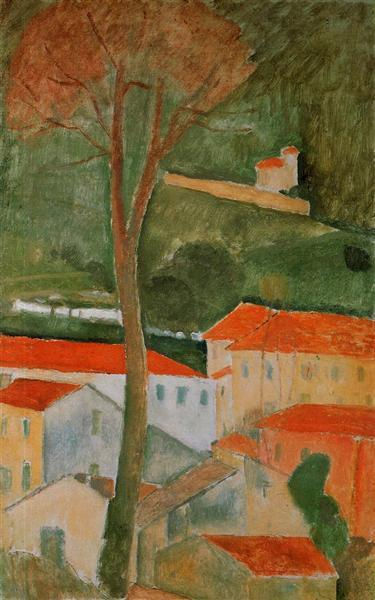
Modigliani, Cagnes sur mer, 1919

Amedeo Modigliani, Trees and House, 1918

Comments