


Mexican kitchen tools and gadgets at the La Cruz street market


A Mexican street market is always fun, especially for someone who likes kitchen tools and gadgets. Mexican cooking does not require a lot of utensils, but whatever you need, you will find at the weekly market. Pick out a basic pot, wooden spoon, bean masher, lime squeezer, and you will be equipped to set up a food stand on the street or cook classic Mexican recipes at home.
Our part of Mexico has been having its share of rain lately. Bridges are washed out, roads are blocked by mudslides, motorists are stranded on the highways. I didn’t know if La Cruz de Huanacaxtle would have much of a market at all this Wednesday, but all the regulars turned out, except for the vegetable guys who took one look at the skies, and packed up and left. Between rains, I dashed to the market for photos and for a little education on kitchen gadgets. On wet streets, under a gray sky, the sun was trying to shine.

Every Mexican kitchen has a tortilla basket (tortillero de palma) and maybe a tortilla press (prensa para tortillas). I say maybe, because it’s easier to run to the nearest tortillería and buy hot tortillas. The baskets are only 10 pesos each, the press, 85 pesos. The rate of exchange these days is about 13 pesos to the dollar.


The orange juice squeezers look heavy duty and cost 140 pesos, the same price for the plastic jugs (barril para agua) for aguas de frutas.


Blue enamel ware is one of my market favorites. I think it is the sky blue color that makes me want to buy more than I need. The spoons (cucharas) are cheap at 12 pesos. The blue pots (ollas de peltre) are 100 pesos. As pretty as they look, the pots are thin and do not conduct heat well, plus they need extra care in handling, as the enamel chips easily. Still, I enjoy the pieces I have, appreciating the color they add to the kitchen and table.
The first photo below needs some explanation. The objects in the foreground have nothing to do with food or cooking, unless you like to eat parakeet eggs. These are quiotes, made from the dried flower stalks of huge maguey plants, also knows as century plants. Quiotes are put into bird cages, where small parrots or parakeets peck away at the hole already started, until it is hollowed out enough to make a nest for egg laying.


These pot scrubbers (escobetillas) are biodegradeable, made from ixstle (or istle) fibers from an agave plant. Also biodegradable are the beaters (molinillos) for making hot chocolate, though plastic has made huge inroads in Mexican manufacturing. Prices are 10 pesos and 25 pesos, respectively.


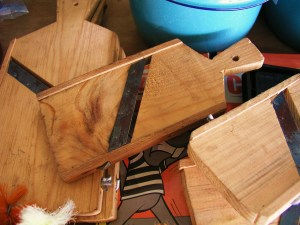
Pine is plentiful in the state of Michoacan, where many wooden utensils are made. How often do you see handmade slicers, Mexican mandolines (rebanadors)?

Blender parts. Propane stove parts. You could literally build your own cook stove.


Two of my market favorites: the primitive earthenware dishes (platos de barro) and colorful plastic strainers or sieves (coladeras). The low-fired, terracotta dishes chip easily, and are not dishwasher or micro-wave proof, but they seem to make Baja fish tacos or chiles rellenos taste better. The strainers, in a rainbow of colors and every size, perform multiple duties in my kitchen. I use them for sifting flour, dusting powdered sugar over a cake, and straining orange juice, cafe de olla or jamaica tea. Small, earthenware dishes start at 12 pesos, and strainers are 5 to 25 pesos, depending on the size.


Mark, the largest vendor of cookware utensils and gadgets at the La Cruz market, was happy to check my spelling, but there might be a mistake or two, despite our efforts. My Spanish is not great, but I try. Coming home from the market, Luis asked me how much rain had fallen in the past week. I don’t measure in metric, due to America’s inability to teach and use the system of measurement that makes the most sense, so I gave him the amount in inches, “Doce pulgas.” He burst out laughing, and I knew immediately what I had told him: twelve fleas, not twelve inches, which is “Doce pulgadas.” Oh well, if you find an error in my Spanish (or English) spelling, please let me know. And if it’s raining cats and fleas where you are, stay dry.

Mark’s daughter, Alexa, spending the day under a table of pots
Notes:
Street markets in Mexico are called “tianguis”.
When you visit the tianguis, take re-usable shopping bags, drinking water and a camera. Also small change, as some vendors can’t change large bills. Always ask permission before taking a person’s photo.


Comments