


MetFut/Latimeria M30000 Solar USB Power Bank Teardown and Review

Introduction
I’ve only disassembled a handful of power banks so I am still learning about them. When MetFut reached out to me about reviewing their M30000 power bank, I wasn’t initially enthusiastic as they implied that I should participate in some sort of Amazon review shenanigan. But I was curious about what you can get for only $20 ($17 on sale) and they agreed to send me a unit directly, so I accepted.
Full disclosure: While this is not a sponsored post, the products showcased were provided at no cost for evaluation purposes. Products received in this capacity are destined for teardowns, future device interoperability testing, giveaways, trades for other items to test, and/or charitable donations. MetFut & Latimeria are brands owned by Shenzhenshi Xianboshi Keji Youxian Gongsi, based in Shenzen, China.
Advertised specs
33800 mAh (misleading – it should be 33800 mWh)
LED flashlight
solar panel with suction cup
IPX7 shockproof/dustproof/waterproof
11.3 ounces (320 grams)
Unboxing & Physical Characteristics
The packaging was a durable brown cardboard box with a legible blue and white label identifying the product and specs. Inside, the power bank was wrapped in a thin white plastic baggy. Included was a 10cm USB -> microUSB charging cable, dual suction-cup clip, mini carabiner clip, user manual, and a thank you card. The power bank itself had an outer black textured hard plastic shell with a blue silicone/rubber insert. Different variations have different color silicone inserts but are otherwise identical.
Weight of the power bank was 215 grams and exterior dimensions measured at 139mm x 75mm x 19mm.

Usability and Performance
Charging the power bank
The solar charging feature was SLOW – as advertised it did 5V @ 0.15amps or 750mW. So charging from 0 – 100% would take ~40 hours under ideal conditions and without direct sunlight, it could take much longer. MetFut did mention in the documentation that the solar feature was not intended for full charging but just to top-off the battery. Given the solar panel adds little weight, I guess its a nice-to-have feature. Charging via AC/Mains was more reasonable at 3-6 hours depending on the style of USB charger which is typical for pocket sized power-banks.
When charging from USB the LEDs illuminated blue and indicated the available capacity in five increments. But when charging from solar, the LEDs illuminated green indicating the brightness of the light hitting the solar panel – not the available capacity.
Charging phones
I was able to charge two phones at the same time with each receiving ~4.6W. The documentation stated that one port can do 2.1 amps but I was only able to get a maximum of ~1.2 amps on a single port. The combined output of both ports was ~2.1 amps though. Having all three USB ports in use simultaneously still allowed the phones to charge, but without “passthrough” charging. For high-end battery packs, when you plug into an AC/Mains charger, not only does it charge the battery but also splits away some power to charge the USB devices at the same time. The ZMI unit I reviewed last year has that feature.
Note: my regular USB power meter was malfunctioning so I used my USB-C power meter with adapters which probably introduced about a 0.1v drop compared to a direct connection. I will re-test when I receive my new tester and post updates if I notice any significant differences.

Other features
The Amazon detail page mentioned an IPX7 waterproof rating which means immersion in at least 1cm of water for 30 minutes should not cause any undesired effects. Little effort was needed to pull the blue silicone cover insert away from the main plastic body revealing glimpses of the inner components. And the part that covered the USB ports was loose-fitting. Based on the fit and finish, water splashes would be OK but I would not trust immersion.
The built-in flashlight/torch feature was bright enough to help find keys in a purse or look for items in the trunk of your car. It has an “SOS” flashing feature which is a gimmick on many flashlights.
The integrated belt clip was thin plastic and I reckon it would snap off with use regular use. Likewise, the included suction cup and carabiner accessories were not inspiring – I didn’t use them so I can’t comment on their actual effectiveness.
Teardown
The construction was simple with two black plastic half-shells fastened together. After popping 4x silicone screw covers off, I unscrewed 4x Philips (+) #0 screws and loosened 6 plastic clips. After separating the two halves, the main silicone insert fell away easily. Inside, there were three main components:
107mm x 61mm solar panel hot glued in place
charge controller PCB marked XHD-2592H
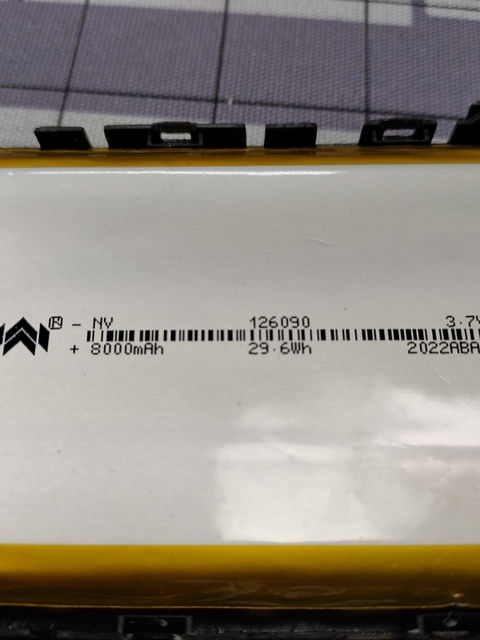
12mm x 60mm x 90mm Li-Po cell rated for 8000mAh @ 3.7V (29.6Wh) with a chevron-shaped logo and factory code “NV”.

Analysis
With hard plastics and hot glue, I can’t praise the assembly. It uses a no-name charging controller with no markings on the two integrated circuits. Although the Li-Po cell has a design voltage of 3.7V and 8000mAh rating (29.6Wh capacity), after charging overnight, the battery voltage reached ~4.1V leading to a real-world capacity of 34.5Wh (34500mWh). This is typical in power banks as overcharging provides a higher capacity at the expense of a reduced number of charge cycles before the battery dies.

Misleading capacity?
The Amazon and eBay detail pages specify 33800mAh and 5 volts. But this voltage is the output of the USB port not the actual battery charge voltage. Across battery pack brands, actual charge voltages can vary between 3.7-4.3V depending on how aggressive the charge controller is. And in all models, that voltage is stepped up to 5V with a boost-converter circuit to meet USB specs. Specifying mAh (milli-amp hours) is only relevant if the battery charge voltage is also specified because you need both to compare capacities across different brands. (When the charge voltage is not specified, its safe to assume 4V.)
If we take MetFut at face-value , then 33800mAh multiplied by 4 volts is ~135Wh (Watt hours). Battery packs of this capacity typically weigh ~800 grams – not ~200 grams and are well beyond the typical 100Wh limit allowed for airline travel.
What we actually see inside is a Li-Po cell rated for 8000mAh – clearly not a 33800mAh cell. If this cell were to be charged to 4.225V it would actually have a capacity of 33800mWh. Had I left the power bank charging longer, perhaps it would have risen from 4.1V to 4.225V.
So the vendor should have advertised 33800 mWh instead of 33800 mAh.
Its plausible the vendor just made a mistake. But after viewing dozens of eBay and Amazon detail pages for competing products, its clear that mAh claims are all over the place. Some vendors substitute mAh in place of mWh but others seem to just pull a number out of thin air. My recommendation is that whenever you buy a battery pack, just divide whatever rating is advertised by 4 and you’ll probably be close to the real rating.
Based on these findings I asked the vendor to correct the detail pages – they are looking into it. But given how all vendors mis-advertise, I don’t expect any changes as it would suddenly appear that this power bank has ~4X less capacity than others.
Manufacturer info
I was able to find the manufacturer of these power banks on Alibaba and they are charging ~$5 USD. Bulk China->USA shipping and Amazon Prime fulfillment probably adds ~$5/unit, so at $16.99-19.99 retail, profit is $10 at best. Amazingly, the Alibaba listing mis-advertises the capacity as 20000mAh. So somehow we got from an 8000mAh cell -> 20000mAh -> M30000 model name -> 33800mAh advertised rating. Amazing!

Conclusion
For under $20 USD ($16.99 on sale), you can’t expect much from a portable power bank. And the MetFut M30000 meets that expectation. It uses uninspiring materials and assembly methods. But with its simplicity, it ends up being fairly rugged. I tossed mine around the workshop and hit the concrete floor hard multiple times and the plastic didn’t shatter and the solar panel stayed in place. The silicone insert doesn’t make the best seal so I wouldn’t trust the waterproof claims, but it should be good enough for the occasional spill or splash. The flashlight is handy and bright enough for casual uses. The carabiner and suction cup are just “filler” accessories that I didn’t evaluate.The solar panel is more of a gimmick than anything else since it charges so slowly – but it adds little weight weight and does actually charge the battery given enough time.
Would I recommend this product for daily use? Probably not. For battery packs, I prefer spending more for something that is higher quality. But if you just want to have something cheap to toss in a vehicle glovebox for occasional use, I think this would be OK.
If you know of any reputable power bank brands that advertise *real* mWh or Wh ratings, please let me know. Even highly regarded name-brands seem to screw this up.

Comments