


M.R. James: The Pen is Mightier Than the Poltergeist

August 1 is the birthday of British scholar and author Montague Rhodes (M.R.) James (1862-1936).
James’s primary work was as a Cambridge scholar whose academic specialty was the Medieval period. On the side he wrote ghost stories, which is what he became best known for. Initially he wrote them just to entertain his friends, but they wound up being published in the volumes Ghost Stories of an Antiquary (1904), More Ghost Stories of an Antiquary (1911), A Thin Ghost and Others (1919), A Warning to the Curious and Other Ghost Stories (1925), and the hardback omnibus The Collected Ghost Stories of M. R. James (1931).
James was a gifted wielder of words, the farthest thing from a pulp hack. What I love about the stories is that his experience as a Medievalist wends its way into the writing, adding a platform of realism that is inevitably breeched by the supernatural. (Not unlike Agatha Christie whose experience on archeological digs sometimes found its way into her mysteries). A lot of his tales are rooted in genuine folk beliefs. Many of the plots concern mysterious objects and artifacts that someone gets ahold of, bringing destruction to the material plane. Sometimes spirits or demons are unleashed. Sometimes the person who is in possession misuses the power he has acquired. James was a fan of Sheridan Le Fanu, and his own work inspired the likes of H.P. Lovecraft, H. Russell Wakefield, and Stephen King.

Most of James’ stories have been adapted for British radio and television as far back as the 1930s, but to date there is only one feature film based on one of his works: Night of the Demon a.k.a. Curse of the Demon (1957). (The latter variation on the title was out of concern that ticket-buys might confuse the film with Night of the Iguana.) Based on the story “Casting the Runes”, the film is directed by Jacques Tourneur, who’d previously directed several horror classics for Val Lewton at RKO, such as Cat People (1942), I Walked with a Zombie (1942), and The Leopard Man (1943). It’s an interesting transitional film: harkening back to that tasteful older tradition (during a period when most horror films were about giant atomic monsters and U.F.O. invasions), and pointing the way to a new period of spiritual horror films in the ’60s like The Devil’s Hand and Burn, Witch, Burn.
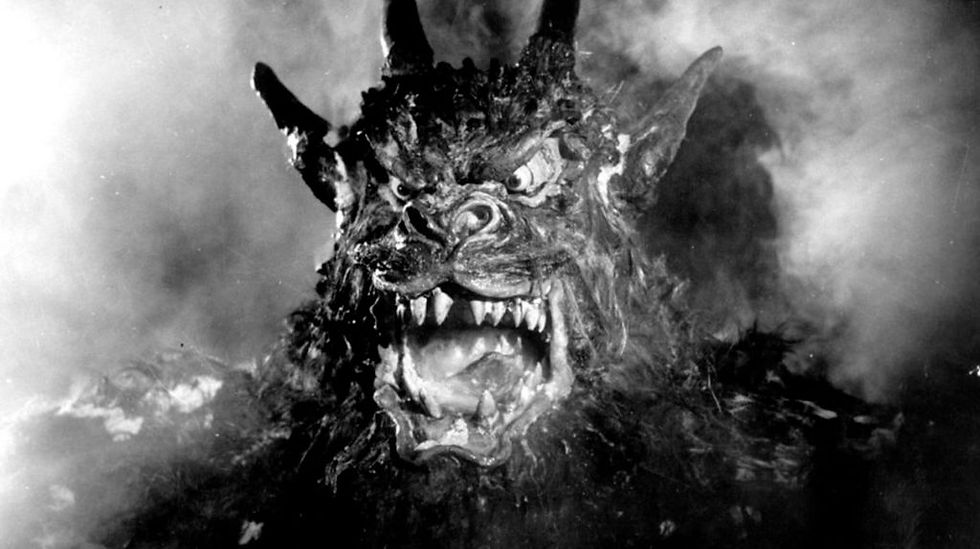
Dana Andrews stars in the film as a scientist called upon to investigate a murderous cult in possession of a magical parchment that summons the demon. Unlike those early Lewton films though, the film-makers decided to show the demon in the film — the image of the monster is the most commonly circulated picture associated with the movie. It’s somewhat over the top. James’ writing could be graphic on occasion, but never silly in quite this way. It was clearly a concession to the expectations of the times.

Comments