


Life in the Desert – Prickly Pear Cactus Jelly !

CLICK ABOVE TO PLAY MUSIC
Music – “Don’t Sit On a Cactus” from Don’t Sit on a Cactus by Joel Frankel. Released: 1997
It’s that time of year around New Mexico, when the Prickly Pear cactus fruits begin to ripen to their luscious deep red colour and you only have one chance a year to make Prickly Pear Jelly. So, don your elbow high leather garden gloves, long-handled barbecue tongs and a couple of paper bags and trip carefully through the cactus in your yard!
When I first moved to New Mexico in 1994, I didn’t realize that those beautiful fruits that ripened on our cactus in the fall were edible. The second year, I caught on and made my first batch of jelly. Over the past few years, even though all cacti species are drought tolerant / drought resistant, even our 20-year-old Prickly Pear patches suffered and produced very little fruit. This season, however, there were enough fruits to whip up a batch of jelly, and so I did just that.
The recipe I used, “Prickly Pear Jelly” is from “Fruits of the Desert” by Sandal English, published by The Arizona Star in 1981. The book contains recipes for a multitude of desert fruits, berries and seeds, including numerous pages for using cactus fruits. The recipes are gathered from readers of the newspaper and the recipe I used was contributed by Gloria Thomasson of Tucson, AZ. The instructions follow below the photos:
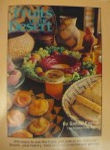
“Fruits of the Desert” by Sandal English


Ripe Prickly Pear Cactus from my garden

Several patches have more shade and the fruits are not yet ripe
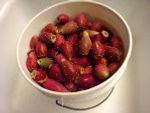
About 5 or 6 quarts of Prickly Pear Cactus fruits from my yard

Washing the cactus fruits

Carefully measure out 3 quarts of fruit

Put the cactus fruit and water into a large pot

Bring the fruit and water to a boil

Briefly remove from the heat and mash the fruits with a potato masher

Bring the fruits and the water to a rolling boil

Strain the pulp through several layers of cheesecloth

The juice after straining the mixture through cheesecloth


Boil the strained mixture down after adding the pectin until reaching the “gel” stage

Pouring the jelly into the jars

Pour the jelly into sterilized jars and let cool before refrigerating

Some of the finished products
Gather and wash 3 quarts of fruit, using gloves and tongs. Place the washed fruit into a large 6 quart kettle with 3 quarts of water. Cook for 20 minutes (I cooked mine for about 40 minutes, due to the altitude adjustments needed). Briefly remove from the heat and mash the fruits with a potato masher. Strain the juice through several layers of cheesecloth.
Although the recipe indicates that you should be able to obtain about 8 cups of juice, it wasn’t enough, so I proceeded with another batch in order to get enough juice.
Measure 4 cups of juice into a large kettle and add juice of ½ lemon and 3 cups of sugar. Bring to a boil. Add another 3 cups of sugar and bring to a boil again, stirring until it reaches a full boil. Add 2 packets of liquid pectin (or 1 bottle) and continue cooking over high heat for 15 minutes (I cooked mine for 30 minutes)(In addition, I located an article in an old edition of The Albuquerque Journal, about making Prickly Pear Jelly. The author indicates that Prickly Pear fruits, like pineapple and kiwi, contain enzymes, which can cause the proteins in gelatin to break down. Sure enough, my jelly was not truly at the point of being able to gel, so I added 2 additional teaspoons of granulated pectin and this seemed to do the trick) Although the recipe indicates that the 4 cups of juice makes 6 glasses of jelly, my fruits were not as juicy, I think, and my two batches of 4 cups each made a total of 7 jars of jelly.
After all is said and done, the jelly with all of that sugar, is not surprisingly, extraordinarily sweet, although you can still taste the prickly pear fruit through the sugar. Next time, I’m going to cut back on the sugar or use a substitute, such as blue agave nectar and adjust the recipe accordingly.
Whoever said that nothing worthwhile grows in the desert was just plain wrong!

Comments