
.png)


Ken Burns’ Civil War
- goldenstateservicesj
- Sep 23, 2025
- 8 min read


Today marks 35 years since the opening shot of Ken Burns’ The Civil War (1990) went hurtling toward Fort Sumter. Arriving at the height of the Culture Wars, this nine part, ten hour documentary series did the impossible by appealing to Americans of most every political stripe, becoming the most watched show ever to air on PBS. The present anniversary, though not a round one, comes at an equally fraught time, when Americans whisper about the coming of a new Civil War. One of a million manifestations of the present strife is that PBS is under threat and has been starved of funding by the present administration in order to neuter its criticism. Into this environment Burns will be releasing his latest effort in a few months, The American Revolution, in honor of the 250th anniversary of that event. One doubts that it will be able to unite the nation as its predecessor did, though if anyone could do that, Burns could.
There are two Burns brothers, btw. and both are distantly related to that great figure of the Scottish Enlightenment, Robert Burns.RicBurns, the younger one, who co-produced The Civil War with Ken,often gets short shrift. I love the movies of both brothers, and both have influenced me greatly. Both Burnses specialize in films about discrete, important areas of American history. They are terrific showmen, adept at evoking the periods of which they treat, with a flood tide of historic images, often still ones, which are filmed with moving (tilting, panning, zooming) cameras to make them come alive. Ken set the template in The Civil War and earlier films. He hires popular stars to play historical characters, as you would do in a radio play. And he gets top contemporary historians to be talking heads, usually people who are so striking that they become characters in the film themselves. I am a special admirer of how he writes his scripts; it definitely impacted the way I organize books. It’s what you might call the Ripley’s Believe It Or Not approach. Earth shaking world events tend to be full of startling and amazing anecdotes as well as jaw-dropping statistics. Burns assembles his films from these elements almost exclusively, which has the effect of constantly jolting you awake. There is no excuse for a history documentary ever to be boring, yet prior to the Burns brothers’ most of them were, in fact, that’s what they were known for. The Burns’ seek to connect you to their subjects emotionally, to make you realize their significance at a human level. I’ve never watched this series without weeping just about through the entire thing — because I’m sane!

The debut broadcast of The Civil War was a national event. I watched the whole series on its original airing, and subsequently at least five additional times, and have the companion book, which is pretty well dog-eared. My attachment to the film series grows over the years, as I have learned about what my own ancestors and relations did (good and bad) during the war. My great-great grandfather James Calvin Stewart enlisted in the Confederate army, served a few months, and then deserted (his wife had a newborn); his brother was badly injured at Gettysburg. There are dozens like this in my family tree. I’ve also learned of distant relations to several better known players in the drama, including Grant, Sherman, Joshua Chamberlain, and Rhode Islander Elisha Hunt Rhodes. Christopher Murney, who provides the voice of Rhodes, is from my hometown. George B. McClellan’s family originally came from my mother’s small rural Connecticut town; my father’s people lived a few miles from where Tennessee soldier Sam Watkins came from. So I relate to this story like a Greek appreciates the Iliad and the Odyssey, or an Englishman, Henry V, or a Jew the Torah. It is the American national epic.

Already that will be off-putting to many of you, a turn-off, but that’s not what this is about, some kind of exclusionary white identification trip. The abomination of slavery was at the heart of this conflict, has been a cancer in the American story since the beginning, and Burns articulates that at every available opportunity. He accomplishes this largely through the frequent commentary of black historian Barbara J. Fields, the only one of the film’s talking heads who resembles an actual movie star, and the voice of Frederick Douglass (provided, inevitably by Morgan Freeman). Laurence Fishburne is among the readers, as well, and another of the presenters is Daisy Turner, the 102 year old daughter of an actual slave. The voices of Irish and German immigrants are also part of the mix, though the 1860s were somewhat early in terms of the American immigration story. Julie Harris provides the voice of diarist Mary Chestnut, one of the more prominent female voices.
Modern criticism of The Civil War hinges largely on the fact that it doesn’t present enough perspectives, and that it doesn’t go into the failures of Reconstruction and what happened thereafter, which results in a rosier picture of the war’s outcome than reality merits. Granted. But the virtue of this particular series is that it attempts to include all Americans, including ones whose perspectives you might not be crazy about. I’ve certainly watched the film in the presence of family members who were the opposite of progressive, and who were vocally dismissive of some of the modern takes represented in the film. I’m not pleased by racist or reactionary views on the issues brought up by the American Civil War, but if you’re going to tell this story, and have this conversation, there needs to be trust and an opening for all of the stakeholders. Burns struck the best balance he could at the time — and it may have been the last time in our history such a thing would even be possible. My point being that both factions think that we hear too much from the opposing side. Burns did it about the best that it could be done in this highly divided country.

So, yes, in addition to the photogenic Dr. Fields, we also get more traditional perspectives by the likes of Shelby Foote, Stephen Oates, William Safire, Robert Penn Warren, and the entertainingly eccentric Ed Bearrs. (I mean, how are you not gonna put that guy in?) The icing on the cake is the effecting and folksy presence of historian David McCullough as narrator, with whom Burns had worked on his 1981 Brooklyn Bridge film (based on McCullough’s book) and his 1985 one on the Statue of Liberty. (McCullough is the man responsible for America’s re-evaluation of John Adams, resulting in the HBO mini-series, and he also wrote terrific books on Harry Truman, Teddy Roosevelt, et al).
The voice-over actors in the film range from familiar and beloved thespians to literary figures whose presence lends the same kind of weight to the film as the historians do. Beyond some I’ve already mentioned, the roster includes Sam Waterston as Abraham Lincoln; Jason Robards as Ulysses S. Grant; Garrison Keillor as Walt Whitman; Paul Roebling as Joshua Chamberlain, Sullivan Ballou (author of a heartbreaking farewell letter to his wife), Oliver Wendell Holmes, and his own ancestor Washington Roebling (the guy who built the Brooklyn Bridge); Arthur Miller as William Tecumseh Sherman; Horton Foote as Jefferson Davis; George Plimpton as financier George Templeton Strong; Philip Bosco as Horace Greeley; Studs Terkel as Benjamin Butler; and in sundry other roles such notable readers as Hoyt Axton, Colleen Dewhurst, Jeremy Irons, Derek Jakobi, Kurt Vonnegut, Pamela Reed, and M. Emmett Walsh.

The movie also has over 16,000 images, including uncountable Matthew Brady portraits and battlefield photos, many of which speak more eloquently to the horrors of war than any words possibly could. (These are the same photos that inspired Buster Keaton’s The General, btw). There is something revolutionary about the volume of images in Burns’ films. He obviously puts about a hundred times the effort into researching, acquiring, and shooting still images than just about any documentary maker who came before him. The result is a film that is far more cinematic than used to be the norm for documentaries depicting pre-cinematic periods. His movies are endlessly engaging.
I mentioned how The Civil War and other Burns docs influenced how I write historical non-fiction. But it also influenced the theatre I make. As I have mentioned before, in creating my American Vaudeville Theatre, I was very much influenced by visits to the Smithsonian’s re-creating of exhibitions from the 1876 Philadelphia Worlds’ Fair. The patriotic use of American flags and bunting were very much an omnipresent motif in those years, and I have always loved the look of that, and intend to revive it once again as a I revive my vaudeville activities over the next year. Vaudeville was born on the heels the Civil War. March music, and drill teams of veterans were very much on the bills of fare in early variety shows. I also wrote a play that was set in the Civil War during my 1994 stay at the MacDowell colony that was very much influenced by the second airing of the series (including a song that parodies its beautiful theme music “Ashokan Farewell”.
As we have stated, The Civil War was a grand success and it allowed Ken Burns to go on to make some three dozen additional documentaries and series, including Baseball (1994), Thomas Jefferson (1997), Jazz (2001), Mark Twain (2002), The War (2007, on World War II), Prohibition (2011), The Dust Bowl (2014), The Roosevelts (2014), The Vietnam War (2017), Benjamin Franklin (2022), and most recently Leonard Da Vinci (2024), and many others. Another personal favorite is Not for Ourselves Alone: The Story of Elizabeth Cady Stanton & Susan B. Anthony (1999) on account of this and this.
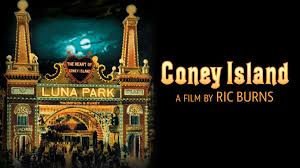
We would be remiss in the extreme if we did not talk about the equal influence that Ken’s younger brother Ric has had on us. Ric dropped out of college to help produce The Civil War. After that, the Burns brothers seem to have had their own Civil War (i.e. they don’t seem to collaborate any more).
Ric also tackles topics of Americana, although usually in smaller scale. His first couple of films are particularly important to me. Ric is a lover of Coney Island; he named his production company Steeplechase Films, and made the history of Coney as an amusement mecca the topic of his first doc in 1991. I’ve lost count of how many times I’ve seen that one! He followed that up with his series on the history of New York City, which was originally completed in 1999, though he added another episode, a kind of coda dealing with September 11, in 2003. We premiered it at the New-York Historical Society during the period I wrote about here. He’s also done several films dealing with such topics as the American West, whaling, the Pilgrims, etc. Like, Ken, in 2024 Ric Burns deviated from his usual Americana turf to write about an Italian cultural titan, in his case Dante Alighieri.
Anyway, my sons both tickled me recently by mentioning their intention to screen the Civil War series as preparation for our upcoming trip to the soil of our problematic ancestors. My Tennessee relatives fought on both sides of the Civil War. It’s a seldom stressed fact but this North/South binary thing is a convenient simplification of what actually occurred. Both regions were internally divided, and both had culpability in the original sin of slavery as well as the ongoing disgrace of racism. The difference between the two spheres was one of degree, not one of kind. Which is the selfsame reason the country appears on the verge of a second Civil War as I type this. That’s the main tragic flaw in Burns’ documentary. The shit ain’t over yet.
Which raises another important point: give to PBS!


Comments