


Kansai water features


“The Temple of the Blue Waves”
Kansai, Japan. November 2018. (12 photos)
This is part 5 of my Japan 2018 photo series.
The Kansai (Kinki) region is in the southern-central region of Japan’s main island Honshu. The region includes the prefectures of Mie, Nara, Wakayama, Kyoto, Osaka, Hyōgo and Shiga. The urban region of Osaka, Kobe, and Kyoto is the second-most populated in Japan after the Greater Tokyo Area. I thought I might group together a few Kansai water features I visited and photographed, features both man-made and natural, which complement or are complemented by the presence of water.
Above is the iconic Seiganto-ji (青岸渡寺), the Temple of the Blue Waves, a Tendai Buddhist temple in Wakayama Prefecture. In 2004, it was listed as a UNESCO World Heritage Site. According to legend, it was founded by the priest Ragyō Shōnin. The temple was purposely built near Nachi Falls, where it may have previously been a site of nature worship.
In the background is Nachi Falls (那智滝 Nachi no Taki), one of the best known waterfalls in Japan. With a drop of 133 meters, it is the country’s tallest waterfall with only a single uninterrupted drop.

“Nachi Falls”
There are two rocks at the top of the falls that are the guardian kami* of the falls. There was also a Buddhist temple here that was destroyed during the Meiji Restoration (late 19th century). Many star-crossed lovers have leaped from the top of the waterfall in the belief that they will be reborn into paradise.
*Kami (神) are the spirits or phenomena that are worshipped in the religion of Shinto. They can be elements of the landscape, forces of nature, as well as beings and the qualities that these beings express; they can also be the spirits of venerated dead persons. In Shinto, kami are not separate from nature, but are of nature, possessing positive and negative, and good and evil characteristics. Does this sound familiar? It’s been said that George Lucas was significantly influenced by Japanese culture when creating Star Wars.

“A river in Kansai”
Mother Nature does a good job of providing her own seasonal water features as well.

“Meoto Iwa”
Meoto Iwa (夫婦岩), known as the “Wedded Rocks” or “Husband and Wife Rocks” are a pair of sacred rocks in the sea off Futami, a small town that is part of Ise City in Mie Prefecture. The rocks are located near Ise Grand Shrine, which is an important and sacred Shinto shrine in Japan.
According to Shinto beliefs, these particular rocks represent the union of the central deities in the Shinto creation myth, Izanagi (the male deity) and Izanami (the female deity). The rocks, therefore, represent and celebrate the union of man and woman in marriage. The larger of the two rocks has a small Shinto torii gate at its peak. The two rocks are joined together in matrimony by a sacred Shinto straw rope called a shimenawa. The ancient Shinto custom of worshiping stones is called iwakura, and these places are considered pure and sacred by worshipers, as well as spots where kami are invited to descend.

“Like a bridge over troubled waters”
The sacred rope is massive, and weighs over a tonne. It is replaced three times a year in a special Shinto ceremony held in May, September and December.

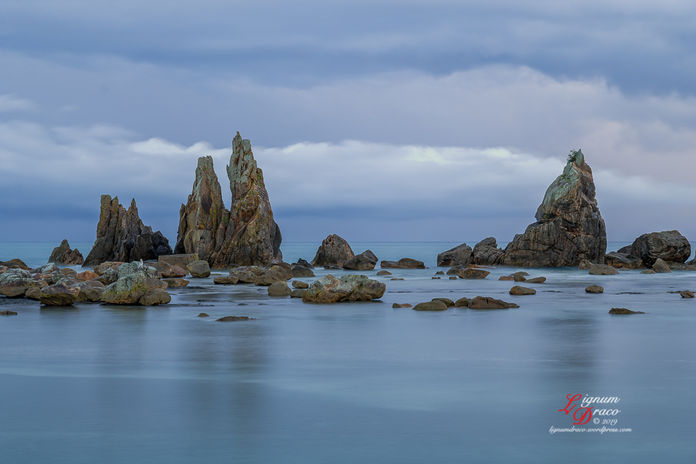
“Hashigui Iwa”
Near the town of Kushimoto, approximately 40 island like outcrops of rock form a 850 metre line just off the southernmost tip of the Kii Peninsula. They are known as Hashigui Iwa (橋杭岩), the Bridge Post Rocks.

“Building blocks”
According to folklore, the legendary Buddhist monk Kobo-Daishi came to Kushimoto where the locals explained they had been trying to build a bridge to Kii Oshima from the mainland, but the local devil, Amonojaku, kept destroying their work. Kobo-Daishi met Amonojaku, and the latter agreed that he would allow a bridge to stand if, and only if, the bridge was built by Kobo-Daishi himself, and as a goodwill gesture Amonojaku would grant Kobo-Daishi superhuman strength for the task. Amonojaku added the stipulation that the bridge must be built in a day and a night.
“Kansai water features”
Kobo-Daishi set to work, gathering boulders from the mountains and piling them into piers for the bridge. Amonojaku began to fear that Kobo-Daishi would complete the task, in spite of Amonojaku’s impossible conditions, so he intervened. Well before sunrise, Amonojaku faked the crow of a rooster, causing Kobo-Daishi to think it was dawn. Kobo-Daishi stopped work. Amonojaku won. And the posts of the unfinished bridge remain to this day.

“Floating torii”
In Shiga Prefecture, northeast of Kyoto is Lake Biwa, Japan’s largest freshwater lake. Along its shoreline are historic sites including Shirahige Shrine (白鬚神社), famous for its “floating” torii.

“Morning has broken”
The shrine is considered to be a good place to pray for longevity, matchmaking, having a baby, better luck and prosperous business. Perhaps the name is a reference to longevity, because shirahige means “white beard”.

“White beard. White light.”

“Osaka Castle”
From the other side of the moat, Osaka Castle has a grand disposition. In time, I’ll put up a post about my visit to Osaka.
…
This is part 5 of my Japan 2018 photo series.

Comments