


Isle of Dogs

Directed By: Wes AndersonWritten By: Wes AndersonStarring: Bryan Cranston, Ed Norton, Live Schreiber, Greta Gerwig, Koyu Rankin

There is one inevitable question which lays at the core of every Wes Anderson film. Can the humanity of the story withstand the artifice of the style?
Anderson’s surgical tendencies have long toed the line between charming and wearisome. There is an undeniable degree of craftsmanship in the work; every frame of every film feels as though it was whittled with a scalpel from a block of wood and then strummed into a living, breathing dollhouse. The arrangements are impossibly symmetrical, the details fiercely obsessed upon, the air scented with an idiosyncratic waft of artificiality which infects the humour to quirky reward, but which, more problematically, has the inclination to infect characters too. Isle of Dogs is an example of the more troubled breed of Anderson film, the type in which the heart of the piece is unable to attenuate the chill of the craft; the type in which the answer to that inevitable question, is “no.”
The film’s characters must strain for personalities deeper than what meets the eye. There’s the gossiper, the mascot, the partial celebrity, the rational thinker, and the violent outlier earmarked for a crash-course in affection. They are all dogs, banished from a near-future Japan to “Trash Island,” alongside the rest of their species following the spread of dog flu. They will soon be joined by a twelve-year-old boy named Atari, a gallant youth who journeys to the trash heap in search of his own ostracised pet, and with whom these dogs will forge a ragtag union seemingly hardwired for sentimental allure. Their cause is sympathetic, their virtue unassailable, and yet Anderson never truly endows them with a soul. Instead, they’re used to merely contextualise the world the director longs to build, rather than inhabit it.
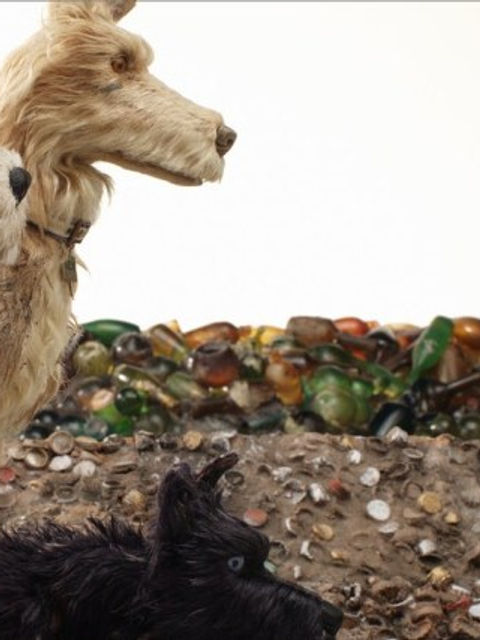
It would be remiss to neglect the meticulousness and imagination that courses through that world. Anderson’s penchant for fastidious craft is undeniably seductive, never more so than it is in Isle of Dogs, where, through rigid precision and a telescopic eye for texture (every wind-brushed follicle of dog hair is delicately grafted,) Anderson transfigures the grimiest of settings into an ornate confection for the eye. Alexandre Desplat’s off-kilter, percussive score (taiko drumming is the fabric of this melodically sparse soundscape) provides a primitive framework and drive, whilst cute visual flourishes—skirmishes rendered via Looney Tunes-esque dust clouds, for example—preserve a beguiling child-like glee.
It’s all in service of a craft which remains impenetrable however, a craft so tightly wound that the characters confined within it are forced into unbending routines from which little humanity can be distilled. There are many close-ups of tear-glazed eyes, many displays of gentility, many allusions to samurais and haikus and all manner of Japanese cultural ticks, but there is too little sincere affection behind them. Enough, perhaps, to justify Anderson’s flirtations with cultural appropriation, but never enough for the film to rival the melancholic charms of the director’s best— Moonrise Kingdom and The Royal Tenenbaums, for example. Isle of Dogs is instead an ostensible treat that proves undernourishing; all dollhouse and no dolls, all percussion and no melody, all bark and no bite.
Rating:
2.5/4

Comments