


Gujarat Travelogue – 4 : Dwarka

Hi 🙂 I hope that you have enjoyed the third part of my nine-part series on India’s western state of Gujarat. If you’re visiting me for the first time, here’s the link : Gujarat Travelogue – 3: Somnath & Diu
In this fourth part of the series, I’m covering one of the four most holy pilgrimage sites (called Char Dham) and also one of the seven sacred cities for Hindus…Dwarka, the legendary capital of Lord Krishna, located alongside the Arabian Sea on the western tip of Gujarat.
Happy reading 🙂
Friday, 30 January, 2015
8:00 am. I’m standing outside the hotel main gate looking for someone who can show me the way to the private bus stand. An autorickshaw driver comes over and offers to drop me there. The distance is hardly 100 metres and yet he asks for 20 rupees. Not wanting to hurt my trolley bag along the messy, pot-holed road, I climb in. At the bus stand, the rickshaw driver finds out if the bus to Dwarka has arrived. It hasn’t. The stand is desolate except for a small family. The lone male among them suggests to the driver that I take the non-AC minibus to Dwarka which he says will most definitely have one seat available for me. He couldn’t get seats for himself & his family in the private AC bus. On learning about the non-AC minibus service to Dwarka, I feel very relieved. Over the next few minutes, some more people arrive at the stand. When the minibus drives in, I hope for the best. Luckily, I get a window seat in the second front row. The fare is 200 rupees. The man who had suggested the minibus sits next to me. When the minibus starts after 15-20 minutes, only a few seats remain vacant at the back.
In the absence of rail link between Somnath and Dwarka, the only mode of transport is by road. It’s an enjoyable drive as it passes along the sea. After about two and a half hours, the bus makes a breakfast halt. A Narvai Mata temple stands alongside the road. Not keen on trying the food at the small roadside eatery, I buy half a dozen packs of potato chips in assorted flavours. Then I stop to watch two men preparing the deep-fried fafdas (a chick pea flour snack) which everyone is feasting on with gusto, along with fried green chillies.
After travelling around 130 kms from Somnath, we reach the city of Porbander, the birth place of Mahatma Gandhi. We pass by the Birla cement factory on the highway and get a brief tour of Porbander. Soon, the passing landscape is dotted with windmills of Suzlon Energy harvesting energy from the strong sea breeze. The man seated next to me starts taking pictures with his smartphone. After some photos of the landscape, he takes a couple of selfies. Seeing this, the bus conductor tells him to exchange seats with one of his female family members. It’s not that he was bothering me but I’m glad to see him go.
After a few kilometres, the bus makes the second temple stop at Mool Dwarka. Mool means original or root. It’s said that this is the place where Lord Krishna stopped at after leaving Mathura. Fed up of sitting for hours, I step out to stretch my legs. There are 2-3 old temples at the place where the bus has stopped. It’s 1:00 pm and I’m very hungry. I haven’t eaten anything else but potato chips. With no other option on hand, I open the second pack of chips. The third stop is at the Harsiddhi Mata Temple.
Around 2:30 pm, we reach Dwarka. I liked the Somnath Temple Trust guest house so I decide to try the Kokila Dhiraj Dham guest house here. It’s within walking distance from the bus stop, but the narrow road is rough and dusty. Tired and exhausted, I reach the place only to learn that all its rooms are booked. Being one of the four holiest pilgrimage sites for Hindus, I had expected Dwarka to be a large city. Disappointed, I start my hotel search along the dusty road till I find an autorickshaw to help me. I tell the driver to take me to some good city-centre hotels located close to the temple. This is when my nightmare begins. The driver tells me that most of the good hotels are full but checks up with a few of them. The rooms are full so we go around checking some more. One after another, the good hotels with available rooms turn out to be ordinary places with disgusting bathrooms! I really don’t understand why hotels find it so difficult to keep bathrooms clean and well-maintained. They focus their attention on the room but ignore its bathroom. As for me, I don’t mind a small (but CLEAN) room without television or AC but the bathroom has to be large and most important of all, CLEAN. I feel miserable. Here I am, in one of the most ancient and sacred cities of the country checking out the bathrooms of “good” hotels. Four of them, having rooms priced around 700-800 rupees but with yucky bathrooms. Very tired, I ask the driver to take me to the best city-centre hotel located close to the temple. He takes me to Hotel Guruprerna. It’s a nice place. The non-AC room tariff is 1200 rupees plus taxes but I get a 10% discount. My room is good with a clean bathroom. By now, it is 3:00 pm but I’m too tired to have lunch. I prefer to rest for a while. I still have a few packs of potato chips to satisfy my hunger.
The first place that I have to visit is the Dwarakadhish (or Dwarkadheesh) Temple, a Vaishnava temple dedicated to the Krishna avatar of Lord Vishnu, who is worshipped here by the name Dwarkadhish (‘King of Dwarka’). Lord Krishna is an incarnation of Lord Vishnu. There are plenty of legends connected with this temple. In addition to its temples and legends, Dwarka is also sanctified as the seat of Adi Shankaracharya (788-820 AD), one of the most revered Hindu theologians and philosophers, who established four maths (religious centres or seats) in four different directions in the country. The Dwarakadhish Temple became part of the Char Dham pilgrimage considered sacred by Hindus after Adi Shankaracharya visited the shrine. Situated on the right bank of the Gomati creek, Dwarka has a history that dates back centuries. ‘Dwar’ means door and ‘Ka’ means Brahma, the Creator. In ancient times, its flourishing port was considered to be the gateway to the main land and, hence, gateway to Moksha (Salvation). According to ancient Hindu texts, Lord Krishna settled here and made this place the capital of his kingdom after leaving Mathura. The kingdom of Dwarka is also mentioned in the ancient Hindu epic, Mahabharata. Moreover, scientific marine archaeological investigations have inferred that “there was really a city which got submerged in Dwarka in 1500 BC”. It all sounds interesting to my curious mind.
At 5:30 pm, I leave for the temple. But before that, I book a tourist car for local sightseeing at the hotel desk. Dwarka is known for temples and I intend to visit a few of them. The tourist car cost is 1300 rupees. I have to leave tomorrow for Jamnagar before noon so it’s best to start the tour very early in the morning at 6:30 am. It takes about five hours to cover all these places so I should be able to return by 11:30 am. Before starting for the Dwarakadhish Temple, I need to download my photos onto my pen drive. I get directions to a cyber café but the person in charge tells me that it’s closed. Seeing me walk out, the college kid who has shown me the place wants to know the reason. “The fellow told me that it’s closed,” I answer blandly. Hearing this, the kid gets angry. “In that case, why is he sitting inside with the door open?” I don’t know, but if the fellow isn’t interested in letting me use the computer, why should I force him to do so? That’s his loss, poor sod! In the same building complex, I find a small establishment providing digital services. But I’m shocked when the fellow inside says that it would cost me 100 rupees to transfer the photos to my pen drive. Schmuck! I have no other choice so I hand him the memory card and pen drive. I try to contain my irritation when he downloads the photos to his computer instead of doing copy and paste to my pen drive before emptying the memory card. I point it out to him and he mutters something about deleting the photos from his computer after transferring them to my pen drive. I let out a silent sigh wondering why I have to cross paths with idiotic specimens, of all places, in this sacred city. The download takes more than the normal time. Work done, I suddenly realize that I have forgotten to check whether he has deleted the photos from his computer. One never knows how people can misuse original photos. My agitated mind calms down only when my inner voice assures that if he hasn’t or doesn’t delete them he will be punished by his family deity, the goddess whose photo is the background image on his computer.
The main entrance to the Dwarakadhish temple, the north entrance, is called Moksha Dwara (Door to Salvation). It is located in a crowded market area with narrow lanes lined by shops. I soon get my first glimpse of the famed temple. The exquisitely carved tall, conical steeple of the main temple towers over the adjacent temple domes.
It’s 6:05 pm. A bright-coloured flag is being hoisted atop the temple spire of the main temple.

Like all other sacred Hindu temples which are at high risk of Islamic terrorist attacks, here too, strict security measures are put into place. Cameras and mobile phones have to be deposited in a locker before entering the temple. The temple visiting hours are 6:30 am to 1:00 pm and 5:00 pm to 9:30 pm. I have missed the 5:00 pm first evening darshan (glimpse of the deity) which attracts plenty of devotees. However, the temple sees maximum crowd of devotees during the first morning darshan at 7:00 am. I pass through security check and join the crowd of devotees and a good number of pandas (priests and pilgrim guides) inside the precinct. It’s very common to see pandas at well-known temples in the country. They offer devotees a complete tour of the temple along with its history, a quick darshan of the deity in case there’s a long queue for it, and help in conducting prayers for the devotees inside the temple. Of course, it’s not for free. I decline the offers coming my way and proceed straight to the main temple.
The lower part of the temple is from the 16th century while the soaring steeple is from the 19th century. In sharp contrast to the exquisite exterior façade, the interior of the temple is very simple. Like all other sacred Hindu temples in the country, the Dwarkadhish Temple too suffered at the hands of Muslim invaders. It was destroyed many a times but rebuilt each time. It is said that the idol of the main deity was hidden for years to protect it from Muslim invaders and was reinstalled during the 16th century after the construction of the new temple.
The one-metre tall, four-armed idol of Lord Dwarkadhish is made of shiny black stone. It’s a captivating idol with elaborate ornamentation and I find myself making a parikrama (circumambulation) of the temple more than three times just for another glimpse of the deity, giving a long, lingering look each time. At one time, I’m interrupted by a man who turns out to be the selfie-taking chap. I’m unable to recognize him at first till he goes: ”The mobile number which you gave me is missing one more digit.” Huh? I don’t believe my ears. This fellow, with whom I had exchanged just a few words, who had introduced himself without my showing any interest whatsoever in knowing him, who had asked for my mobile number which I said I didn’t carry, just wouldn’t get the message that I’m not interested in knowing him. I had been polite as he had helped me with the minibus info. I had blurted off some random numbers passing them as my contact number thinking it would be the end of the story. And now, here I am, facing the Lord, not knowing what to do. I can’t tell lies in front of the sacred idol. Finally, I give him a digit to add to the number. Well, that’s not a lie. He asked for an extra digit and I gave it to him. My inner voice screams at him silently “GO! Run after your wife!” Having got rid of him, I take another round of the temple.
The temple complex contains many shrines, of Hindu gods as well as Krishna’s main queens besides Rukmini, who is considered an incarnation of Lakshmi, the goddess of wealth and beauty. I take a quick tour of the place. When I step outside the compound wall and look up at the temple spire, I find a huge red-orange-blue flag, triangular in shape with the symbol of the sun and moon, fluttering in the breeze.

Yours truly at the temple…

The triangular flag (with the symbol of the sun and moon) on the temple top is changed at regular time intervals. When I exit the temple complex, I see a newly hoisted orange-red flag atop.
View of the Dwarkadhish Temple from outside the main gate…

I visit the Gomati Ghat (a flight of steps leading down to a river) located behind the main temple where the second gateway called “Swarga Dwara” (Gate to Heaven) stands. From here, steps lead to the Gomti creek, which is a holy place for pilgrims to take a dip in the river to get rid of sins. This is the place where River Gomati meets the Arabian Sea. Numerous small shrines can be seen here.
This is the Gomati Ghat…

The bright moon, nearing the full moon phase, adds to the beauty of the peaceful, scenic surroundings. It’s dusk and I have yet to visit the “must-see” Bhadkeshwar Mahadeva Temple which is surrounded by the sea. I hail an autorickshaw for the place. The driver gives me a surprised look. “You are alone?” Why? Is that a problem? There are hardly any vehicles on the road, which is covered in darkness. He tells me that I won’t be able to get an autorickshaw on return so I agree to a two-way ride for 80 rupees. If I had made an early start from my hotel, I would have been able to visit the lighthouse which is at the land’s end point of Dwarka. But now, at 7:15 pm, it’s closed.

The cool sea breeze is inviting. As we near the temple, I can make out the promenade and children’s park in the dark. The driver tells me that this is a popular place in the evenings with plenty of food stalls and fun activities. Reaching the temple, I see a few vehicles parked alongside the road. The temple is accessed through a long path, stepped at places, which gets submerged in water during high tide.
View of the well-lit small temple topped with flags…


The moon and a prominent star shine in their full glory in the dark sky while sea waves lash against the rocks. Such a splendid place! On the way back, I sight a few expensive-looking hotels overlooking the sea. Sigh. Anyway, my centrally-located hotel is very nice and convenient for me.
Back in the town centre, I make enquiries at a travel agency for booking tomorrow’s bus ticket to Jamnagar. I’m told that there’s just one bus company that has buses leaving for Jamnagar during the day… and its booking office happens to just opposite my hotel! I reach that place within a short while, but the man at the booking counter tells me that I’ll have to buy the ticket tomorrow. Buses to Jamnagar leave each hour. Relieved, I think about having dinner.
I’m eager to try the local Gujarati thali (Indian-style meal of a variety of dishes served on a platter… with unlimited helping!) now that I’m visiting the state. Gujarati food is a bit on the sweeter side so I usually avoid it, except for the yummy savouries. But I decide to have it tonight. The restaurant in my hotel doesn’t offer Gujarat thali so I have to look for another one. The town is full of vegetarian restaurants offering Punjabi and even Chinese food but it’s difficult to find one offering a Gujarati thali. I get a few suggestions and opt for one in a popular budget hotel.
The hotel looks okay and so does the restaurant. Soon, the large steel plate with small steel bowls is placed before me. The food presentation is horrible with some spilt buttermilk on the plate. The two vegetables that I try are so spicy that tears start rolling down my cheeks. One of the two dals (lentils) is too sweet for a second spoonful, the other is cold. Rice is served in such a shabby manner that I leave it untouched. The hot rotla was the only saving grace of the thali. Furthermore, the sloppiness of the attendant adds to my anger. The cool glass of buttermilk calms me a bit though. I pay 120 rupees for the meal and leave the place immediately. The dinner has left a bad taste in my mouth and I need to have a hot drink. I return to my hotel. The restaurant is busy. A look at the menu card shows me a variety of South Indian dishes. I’m tempted to have a masala dosa but thanks to what I have just had, I have lost my appetite for food. I ask for a glass of masala milk instead. A sip later, I wonder whether it’s milk or milk in water. By the time I retire to my room, it’s around 10:30 pm. I have to be up by 5:00 am for the morning sightseeing tour. Tired, I flop into bed.
In the course of my short stay in Dwarka, I have noted one interesting thing. Despite being the legendary capital of Lord Krishna’s kingdom, no one uses the word “Krishna” here, not even in shops and establishments. He is worshipped as Dwarkadhish (or Dwarkadheesh), Dwarkesh, Dwarkanath, Dwarkapati, etc. but not Krishna.
So here, it isn’t Jai Shree Krishna but Jai Dwarkadhish…
Saturday, 31 January, 2015
It’s 6:30 am and I’m still waiting for the tourist car. It arrives after fifteen minutes. I was planning to reach the first stop, a nearby Sun Temple, before sunrise. The temple isn’t known to many. I had learnt about it on an online travel forum. After a few kilometres, the 20-something driver tells me that he has never heard of the temple so he calls up a friend. By then we have already passed the place and have to turn back. Idiot! And I was told that the driver knew the place! Luckily, the place is not far so we reach before sunrise. It feels good to be in this quiet and peaceful place. Outside the Sun Temple, there’s a small temple of Lord Shiva in the middle of a water tank.
When I enter the small Sun Temple, I’m the only person around. A little later, the temple priest emerges from a room. And then, a youngster enters with drums, followed by a female devotee. At sharp 7.00 am, the priest draws aside the curtain and I get to see the deities. They are identical to the three deities (Jagannath, Subhadra and Balabhadra) of the famous Jagannath Temple in Puri, on the opposite end of the land. The aarti begins. After sunrise, the sky brightens for me to take pictures.
The Sun Temple…

The temple of Lord Shiva…

The next stop is the Nageshwar Jyotirlinga, about 10-15 minutes away. It is one of the 12 jyotirlinga (essence of Lord Shiva) shrines.
This tall statue of Lord Shiva dominates the temple complex…

I see pigeons everywhere. The floor of the temple complex is littered with their poop so after removing my shoes, I gingerly walk barefoot until I reach the entrance door. I’m among the few early arrivals at the temple. So I get to spend a good deal of time in the inner sanctum. Unlike other Shiva lingas, this linga is made of Dwaraka Shila, a porous stone marked with small wheels, found in the Gomati creek. The shape of the linga is different too.
The morning landscape looks glorious…

On the way, I catch a view of Mithapur, the industrial township of Tata Chemical Ltd. The third stop of the temple tour is at Gopi Talao, which is five minutes away. Gopi Talao is a place of religious importance and is mentioned in Hindu mythology and legends. The talao (pond) is a natural pond.

When the pond dries up in the summer, the soil is collected and turned into clay stones which are purchased by pilgrims as Gopi Chandan. These are considered auspicious for religious use and also sold as face packs. One of the girls tries to sell me a packet of it but I move away.
The fourth stop of the tour is ten minutes away at Okha Port, the land’s end on Saurashtra (or Kathiawar) peninsula. Primarily engaged into fishing, it is mostly visited by pilgrims proceeding to Beyt Dwarka (or Bet Dwarka or Bet Island), the island residence of Lord Krishna and his family. This is where I’m going too. The jetty is crowded with pilgrims from all over the country. Soon, I’m aboard one of the crowded ferry boats surrounded by noisy seagulls. It’s very entertaining to see them catch the food thrown towards them. When the boat starts, they follow us for some time and then drop off.


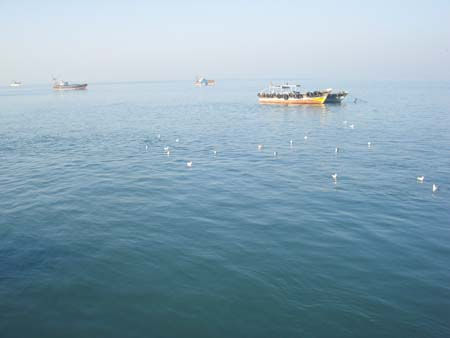
After a 25-minute ride, we reach the island. Here too, we are greeted by seagulls. Beyt Dwarka is known for the old temple of Lord Krishna. It is said that this is the place where Krishna met his childhood friend Sudama. It is also said that Krishna used to conduct the administration of his kingdom from Dwarka while he resided with his family in Beyt Dwarka. Right now, all that I can see from the jetty is a disorganized growth of ugly, dilapidated buildings spread around the island. Soon, I find myself among the crowd of pilgrims walking away from the jetty in the direction of the temple. Not knowing its location, I hail an autorickshaw which looks quite big for the narrow road. It turns out to be a quick ride of less than a minute!

It’s 8:50 am. The temple complex is filled with pilgrims, mostly from faraway villages across the country. Cameras and mobile phones have to be deposited at a counter before entering the temple. One of the pandas (priests) gathers everybody around, including me, and leads us into a room. There, he starts off with legends and stories of the temple and ends up talking about voluntary donations. A higher amount of donation results in higher benefits for the temple and temple priests as well as for the donors and their families. I leave the place and wait at the main temple where the deity is hidden behind a curtain. After a long wait, I finally get a glimpse of the deity when the curtain is drawn aside and the aarti begins. Later, one of the pandas gives me a quick tour of the cluster of old small temples. He said it was a free service. At the end of it, he says that if I feel like it, I can make a small donation to the temple fund. But I’m just a budget traveller, so maybe next time…
Forty minutes later, I’m back at the jetty looking for a ferry to Okha. The jetty is full of locals from the island, which is vastly dominated by Muslims engaged in fishing. Like me, there are a couple of visitors looking for a return trip. Boats are aplenty, but the boatmen tell us that those are available only for the islanders, not visitors. Such a disorganized place! A family of 5-6 members pays five thousand bucks to a boatman to ferry them to the other side! After spending half an hour in vain, we manage to convince one fellow who charges 20 rupees per passenger (instead of the normal fare of 10 rupees). We happily board the boat thinking it will leave immediately. But the boatman waits till the boat is full, by which time it’s almost 10:30 am.


Reaching the port, I hurry towards the car park. The driver has gone off for a drive instead of parking the car. What the…! I take a slow, deep breath and then call up the twerp, who comes after ten minutes. It’s 11:00 am. The last stop of the tour is half an hour away….the Rukmini (or Rukmani or Rukshmani) Temple dedicated to Krishna’s wife, Rukmini.

Rukmini Temple is a beautiful 1600 year old temple located in a deserted area. Its intricate carvings have made it a nationally protected monument. After the temple visit, I start for The Grand Thakar restaurant.
Someone had recommended the delicious Gujarati thali served at this restaurant. The thali service is available only at lunch time. Since it’s almost noon, I decide to check the place right away. The hotel housing the restaurant looks good and so does the restaurant. The staff is friendly too. Very soon, food is served. One after another, I tuck in yummy savouries like dhokla, bakarwadi, etc. and sweet delights like puran poli and basundi. The attendants describe each item before placing it on my plate. I can see that it’s not authentic Gujarati food. It’s fusion cuisine incorporating Maharashtrian, Rajasthani and Punjabi dishes to cater to customer tastes. The vegetables are similar to the ones I had last night but they taste good today even though they are spicy. I’m told that customers generally don’t like eating food on the sweeter side so they make the vegetables spicy. I douse the fire in my mouth with two glasses of delicious buttermilk. After one rotla, I have no place in my tummy to try other items. The unlimited food is absolutely delicious and value for money at just 166 rupees including mineral water. While leaving, the hotel owner happens to be around. He recommends a few good hotels at some of the places that I’m going to visit on my trip.
When I return to my hotel, it’s 12:30 pm. I checkout from the hotel, walk across the road to the bus booking office and get a front row ticket for the 1:30 pm AC bus. The fare is 200 rupees. It’s a three-hour journey to Jamnagar which is 148 km away. I should hopefully reach there by 4:30 pm.
After a few minutes, the bus journey begins…
Coming next:Gujarat Travelogue – 5 : Jamnagar

Comments