


Grafting

Our last article was about Pruning. Another task we have been doing this spring is Grafting.
Grafting, which is carried out in very early spring, is the technique where the tissue of two plants (in our case apple trees) are physically joined, and therefore grow together. Grafting is used to asexually propagate apple trees, and is the only way to propagate an apple variety that will actually bear the true variety. (If you grew the pip of an apple it’s fruit would not be the same variety and in most cases would taste horrible.) In fact if it wasn’t for grafting, fruits such as apples and cherries would never have been domesticated in the way they have been!
With apple trees, and most other cases, one plant is selected for its roots and this is called the stock or rootstock. The other plant is selected for it’s fruit and this is called the scion or cion. The scion (usually a short length of one year old growth) is then attached to the rootstock so that the Cambium layers (this is the part between the bark and the wood) are touching and the join is covered with tape or wax to protect it. A few weeks later, if the graft has ‘taken’, the buds will start to break on the scion and it will have become part of the tree. There are different techniques used depending on the thickness of the wood used and desired effect. (see photos below for some examples)
All of our trees (and the apple trees you buy in shops or from nurseries) are grafted: a variety e.g. Cox’s Orange Pippin is grafted onto a Rootstock such as MM106. The variety produces a good yield of tasty good-sized apples and the rootstock is strong, good at growing in particular soils and makes the tree reach a desired height. By selecting a different rootstock you can get a bigger or smaller tree, for example an apple on MM106 will grow 4-5 meters high, whereas that same variety on an M26 will produce a tree of around 3-4 meters.
This season we were grafting for two different reasons however. One was to propagate new trees for people; we dug up rootstock that we have growing in the orchard, potted it up and then grafted selected varieties onto it. The other reason was to change a variety over on an existing tree and this is called topworking. Topworking is a good way of getting more trees of a desired variety without having to propagate new trees from scratch. Once the graft is complete you will have two different varieties growing on one tree and you can then prune back the old variety and let the new one gradually take over. In fact it is possible to grow up to six varieties on one tree at the same time! Below you can see some examples of our grafting from this season and two seasons ago.
With regards to the current weather in our area, the drought may have a detrimental effect on the success of any attempted grafts, and even if they do take they may struggle to put on growth. Simply because there is not enough moisture in the ground.

These are some grafts in pots, the rootstock was dug up from the orchard and different varieties have been grafted on to them.

A Cleft graft from this spring. Cleft grafting is where the rootstock branch its slit down the middle, the scion is cut into a wedge and slotted in until tight.

A type of Veneer (or Bark) graft, a triangular slot is cut out of the bark and cambium layer, the scion is then cut to shape and pushed into the slot.

Side graft: a slit is cut into the side of the trunk and the scion slotted in. This is useful for when there isn't an appropriate branch to use.

Two whip and tongue grafts, the scion and stock have corresponding notches cut in them so they fit together, this technique can be very succesful as it increases the amount of cambium layer touching.

A very successful graft of Arthur Turner on White Transparent which was done 2 years ago.
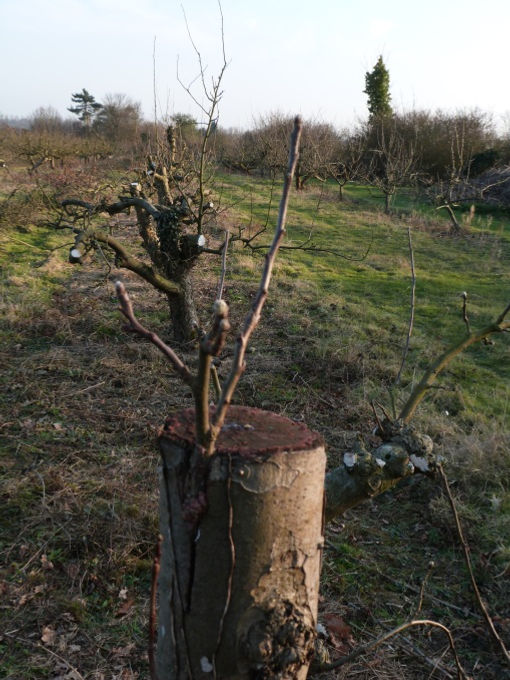
A graft which has taken from two years ago, but has not put on any growth (probably because of dry weather)

Comments