


Ford Dabney and the Story of “Shine”

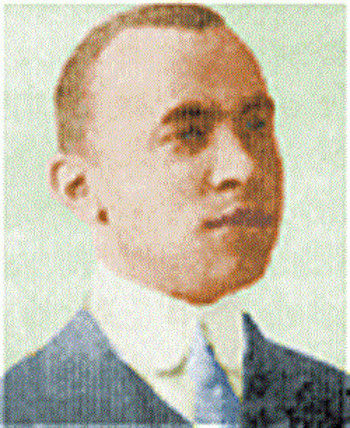
Ford Dabney (1883-1958) was an African American composer, pianist, and bandleader of the ragtime and early jazz eras, best known for writing the tune to the song “Shine” a.k.a. “That’s Why They Call Me Shine”.
A native of Washington DC, Dabney studied music there and in New York City. He was working as a piano player at society gatherings and private parties when he was hired to be the official in-house pianist to the President of Haiti, a post he held from 1904 through 1907, with trips to France and Germany as one of the perks. After returning to the States, he began writing music for the theatre. Most notable was the 1909 Sherman H. Dudley show His Honor, the Barber, which introduced the song “Shine”.
In 1910, he founded Ford Dabney’s Theatre in Washington, DC, and sent out vaudeville companies on the road, including Dabney’s Ginger Girls. The talent bureau he started lasted for decades. He was a founding member of the Clef Club and a close collaborator of James Reese Europe, including his accompaniments to Vernon and Irene Castle (until the deaths of Vernon Castle in 1917, and of Europe in 1919). From 1913 through 1921 he played several seasons with Ziegfeld’s Midnight Frolic on the Amsterdam Roof. With his band, variously named Dabney’s Syncopated Orchestra, Dabney’s Band, et al, he made numerous recordings between 1917 and 1922. You can hear them on the 48-track Archeophone Records releaseFord Dabney: After Midnight.
In 1927, Dabney wrote the music for the Broadway show Rang Tang, with Miller and Lyles, Mae Barnes et all. He joined ASCAP in 1937, and continued to write songs, operate his talent agency and play at society parties through the end of his life.
But the tale of his song “That’s Why They Call Me Shine” (later simply “Shine”) is worth telling on its own account. Co-written with Cecil Mack and Lew Brown, it was introduced by Aida Overton Walker in the 1909 show His Honor, the Barber. Some have speculated that the song was inspired by a gent who was with her husband George Walker when the two were nearly killed in a 1900 race riot. Here are some of the notable versions, recordings, and performances (out of nearly 700):
California Ramblers (1924)
Jesse Stafford and His Orchestra (1928 movie short)
Louis Armstrong (1931 recording and 1932 film short Rhapsody in Black and Blue, as well as a 1942 short)
Bing Crosby and the Mills Brothers (1932). Bing also sings it in Birth of the Blues (1941)
Frank Sinatra with the Hoboken Four on Major Bowes’ Amateur Hour (1935)
Ella Fitzgerald (1936)
Jay C. Flippen (1936 film short Flippen’s Frolics)
Dave Apollon and His Orchestra (1938 film short)
Dooley Wilson in Casablanca (1942)
Buck and Bubbles in Cabin in the Sky (1943)
Harry James plays it in The Benny Goodman Story (1957 — the single had been released a decade earlier)
It’s also used in The Eddy Duchin Story (1956), Nickelodeon (1976) and the Woody Allen films Wild Man Blues (1997) and Sweet and Lowdown (1999).
For more on vaudeville history,please read No Applause, Just Throw Money: The Book That Made Vaudeville Famous.

Comments