


For World Orca Day: On Orcas in the Show Business


July 14 is…yes, Bastille Day and World Chimpanzee Day, I know, but it is also World Orca Day. We used to call them “killer whales” but people objected to the false, negative impression the name created. Indeed, orcas are apex predators, but in the wild, believe it or not, there are no known instances of them killing people, so why demonize them? Humans have a tendency to exterminate animals they consider a threat, and orcas are not a threat. (Yet. Mwahahahahaha!)
You may be surprised to learn that the exhibition of trained orcas in aquatic theme parks is quite a new phenomenon. I was a child when it just taking off at Seaworld and other theme parks. For some historical background, P.T. Barnum had exhibited beluga whales at his American Museum in the mid 1800s; they perished in one of his fires. In 1895 Captain Paul Boyton founded the first aquatic amusement park Sea Lion Park in Coney Island. Marineland of Florida, the first such park to exhibit dolphins, opened in 1938.
The first orca to be captured and studied in activity was not until 1964. It wasn’t until the 1970s that Seaworld and other parks really began leaning into training the creatures to do circus type tricks and stunts for fun and profit. The public has been arguing about it pretty much ever since. Like all animals, orcas like and need to roam free throughout spaces vastly larger than the enclosures humans put them in. And while their exhibitions are impressive and entertaining, the intelligence of orcas also means that they are independent and unhappy about being forced into unnatural, regimented behaviors. The few humans that have been killed by orcas (four, at this writing) happened to be in a pool or tank with disgruntled, stressed out captives.
At any rate, the small handful of films highlighted below are a good gauge of changes in public attitudes towards orcas over the decades. There are many, many more documentaries on the subject of orcas, but we don’t want to stray too far off mission here!

Namu (1966)
Namu was the fourth orca ever captured; he had the bad fortune to get caught in a fisherman’s net. He became an attraction at an aquarium in Seattle. A female, Shamu, was captured to be his companion. Neither one lived long in captivity, although subsequent orcas were named Namu and Shamu much as there have been many Lassies, Cheetas, and so forth. When I was a kid, these were the famous orcas. At any rate, the original Namu was the centerpiece of this fictional movie starring Robert Lansing, who plays a marine biologist who gets to know this captured cetacean that is misunderstood by local fishermen and townspeople but is only just mourning the death of its mate. The film was renamed Namu, My Best Friend, to better reflect the spirit of the movie. It is very much like the movie and TV series Flipper (1963, 1964-67). Others in the cast included John Anderson, Lee Meriwether, and Joe Higgins.

Orca (1977)
A delightful and scurrilous piece of Dino di Laurentis nonsense, patently designed to capitalize on the success of Jaws. Here, another orca is mourning its mate, but becomes enraged and seeks revenge. It’s essentially a superstitious horror movie. The screenplay fills me with glee it is so preposterous. A minor hit of the day, it starred Richard Harris as the fisherman hero, Charlotte Rampling, Keenan Wynn, Bo Derek, Robert Carradine, Red Barry, and Native American actor Will Sampson, fresh off of Cuckoo’s Nest, who gets to utter one of my favorite painful lines of all time. Cetologist Rampling and Harris are talking on the beach and Samson materializes from out of nowhere like a spirit and say: “It’s true! You may know it from your science — we know it from our traditional ways.” Or words to that effect. Native Americans of both coasts have long revered and mythologized the orca. But this is Tonto stuff.

Almost as though to balance out the public conversation that year, orcas are actually the heroes in this even sillier Italian-made horror movie (also a Jaws ripoff), which I wrote about here.

Free Willy (1993) and sequels
This mega-hit about a boy who frees an orca from a run-down aquatic park is largely credited with turning around public attitudes about captive orcas. It was followed by sequels in 1995 and 1997, and a reboot in 2010. The orca star of the film Keiko was released in 2002 and, ironically, died a year later.
OTHER: Two recent orca appearances on television shows are what prompted me to create this piece, the latest of several animal themed posts we have created.

On the 2023 German series The Swarm, a pod of orcas goes berserk and massacres a boat full of whale watchers. Before you get your pants in a bunch about the slander, you should know that on this show ALL the sea creatures have it out for humankind, right down to lobsters, barnacles, and micro-organisms. Then:
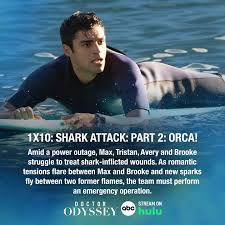
Ryan Murphy’s cheerfully terrible series Dr. Odyssey has just been cancelled but I still may have to write about it at some point, because it is extraordinary in so many ways, though that adjective implies no superlatives. At any rate, in one of the episodes, the ship’s skeleton crew becomes endangered when it is repeatedly rammed by a pod of angry orcas. The plot was clearly inspired by a recent rash of attacks (quite a few, in fact) off the coast of Iberia. Naturally those attacks have been against much smaller vessels, where they can, in fact, potentially be quite dangerous (though no one has even been injured to date). Be that as it may, the idea of orcas actually harming one of these giant multi-story cruise ships, which are like floating cities, is laughable. But honestly not any more so than the premises of any of the other episodes of this damn show.

Comments