


Emmett Miller: Missing Link


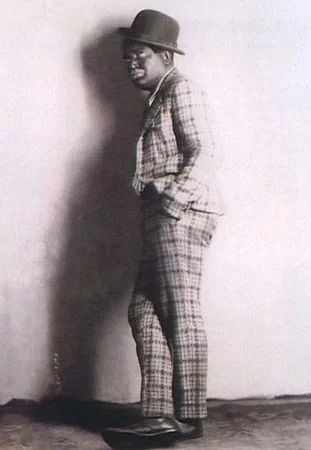
I chose the photo above to head this post on Emmett Miller (1900-1962) because it’s the one I could find that will be least offensive to modern sensibilities. Notwithstanding, Miller was an extraordinarily influential figure, if indirectly, particularly on country music, though he himself figured in early jazz, blues, hillbilly, and pop, performed in vaudeville and minstrelsy, and may indeed be America’s last major blackface minstrel. We don’t condone the practice, but it’s history and must be reported.
Some have called Miller the most important white male blues singer, and he came along decades before Elvis Presley. He’s most notable as the guy who introduced that yodel-sounding falsetto whoop you hear in songs by the likes of Jimmie Rodgers and Hank Williams (e.g. “Lovesick Blues”, Miller’s version of which Williams covered). Bob Willis and The Texas Playboys’ version of the familiar “I Ain’t Got Nobody” also apes Miller’s. A much more recent imitator of his style is Leon Redbone. (As many have pointed out, the yodel-falsetto gimmick predates Miller as well. No doubt it is as old as music itself. But in a concrete way, Miller influenced those above named singers who brought it to popular attention).
Miller was from Macon, Georgia and got his start with Dan Fitch’s Minstrel Troupe when he was only 16. By the mid ’20s (just about a century ago) he’d made it to New York where he performed in vaudeville with the likes of Ukulele Ike, Cliff Edwards. Edwards is said to have got him his deal with Okeh Records. Miller recorded over 20 sides for the label. In addition to ones we already named were “Anytime” (a hit for Eddy Arnold in 1947), the “St Louis Blues” and even some minstrel show comedy bits. His back-up musicians included such future greats as the Dorsey Brothers, Eddie Lang, and Gene Krupa, your signal to the fact that there was a hot jazz element to these recordings, which in the long run proved so influential on country music. He called his band the Georgia Crackers.

Yet this innovator, who made such a mark on the styles of the future was stubbornly old fashioned. Rather than pursuing opportunities in all the new-fangled media that was exploding at the time, he ended up returning to his roots, headlining with Al G. Field’s Minstrel Company in the late ’20s, and continuing to tour with his own shows into the 1950s, still rocking blackface routines. In 1949 he toured with his own minstrel show, called Dixieana. In 1951 he even appeared in a film called Yes, Sir, Mr. Bones with Kathleen Freeman, Cotton Watts, and Scatman Crothers that was a tribute to old-time minstrel shows. The South was still in the grip of Jim Crow, private clubs were still segregated in the North, and Amos and Andy was still on television, but this was still very late for this kind of thing. But this was his act until the end of his life. He is said to have died penniless, while guys who had plundered his act made a mint in the recording business, in live performance, from radio airplay, and television bookings.
This article by Charles Wolfe on Emmett Miller was the best one I could find on the internet. Other recommended sources include Jack Norton’s book Emmett Miller: An Obscure Minstrel Yodeler Who Changed Music Forever, and the 1996 compilation CD Emmett Miller: The Minstrel Man from Georgia.
For more on vaudeville in general please consult No Applause, Just Throw Money: The Book That Made Vaudeville Famous.

Comments