


Discovering Sacred Destinations in India – V: Pandharpur and Tuljapur

Hey guys 🙂 Hope you’re doing gr8 🙂 It’s been a long while… almost six months since my last post so I hope I have been very much missed 🙂 😉 🙂
With 2025 being less than two weeks away, here’s wishing you a wonderful new year full of health, happiness and prosperity 🙂 Besides, you will already feel blessed after reading this divine post of mine 😉
So this fifth part of my “Discovering Sacred Destinations in India” is about my religious travels in the last week of July 🙂
If you’re my first-time reader, here are the links to the earlier parts:
While most of my travels in the last few decades have been solo adventures, my visits to the holy destinations in my home state of Maharashtra have always been family trips. We have been to most of them, but somehow, two major ancient temple towns remained pending for a very long time. Pandharpur and Tuljapur. Finally, I got my calling and visited these holy places in July 27-30, 2024, with my eldest sister Shilpa 🙂
Here’s my story… happy reading 🙂
A major holy place in Maharashtra, Pandharpur is famous for the 12th-century Shri Vitthal Rukmini Mandir, dedicated to Lord Vitthal, one of the many forms of Lord Vishnu.

Shri Vitthal or Vithoba is the ‘kuldevta’ (guardian deity) of Maharashtra.
Tuljapur is well-known for the famous 12th century Shree Tulja Bhawani Mandir dedicated to Goddess Bhawani (an avatar of Goddess Durga). The temple is one of the four ‘Shakti Peethas’ in Maharashtra and one of the fifty-one ‘Shakti Peethas’ of Hinduism.
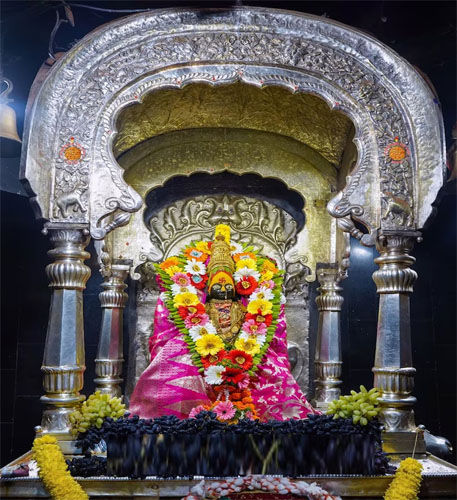
‘Shakti Peethas’ are places of worship consecrated to the goddess Shakti or Sati, the female principal of Hinduism and the main deity of the Shakta sect.
Goddess Bhawani was the ‘kuldevi’ (ancestral tutelary deity) of the 17th century founder of the Maratha kingdom, Chhatrapati Shivaji Maharaj. He frequently visited this ancient temple to seek her blessings. Legend has it that the goddess gifted him the ‘Bhawani Talwar (sword)’ to establish ‘Hindavi Swarajya’ (self-rule of Hindus).

During his reign, both temple towns faced large-scale attacks and temple desecration at the hands of the Mughals led by Aurangzeb.
The term ‘Hindavi Swarajya’ attributed to Chattrapati Shivaji Maharaj came into widespread use after his death. But the term was referred to as Swarajya only, without ‘Hindavi’, which was replaced by ‘Maratha’.
So the two temple town are of highly religious as well as historical importance.
Related posts:
Just a few days prior to our trip, the ancient holy ‘Ashadi Ekadashi’ pilgrimage to Pandharpur had concluded so we expected less crowd on our visit, which we fixed on a Monday.
It was rainy season, which is not all that good for travelling to small towns due to risk of heavy rains and flooding. But then, I didn’t want to delay the trip, which was pending since a couple of years. A few days later, it would be the month of Shravan, when religious fasting is observed and festive days are frequent. After that, there were various festivals and then, the ‘Shraadh’ period.
Normally, Hindus don’t visit temples during the 15-day ‘Shraadh’ period, which begins after the end of Ganesh Chaturthi festival (in September), and concludes before the start of Navratri festival (in October). During Shraadh (or Pitru Paksh), Hindus pay tribute to their dead and departed loved ones and ancestors by performing specific rituals. Once the Shradh period gets over, people flock to the temples. Thereafter, the Pandharpur temple attracts huge crowds. So we had chosen the perfect time.
Both Pandharpur and Tuljapur are close to Solapur, which is located in the south-western region of Maharashtra. Pandharpur is 80 kilometres by road from Solapur and Tuljapur is 45 km from Solapur.

Besides these two temple towns, we also visited Akkalkot, which is 40 kms from Solapur. Akkalkot is widely renowned for its connection to Shri Swami Samarth Maharaj, the powerful 19th century spiritual master of the Dattatraya sect, who settled in this town in 1856 until his death in 1878.
My travel story…

On Saturday night (July 27), we boarded the Siddheshwar Express at Chattrapati Shivaji Maharaj Terminus departing at 10:45 PM for Solapur. Solapur is 410 km from Mumbai, so it’s a very long road journey. With no airport in Solapur (the new airport was inaugurated only a month later in September), this train journey was convenient… go off to bed when the train departs and wake up just before the destination arrives.
Solapur
Solapur is a hidden gem with a unique charm. A historic city, land of cotton mills and small-scale industries, and one of the largest and fastest-growing cities in Maharashtra. It has a significant place in the annals of Indian history and is popular among tourists for temples and ancient sites. It is blessed with a rich heritage of history, culture, spirituality, and natural beauty. And that includes ancient sacred temples, historic forts, serene lakes, gardens and wildlife sanctuaries, thriving textile markets, etc.
There is lots to explore in this vibrant city which was ruled over by various ancient dynasties such as the Andhrabhratyas, Chalukyas, Rashtrakutas, Yadavas and Bahamanis. It was called ‘Sonnalage’, an old Kannada name, which came to be pronounced as ‘Sonnalagi’ until the times of the Yadavas. Thereafter, according to a 13th century Sanskrit inscription, the town was known as Sonalpur. British rulers pronounced the town as Sholapur and the name remained as such.
Solapur is the home of Handloom and Power-loom weaving industry in Maharashtra. It has the world’s second-largest and Asia’s largest spinning mill. Its ‘Chaddars’ (a type of textile known for its unique designs and vibrant colours) and home textiles are well-known and also exported to various countries in the world. “Solapuri Chaddar” is the first product in Maharashtra to get a geographical indication (GI) tag – a sign used on products that have a specific geographical origin and possess qualities or a reputation that are due to that origin.,
The city houses the National Research Centre on Pomegranate (NRCP). Pomegranate farming is done on a large scale in the region.
Maharashtra’s first waste-to-energy electricity plant is situated in Solapur. Furthermore, the Raichur-Solapur Power Transmission line suffices the power grid accessing need of the neighbouring southern states of Karnataka and Telangana.
Most of the local population follow Marathi culture and tradition, but the cultural impact of neighbouring states such as Karnataka and Telangana is prominently visible. So it is a regional blend of Marathi, Kannada and Telugu language speakers.
Besides ancient Hindu temples, Solapur also has many famous Jain temples with beautiful architecture such as Parasnath Jain Temple, WIT Jain Temple, Mallikarjuna Jain Temple and Adinath Temple.
Sunday, 28th July 2024
The train reached Solapur at 6:10 AM. The hotel that we had booked was close by so we took an early morning walk instead of an autorickshaw ride. Google Maps came in handy. Being a Sunday and an early hour, the road was mostly deserted.
Hotel Naman is a nice place in a quiet, residential locality. They have an in-house restaurant, only for guests. At the hotel desk, we booked a tourist car for the next day’s temple tour. The tariff was 3600 rupees for 300 km, which covered both Pandharpur and Tuljapur. Above 300 km, the charge was 12 rupees per kilometre.
At 10 AM, we left for city sightseeing. The Solapur Municipal Corporation was just around the corner. A beautiful building built in 1949…

This beautiful edifice was built by Rao Saheb Mallappa Warad (born in 1851), one of the prominent leaders of Solapur, a very close associate of Lokmanya Tilak and one of the ten members of ‘Chamber of Merchants’ under Queen Victoria. It was his wish that the building (also called Indra Bhawan which means ‘Abode of Lord Indra’) should be used for some public purpose and thus it was made the municipal corporation.
Rao Saheb Mallappa Warad is recognized for introducing innovative agricultural techniques in farming. He was one of the first to bring the farming tractor to India.
A Tata Marshall tractor of that era…

Late-evening view from our hotel room… the Indian tricolour fluttering in the wind atop the Solapur Municipal Corporation building 🙂
Solapur has a unique place in the history of Indian Independence Movement. The district enjoyed full freedom during British rule until 1930, when in the first and only event of such kind throughout British India, the freedom fighters of Solapur hoisted the national flag on its Municipality building. This happened on April 6, 1930.
Thus Solapur Municipal Corporation became the first in the country to hoist the Indian National flag on a Municipal Corporation building.
Solapur also became recognized as “The City of Hutatmas (Martyrs)”. Here is the reason…
On 4th May 1930, the British Government arrested Mahatma Gandhi on the day of his planned Salt Satyagraha to Dharasana Salt Works in Gujarat. In protest, Solapur’s textile mill workers went on strike. On 6th May, a complete bandh was called by the workers. The British imposed martial law to control the situation.
Then, on 8th May, a huge protest procession started in Solapur. Several protest rallies took place that day. At one such rally, the British police resorted to firing in which several people were killed. Following this, an unidentified angry mob attacked and set on fire a police station and a court building. It resulted in the death of two policemen.
On the night of 12th May, four young and prominent social and political leaders of Solapur were arrested. Mallappa Dhanshetti, Jagannath Shinde, Shrikisan Sarda and Abdul Rasul Kurban Hussain. All four were active in the freedom movement but had nothing to do with the mob attack incident.
Mallappa Dhanshetti was an influential political worker of Solapur.
Jagannath Shinde was the Secretary of Solapur’s Youth League. He worked for the cause of railway and mill workers, strived for education of the poor and enthusiastically organized public festivals such as Ganeshotsav and Shiv Jayanti celebrations.
Shrikisan Sarda belonged to a wealthy family of merchants and financially helped in many religious and social causes. He provided financial support to wrestlers and public servants. He participated in public meetings as a citizen but never presided over any event, thereby maintaining a fine balance between his social work and business.
Abdul Rasul Kurban Hussain was a journalist and advocated for the cause of textile mill workers. He had tremendous zeal for Hindu-Muslim unity.
Many people saw the four in a bleeding state when they were driven around the city in an open truck with their backs tied together. They were brutally tortured by the police. The British Collector Knight deliberately fabricated evidence against the four and implicated them in the police death incident. Twelve false witnesses stood against them. During the trial, Judge Wadia did not allow the accused party to cross-examine the witnesses and did not allow any of the accused to cross-examine the witnesses. The lawsuit was just a farce. The case was settled within a month of the incident.
On 5th June, all four were sentenced to death. A week before the verdict was announced, Collector Knight had written a letter to his superiors seeking permission to hang the accused in a public place to intimidate the citizens. The four patriots were hanged on 12th January 1931 in the Yerawada prison, Pune.
Every year, during Makar Sankranti festival on the 12th, 13th, and 14th of January, Solapur’s iconic Shri Siddheshwar Temple celebrates a 400-year old tradition of Gaddyachi Yatra (Fair).
The British administration chose the first day of this local fair with the vicious intention of insulting the local people and making them learn a lasting lesson.
Shri Siddheshwar is the gramadevata (or deity) of Solapur. He was a 12th century Kannada saint and devotee of Shri Mallikarjuna of Sri Sailam. He attained divinity through his selfless service to society over the years.
He built the Siddheshwar Mandir in the midst of a large lake that he constructed with the help of devotees to solve the drinking water problem of the area. The temple is sacred to Hindus and members of the Lingayat faith.
Situated in the middle of a beautiful lake, Siddheshwar Mandir is ranked as the most picturesque tourist place in the entire city of Solapur.
Being in the heart of the city, this iconic temple was within walking distance from our hotel.
Shri Siddheshwar attained ‘Samadhi’ (final resting place) at the temple site in 1167 AD and as such the location is revered by devotees.
The holy saint is attributed to having installed 68 Shiva Lingams in the main courtyard; the Amrit (immortality) Lingam being one of them.
The temple complex has small shrines devoted to Lord Ganesha, Lord Vitthala (or Vithoba) and Goddess Rukmini (or Rakhmai).
The shrine of Vithoba…

Siddheshwar Mandir draws thousands of devotees and tourists from all over the country during its grand fair held at the time of Makar Sankranti festival in January.
The temple and lake have been administered since 1899 by the ‘Shri Siddheshwar Devasthan Panch Committee’ It is one of the oldest charitable trusts in Maharashtra and does comprehensive work for the society. Its sole purpose is to uplift people from poverty, empower women, eradicate illiteracy, promote public health and comfort and further religious activities and other charitable work, which it has been doing since its inception.
The trust’s first founder president was Shri Bandappa Kadadi. Later in 1958, his son Shri Appasaheb Kadadi became the trust’s president. He was the moving spirit behind the numerous religious, social, educational, co-operative and medical institutes.
The spiritual atmosphere combined with the serene lake surroundings makes the temple visit a beautiful experience. It also offers an enjoyable boat ride in the lake and a quiet stroll around. Furthermore, the temple complex is beautifully lit in the evening.
Ducks…

An ancient looking temple top..


Next place to visit was Bhuikot Fort, also called Solapur Fort, which is located on the banks of Siddheshwar Lake. It’s an important historical monument dating back to 12th century AD.
The fort entrance ticket of 20 rupees per person has to be paid via UPI only i.e. instant mobile payment.
As per information displayed on the board, Solapur Fort was built by Adilshah of Bijapur in 1656 AD. It was occupied by the Marathas led by Chhatrapati Shivaji Maharaj in 1668 and later by the Nizam of Hyderabad. It was built oblong-shaped and fortified by double row ramparts and wall with a 30m wide moat surrounding the fort on three sides.
The lush greenery inside was very welcoming…

Centuries-old banyan tree…

Centuries-old Shri Kapilasidhha Mallikarjuna Temple in ruins…

There are some small shrines too inside the fort complex.
The fort showcases medieval architectural brilliance and retains its historical charm even though some parts of it have weathered over time.
Walking through its high walls and towers gives a feel of the bygone era.

At Elephant Gate…


Doggie looking out of the window…

The view from the higher points of the fort offers panoramic vistas of the surroundings. Tempted, I climbed up the narrow steps for a panoramic view from one of the fort bastions.
The flag bastion provided a fabulous view of Shri Siddheshwar temple…


The fort is spread over a large area and is a great place to enjoy a quiet afternoon.
Yours truly…

I took the opportunity of ‘earthing’ myself on the inviting greenery. It felt gr8!

After going through some online food reviews, we went to Brahmand restaurant which served local cuisine. It was 5-10 minutes away by autorickshaw. The driver wasn’t aware of the place so we took the help of Google Maps, which saved our time and money.
We had Methi Lasun (garlic and fenugreek leaves), Jowar Bhakri (flatbread made of jowar), Mirchi Thecha (a spicy green chilli condiment) and Khava Poli (flatbread stuffed with dried evaporated milk solids). Yummmm 🙂
Solapur is the home of Handloom and Power loom weaving industry in Maharashtra. As such, it is famous for its textile industry, particularly its Chaddars and towels, which are famed for their quality across India. Popular shopping places are Pulgam Textiles, Gangji Textiles, Chilka Textiles, Chatla Saree Centre, V.R.Pawar, Bharadiya Sarees, etc.
After a brief rest at our hotel, we left for shopping in the evening. Solapur is synonymous with cotton home textiles. Bed linen is the most popular product. Navi Peth is the main market place. There were shops everywhere, selling all kinds of stuff. V.R. Pawar Sarees at Chati Gully was highly recommended to us. It was night time and the place was a bit away so we took an auto rickshaw. At the entrance of the 5-6 storied ‘V.R. Pawar Sarees’ building, there was a large footwear stall for customers. Still, hundreds of shoes and slippers were lying around near the entrance. Inside, each sprawling store level housed a specific category of textiles. Cotton saris on one level, wedding saris on another, and so on. The marble flooring was covered with white cotton mattresses for customers to sit and make their selection in comfort while the sales staff laid out a number of varieties of the required material before them. The store was running a discount, hence the huge crowd. We bought two lovely saris and white embroidered cotton fabrics at a great price.
Outside, one of the friendly drivers at the auto-rickshaw stand suggested a popular textile shop to visit before returning to the hotel. He told me it was one of the best places to shop for textiles.
On seeing the name of the store, I immediately recognized the brand as one of the oldest and most trusted for quality. Gangji Textile is a popular household brand and I have known it since childhood. Its colourful Chaddars are well-known everywhere. We bought two best quality and super soft white pure cotton bed sheets.
On the way back to our hotel, we passed a small temple alongside the road. A fleeting glimpse of the beautiful idol of Lord Ganesh had me ordering the driver to stop at once. Within half a minute, I was inside the temple and before the beautiful Lord Ganesh idol! I was bedazzled 🙂

The radiance of the idol reminded me of the mesmerizing Dagdusheth Halwai Ganapati of Pune…
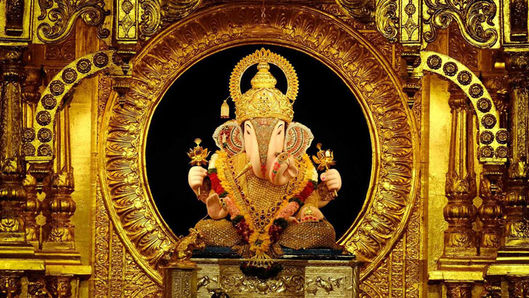
Related Post: The Ganesha Chaturthi Festival of India
At that very moment, the pooja ceremony began with the ringing of bells, blowing of conch and the fragrance of burning incense.
After it was over, I returned to the autorickshaw, hands brimming with temple prasad, which included a yummy motichoor laddoo :).
The next day, I learnt from the tourist car driver that the temple, Ajoba Ganesh Mandir is very old, from the times of freedom fighter Lokmanya Tilak in British India. It is the city’s most important Lord Ganesh temple. The driver also said that the idol is bedecked with jewellery only on special occasions. Meaning it was a special occasion that time 🙂 I was mighty happy on learning all this.
On my return from the trip, I googled a bit and found that the Ajoba Ganesha temple of Solapur has a history of more than 100 years. The first idol of Ajoba Ganesha was installed in 1885 in Shukrawar Peth. The current temple in the Manik Chowk area was built in 1994. It is said that Lokmanya Tilak visited the city from 1893 to 1895 when Ganesha festival celebration was at its peak. After seeing the processions, the enthusiasm among the people and their unity, he was inspired to turn that into a mass movement. In those days Hindus and Muslims celebrated the Ganesha festival together like brothers.
Tuljapur
॥सर्वमंगलमांगल्ये॥शिवेसर्वार्थसाधिके॥शरण्येत्र्यंबकेगौरी॥नारायणीनमोस्तुते॥

Located about 45 kilometers from Solapur, Tuljapur is home to the famous Tulja Bhawani Temple, one of the most revered shrines in Maharashtra.
Goddess Bhawani is an avatar of Goddess Durga so she is depicted with eight arms holding different weapons. She is also called as Tulaja, Turaja, Tvarita and Amba.
Ancient Hindu scriptures such as Hindu Puranas describe her as the impressive and formidable goddess known for combating demons and evil forces to maintain the moral order and righteousness in the universe.
“Bhawani” literally translates to “giver of life”, meaning the power of nature or the source of creative energy. So the goddess is considered to be a mother who provides for her devotees and gives them justice by killing Asuras (demons).
The history of the temple has been mentioned in the ancient Hindu scripture Skanda Purana. Maharashtra comes under the ancient Dandakaryna region. The temple is situated in the hilly area of Yamunachala Parvat (also called Balaghat Hill).
According to legends, a fearsome demon harmed the region, where the temple now stands. Goddess Bhavani killed the demon and chose to reside on the hill. It was her way of ensuring the ultimate protection for all her devotees.
Tuljapur’s Bhawani Mata is the Kulswamini (guardian goddess) of Maharashtra. Her worship is of great antiquity and many royal houses and their nobles have been her devotees. She is the Kuldaivat (family deity) of the Bhonsale dynasty whose most celebrated progeny was Chattrapati Shivaji Maharaj, the founder of the great Maratha Empire.
Chhatrapati Shivaji Maharaj, a devout devotee of the Goddess, used to visit this temple regularly and offer his sword to the goddess for blessings before embarking on his war conquests and for success in his expeditions. This further solidified the association of the temple with victory.
Goddess Tulja Bhawani is revered and worshipped as the Kuldaivat (family deity) or Kuldevi (family goddess), not only in Maharashtra, but in innumerable families across India. Devotees throng in millions to Tuljapur to seek her blessings before beginning any kind of new work or starting marriage preparations or any family event.
Tulja Bhawani Mandir is one of the oldest temples in Maharashtra. The temple has witnessed many rulers and their style of architecture, such as the Yadava Kingdom in the 13th Century with its Hemadpanti Style of Architecture, and the Maratha Kingdom in the late 17th and early 18th century with its Maratha style of Architecture. And later, this area was ruled by Nizam of Hyderabad, who bought Deccan-style Architecture. The main entrance of the temple is designed and decorated with the blend of Deccan and Maratha Style of Architecture, constructed by Sardar Nimbalkar, the Nizam’s administrator.
The temple is open between 4:00 AM to 11:00 PM, but timings vary on festive days. Elaborate daily rituals are carried out at specific hours for the deity. These include a ritual bath, change of clothes, and food offerings four times a day. The daily routine also includes devotional prayers to the Goddess. In the evening, the deity is ceremoniously put to rest.
The temple complex also houses shrines of Lord Siddhi Vinayak, Adi Maya Adi Shakti (Matangi Devi) and Annapurna Devi and some small shrines. Priests conduct the pooja ceremony at Adi Maya Adi Shakti temple first and thereafter at Tulja Bhawani Mata temple,
On festive days, thousands of devotees from across Maharashtra arrive in Tuljapur to seek the blessings of Tulja Bhawani Mata. The temple is well-decorated and looks spectacular during the annual Navratri (nine-day grand festival dedicated to goddesses) in October when maximum arrivals are recorded.
Fridays and weekends sees huge crowds, whereas Mondays through Thursdays has comparatively lesser crowd unless a public holiday falls on any of those days.
Queues are usually long so getting a darshan (glimpse) of the Goddess requires hours and hours of waiting. Darshan tickets are available online at the official website. These include a free Darshan pass and a Denagi (donation) or paid Darshan pass.
Photography is strictly prohibited in certain areas of the temple complex, including the garbh griha (sanctum sanctorum). Mobile phones have to be switched off or put on silent mode before entering the temple premises.
Monday, 29th July 2024
Pandharpur and Tuljapur lie on two different sides of Solapur. Usually devotees visit Pandharpur (which is 1.5 hours away) first and then Tuljapur. But we decided to do the opposite since I thought it would be best to visit the closest temple first for early morning blessings. As we found out later, it turned out to be an excellent decision!
At 6:05 AM, we started for Tuljapur. It was a smooth road journey so we reached the town in 40 minutes.
Vehicles are not allowed near the temple. There’s a separate parking area a short distance away. From the main road, it’s just a 10 minute walk along the temple path, which is dotted by shops and stalls selling pooja items.
It had rained some hours prior to our visit. Thankfully, it did not rain while we were there. Being an early hour (6:45 AM) and a Monday, the crowd was merely 10% of that on weekends and holidays.
Entrance is through one of the two huge gates or ‘Mahadwars’ named after the parents of Chhatrapati Shivaji Maharaj – Raja Shahaji Mahadwar, and Rajmata Jijavu Mahadwar.
There is another gate in the temple complex which was constructed by Sardar Nimbalkar, and is called the Sardar Nimbalkar Pravesh Dwar.
Raja Shahaji Mahadwar, and Rajmata Jijavu Mahadwar …

We entered through the towering Raja Shahaji Mahadwar…


Two temple libraries are located close to this gate. Shree Santh Dnyaneshwar Dharmik Library and Shree Tukaram Dharmik Library.
We walked on. It felt beautiful walking barefoot on centuries-old stone steps that have remained intact over the passage of time. Reaching the bottom of the stairs, to our right was ‘Gomukh Theerth` and to the left `Kalakh`, also known as `Kallol Theerth’. Devotees bathe and wash their hands and feet in these theerths (shallow tanks of “holy” water) before proceeding for darshan of the goddess.
Kallol Theerth was filled with men taking a bath. We proceeded towards the Gomukh Theerth which was through a narrow underground passage where water was streaming out of an ancient stone sculpture of a cow’s snout. Hence the name ‘gomukh’. We washed our hands at the snout. Our feet got cleansed as we walked through the flowing water. It was a very refreshing experience. We climbed up the steps, and walked towards the main temple complex.
Inside the garb griha (inner sanctum), the black stone idol of Tulja Bhawani Mata was in its original form.
The radiant black stone idol of the eight-armed goddess is three-foot tall, bearing different weapons and carrying the head of the slain demon Mahishasura.
Tufts of her long flowing hair appear from the crown of her head. The moon and the sun are on the right and left sides behind her. Her jewellery includes mangalsutra and chandrahaar on the neck, bangles and kadas in the hands, bajoobandh on the arms, kambarapatta around the waist and painjana and tode on the feet.
Her eight hands carry trishul (trident), bichava (dagger), bow, arrow, chakra, shankh (conch), pan patra (bowl) and the head of the slain demon Mahishasura. There is an arrow quiver on her back. Her right foot is on the demon Mahishasura and left foot is on the ground.
To her right stands her vahana (mount or vehicle) – a lion.
We were truly blessed to have a darshan of the goddess in her original “ashtabhuja” (eight-armed) form. The goddess can be seen like this only at the time of the daily 6 AM Abhishek Pooja. After the 10-11 AM pooja ceremony, the idol is dressed and adorned with jewellery. So I was glad that we decided to visit Tuljapur first.
On exiting the temple sanctum, we saw a long queue for the paid darshan, which entailed a view of the Goddess from a slightly closer range than the general darshan. But given the long queue it would have been a 5-second darshan. On the other hand, we got an excellent general darshan of a minute or more and it didn’t even require waiting in a queue.
We made a pradakshina (circumambulation) of the main temple. Around it are some more shrines and a Yagna Kund (holy fire pit).
On the way back, I felt a slight drizzle of cold water on my head and told my sister it was going to rain. She said no. I looked around and realized she was right. Somehow, I feel it could have been a blessing 🙂
Normally, devotees have to spend hours at the temple site for the Devi’s darshan. So we were lucky to conclude our visit in just 40 minutes 🙂 The walk to the temple entrance and back took 15 minutes. Arriving at the temple sanctum, getting the Devi’s darshan and leaving took 10 minutes. Another 15 minutes went in looking around the sprawling temple complex.
We returned to the hotel for breakfast at around 8:15 AM.
Pandharpur
Around 70 kilometres from Solapur, Pandharpur is located on the banks of Bhima river, which is also known as Chandrabhaga as it takes the shape of a crescent moon near the town.
The Vitthal Rukmini Mandir of Pandharpur is one of the most significant pilgrimage sites in Maharashtra, attracting millions of devotees every year. The temple is dedicated to Lord Vitthal or Vithoba (also called Panduranga), an avatar of Lord Krishna (an incarnation of Lord Vishnu), and his consort Rukmini.
The ancient Vitthal temple was renovated in 1195 A.D. Worship of Vithoba is based on the contents of the Puranas and the contributions of the Vaishnava (worshippers of Lord Vishnu) saints of Maharashtra and Karnataka in Bhakti (devotion) tradition during the 13th through 17th centuries.
Pandharpur is called as ‘Naada Brahma Kshetra’. The uniqueness of the Vitthal Rukmini Mandir is that it is the only temple where devotees can touch or rest their forehead on the Lord’s lotus feet.

The deity is worshipped and lovingly called by his devotees with many names in different course of the time, like Pandharinath, Pandurang, Pandhariraya, Vithai, Vithoba, Vithumauli, Vitthal gururao, Pandurang, Hari etc.
The temple draws a regular rush of devotees every day, but festive days are of special kind with tremendous spiritual energies flowing everywhere around. Thousands of devotees walk to the temple on pilgrimage from all over Maharashtra and surrounding States to celebrate the Ashadhi Ekadashi and Kartiki Ekadashi every year.
‘Ekadashi’ is the 11th day from Full Moon Day and New Moon Day in the Hindu calendar months.
The pilgrimage to Pandharpur is called “Vari” which means walking from one’s own house to Pandharpur for the Lord. The person proceeding on this type of ‘vari’ is called a Varkari (the follower of the pilgrimage). The gathering of many Varkaris is called Dindi. They go in groups on ‘vari’ singing and dancing to the Lord’s praises, expressing their devotion to him.

Image credit: https://www.vitthalrukminimandir.org
The famous Maharashtrian saints and greatest devotees of Panduranga Vitthala are Pundalik, Sant Sakhu, Sant Kanhopatra, Sant Dnyaneshwar, Sant Namdev, Sant Tukaram, Sant Sawatamali, Sant Janabai, Sant Eknath, Sant Chokhamela and Sant Gora Kumbhar. Their hymns and writings have contributed to the richness of Maharashtrian culture and tradition.
Palkhis (Palanquins) of these saints and more start from various places connected to them and gather at Wakhari, 5 km from Pandharpur for the vari.

The tradition of Vari and Dindi is very ancient, but the tradition of carrying ‘padukas’ (slippers) of Sant Dnyaneshvar and Sanr Tukaram to Pandharpur in Dindi started some centuries ago.
In the Hindu calendar month of Ashadh, ‘Dindis’ arrive from almost every village, town and city of Maharashtra. Dindis strictly follow the rule of going on foot to take the Lord’s blessings, which is why they take 15-20 days to reach Pandharpur. It becomes a kind of spiritual celebration all over Maharashtra.

There are four main seasons of pilgrimage (or ‘vari’).
1) Chaitri Yatra: This is the first pilgrimage in the Hindu calendar year. Chaitra is the first month of Hindu calendar. Shudha Ekadashi of Chaitra is called as Kamada Ekadashi.
2) Ashadhi Yatra: The Ashadhi Ekadashi pilgrimage is of supreme importance. It attracts millions of devotees in Pandharpur. This Ekadhashi is known as Devashayani Ekadashi. Shri Vitthal goes into a 4-month-long cosmic sleep on this day. This is the holy Chaturmas period during which devotees spend as much time as possible in worshipping the Lord.
The Dindis of Sant Dnyaneshvar and Sant Tukarm along with thousands of other Dindis arrive in Pandharpur accompanied by millions of devotees. On reaching, they take a holy bath in the Chandrabhaga river and then, complete the ‘Pradakshina’ (a holy peripheral walk) of Pandharpur.

In the afternoon of the Ekadashi, a procession of the idols of the gods in a specially designed chariot goes along the ‘Pradakshina’ road. The celebration comes to an end on the day of Ashad Shudh Poornima (full moon day).
3) Kartiki Yatra: Kartik Yatra is celebrated on Shudha Ekadhashi of the month Kartik. Shri Vitthal wakes up from his deep sleep on this day. Celebrations include singing glory to the Lord in the form of Kirtan (story recitation) and Bhajan (devotional hymns), all of which takes place along the banks of the Chandrabhaga.
4) Maghi Yatra: This Yatra is held in Shudha Ekadashi of the month of Magh. This Ekadashi is known as Jaya Ekadashi.
Shri Vitthal is not the Lord of only Varkari culture in Maharashtra but also the Lord of many Vaishnavites from places like Karnataka, Andhra Pradesh, Tamil Nadu, Utter Pradesh, Madhya Pradesh, etc.
To visit, the nearest convenient railway station is Pandharpur Railway Station, which is 3 km away. The nearest bus stand is Pandharpur, which is 2 km away.
We started for Pandharpur at 9 AM and reached there at 10:05 AM. A surprisingly quick and a very smooth journey 🙂
Between 10 AM to 11 AM, the darshan session is closed. It reopens at 11 AM on completion of the ritual ceremony. Someone at our hotel had been to the temple on Saturday. I was told that he and his wife had to wait in the queue for about 4 hours to get a Sparsh Darshan due to the hour-long closure.
At the Shri Vitthal Rukmini Mandir, two types of Darshan (glimpse of the deity) are available for devotees: Mukh (viewing face of the idol from distance) Darshan and Sparsh (touching) or Pad (foot) Darshan.
Mukh Darshan is obtained quick and easy with a glimpse of Lord Vitthal or Vithoba from a distance. Pad darshan or Sparsh darshan is the unique opportunity of touching the lotus feet of the Lord. This special kind of darshan at an important sacred temple is available only here in Pandharpur. Devotees wait in long queues for 2-3 hours every day for this darshan. Weekends draw huge crowds with a waiting period of at least 4-5 hours, which extends to 8 hours on festive days and Ekadashis. It is much longer on Ekadashis during pilgrimage months.
Sparsh darshan pass can be booked in advance online at the temple website. Online booking for this special entry isn’t always available, but in that case, it can be done at the temple office i.e. Tukaram Bhavan.

We entered the temple from Namdev Payari (step), named in memory of Sant Namdev, a famous Maharastrian saint and ardent devotee of Shri Vitthala or Vithoba. This is the traditional temple entrance used by famous saints and kings over hundreds of years.

Online booking of special entry for Sparsh Darshan was unavailable during our visit. We went to Tukaram Bhavan for registration. The narrow road to the office was lined by stores and stalls offering pooja items, souvenir and locker facility to safeguard mobile phones and cameras since photography is prohibited inside the temple.
The long general entry queue for Sparsh Darshan starts from another side of the temple complex. For special entry, it’s directly through the Mukh Darshan entrance. We passed through security check and came into the main area, where we waited until 11 AM, when the temple opened for darshan.
We went through the special entry door which opened into the outer sanctum, where general entry devotees were already waiting in a disorderly queue to the garbh griha (inner sanctum). The crowded enclosure made me nervous. But thankfully, soon enough, the temple security instructed everyone to form a single queue. Thereafter, everyone moved in an orderly manner. Twenty minutes later, my sister and I stepped inside the garbh griha.
The black stone idol of the Lord stands with both hands on his waist, his ears adorned with jewellery depicting fish (reference to his first avatar of Matsya or fish).

This is the only sacred temple where devotees can touch or rest their forehead at the Lord’s lotus feet and seek his divine blessings. This unique opportunity lasts for just a second or more owing to the large number of devotees waiting behind.
After my sister, I got the golden opportunity. I rested my forehead at the Lord’s feet and instantly felt the impact of his “lotus feet”. I remained like that for almost a minute. Nobody said anything or tapped me to move away 🙂
Famous Hindu saints and kings over centuries have touched these very same lotus feet of the Lord. Even Chhatrapati Shivaji Maharaj, The idol is that special and extraordinary 🙂 I felt very much blessed. It was like the Lord had called me to visit him and when I did, he gave me the special treatment 🙂
Thereafter, we went to the adjacent shrine of Devi Rukmini and other shrines. Vithoba’s consort, Devi Rukmini is also in a standing pose with hands resting on her waist.
It took just 30 minutes to complete our temple darshan. We collected the temple prasad from Tukaram Bhavan and made our way to Pundalik Mandir on the banks of the Chandrabhaga.


The temple is dedicated to Pundalik, an ardent devotee of Vithoba and the historical founder of the Varkari culture, which is centred on the worship of Vithoba.
The legend goes like this: One day, Shri Krishna (an avatar of Lord Vishnu) came to the Dandivana forest near Pundalik’s house in search of his angry wife Devi Rukmini, who had left him on seeing him with one of his other wives. After some coaxing, Devi Rukmini was pacified. Thereafter, Shri Krishna appeared at the house of his true devotee Pundalik with whom he was highly impressed because of his deep devotion and dedication to his parents who were ill due to their old age. Pundalik was busy serving his parents at that time and didn’t pay any heed. He merely threw a brick lying nearby towards the Lord for him to stand on or sit while he attended to his parents. Shri Krishna stood on the brick with his hands on waist and patiently waited for Pundalik to complete his service.
The Lord is believed to be standing there for as many as twenty-eight Yuga (eras) just for the sake of all those who are his true devotees.
A devotional hymn of the great Maharashtrian saint Sant Namdeo says: “ ….to meet Pundalik, the real Parbrahma (the Supreme God) arrived in Pandharpur.”
Normally, the river level is low. But that day, all the riverside temples were under water because dam water had been released at Pune, which was reeling under heavy rains and floods. I waded through the water to the nearest temple dedicated to Pundalik. The water level was higher at other temples…and unclean. So we returned to the main road for the car.
I rested on the parapet of a shop for a while until I was jolted out of my reverie by a loud braying. A donkey had stopped right in front of me! Having caught my attention, he walked down the road and stopped to munch a flower garland dumped in a corner. I quickly got up and ran towards a nearby banana stall and bought half a dozen for the hungry animal. After giving him a gentle caress, I placed the bananas near the flowers. He gobbled them in seconds… and returned to the flowers 🙂
On the way back, I was talking about the underestimated intelligence of donkeys. In 2010, on a visit to Zero Point on the India-Pakistan Line of Control (LoC), I had seen how mules were vital for transporting supplies to the soldiers high up in the mountains. I was relating this to my sister when all of a sudden my attention was captured by a beautiful golden four-legged creature sprinting in the lush green field, some 50 metres away. It was galloping carefree in the green field… just the way I love seeing horses! The driver said it was a Khacchar, a Himalayan mule. Mule is the offspring of a jack (male donkey) and a mare (female horse).
I was mind-blown by the golden Himalayan mule and wished I had stopped the car for a photo or a video. But it all happened in an instant and the car was speeding too. The driver said some of the locals kept these animals.
We were back in Solapur around 1:30 PM for lunch. The main element of Solapuri cuisine is peanuts, which is widely grown in that region. We still had to taste a few local dishes for which we to Hotel Nisarg Executive, which was just a short walk away from our hotel. We had some spicy flatbreads containing peanuts – Dhapate and Thalipeeth, Shenga (peanut) chutney and sweet flatbread stuffed with peanuts – Shenga (peanut) Poli 🙂

Back in our hotel room, I noticed a long pinkish mark on my nose bridge. Did it come about after my one-minute darshan at Vithoba Mandir? It faded slowly by the next day.
The temple tour had metered 260 kilometres. Not wanting to waste the paid 40 kilometres, we decided to visit the Shri Swami Samarth temple at Akkalkot, which is 40 kms away. Moreover, two people had asked us about visiting Akkalkot so we took it as a cue that it was a calling from Shri Swami Samarth.
The autorickshaw driver of previous night had asked us whether we had been to Akkalkot and we had told him we had plans only for Pandharpur and Tuljapur. Next, the tourist car driver asked us if he should drive towards Akkalkot even though we had told him after returning from Pandharpur that we will leave for Tuljapur after breakfast.
There is a Shri Swami Samarth ‘Math’ (or temple) near our home, which draws a huge number of devotee on Thursdays and festive days. On those days, devotees of all ages (even office goers) wait patiently in a long queue alongside the main road from morning to evening for their turn to seek the Swami’s blessings. Such is the power and following of the Swami.
My mother has been a devotee of the Swami since childhood and would often visit the Math, which had a huge following in those days too.
Akkalkot
Akkalkot is 40 km southeast of Solapur and very close to the border between Maharashtra and Karnataka states.

Akkalkot is widely known for its association with Shri Swami Samarth Maharaj (also known as Akkalkot Swami), a powerful 19th century spiritual guru and saint, who is believed by his devotees to be the third avatar of Lord Dattatreya, the Adi-Guru(the first Guru or founder) of the Datta tradition named after Lord Dattatreya.
Shri Swami Samarth is famous for his spiritual teachings and miracles. He is known for his ability to perform miracles and heal people of their ailments. His teachings emphasize on the importance of devotion, self-realization, and service to others. He is known for his philanthropic work and for setting up ashrams and schools for the underprivileged.
The Swami himself had said that he had come from the Kardali forest near Sri Sailam, a very powerful pilgrimage centre of Lord Shiva, in present-day Andhra Pradesh. He travelled extensively in China, Tibet, Nepal and the Indian Himalayan region. He also visited religious places across India such as Puri, Varanasi (Kashi or Benaras), Hardwar, Girnar, Kathiawad and Rameswaram. Thereafter, he briefly lived in Mangalvedha, a town near Pandharpur, where a few famous saints had settled earlier. Finally, he settled down at Akkalkot and stayed there for 22 years from 1856 to 1878 and thus came to be known as the Akkalkot Niwasi Shree Swami Samarth Maharaj (the great sage of Akkalkot).
The present temple is known as the Vatavruksh Mandir. It is built around the banyan tree under which Shri Swami Samarth used to meditate and preach his message to followers. His padukas (image of holy footwear) are placed in a small enclosure below the banyan tree.
On April 30, 1878, the great sage attained MahaSamadhi [the last conscious communion with God] under this banyan tree.
The temple complex includes the main temple, Sabha Mandap and temple accommodation. The main temple has shrines of other deities also such as Lord Ganesha, Lord Dattatreya and Lord Hanuman.
The temple trust provides free accommodation and twice-a-day daily ‘Annacchatra’ (free meals to devotees) to arriving pilgrims.
Another local shrine of the Swami is located a short distance away. It is known as Samadhi Math and the house of his disciple Cholappa, where the holy Samadhi place of the Swami was reserved before his bodily demise.
Shri Swami Samarth’s teachings continue to be followed by millions of people in Maharashtra, and his ashram in Akkalkot remains a popular place of pilgrimage. His followers carry on his philanthropic work and believe that he continues to guide and bless them even after his physical departure from this world.
Devotees still experience his divine presence and feel reassured because of his quote “I have not gone, I am still present”.
The spiritual fearless slogan in Marathi language; ‘BHEEYU NAKOS. MI TUJHYA PATHISHI AAHE’ (Fear not, I’m always behind you) was given by Shri Samarth Swami Maharaj himself.
His famous words can be seen printed behind trucks and on taxis, private and public transport everywhere in Mumbai and other cities, towns and villages of Maharashtra.
We started from Solapur at 3 PM and reached Akkalkot after a 35-minute drive. The path to the temple was lined by shops selling spiritual items and souvenirs related to Shri Swami Samarth. My attention was drawn towards a special type of milk sweet on display at each stall. Beside the natural roast variety, it was available in three eye-catching colours – dark fuchsia, bright yellow and dark green.
The entire temple complex is well-maintained and offers free meals and accommodation to devotees, a tradition rooted in Indian spirituality
Lady Luck was still smiling on us 🙂 Besides a good darshan, a temple volunteer guided us around the temple.
The 400 year old tree under which the Swami meditated…

The Swami’s last years were spent under this very banyan tree, where he finally took ‘samadhi’. The tree had grown tall and then branched down to the side, giving an impression of two trees. Our guide opened the gate, giving us the opportunity to rest our forehead on it in reverence. We also paid our obeisance to the Swami’s ‘paduka’ (image of holy footwear) which was below the tree.
This artwork of the Swami was made using Rudraksh beads only. It was made by a devotee from Mumbai…

After the Swami breathed his last below the banyan tree, his disciple built a Samadhi Mandir a few kilometres away. He placed the body of the holy saint as it was in a seated position underground, sealed the ground and built the inner sanctum atop it.
We visited the Samadhi Mandir too. I made a donation towards temple ritual ceremony in the name of my mother, who is a devotee of Swami Samarth. Along with ‘prasad’, I received a crisp 50-rupee note from the priest. My mother had given me a crisp 50-rupee note to be dropped in the donation box, on her behalf, at Pandharpur’s Vithoba temple. I had done it accordingly. Now I was carrying a crisp 50-rupee note back to her as temple souvenir from the holy saint.
At 5 PM, we were back in Solapur with 1.5 kilos of excellent quality peanuts, that I purchased near the Swami Samarth Mandir 🙂
Thanks to divine blessings, we had an excellent pilgrimage tour.
Next early morning, at 6:10 AM, we started our return journey by Vande Bharat train, which reaches Mumbai’s Chhatrapati Shivaji Maharaj Terminus at 12 noon.

Before I end this post, enjoy some of my favourite devotionals songs dedicated to Vithoba 🙂
Stay blessed and keep visiting me 🙂
XXXXXXXXXXXXXXXXXXXXXXXXXXXXXXXXXXXXXXXXXXXXXXXXXXXXXXXXXXXXXXXX
I hope you all are sharing my blog posts with friends and family. To make it more easier for you, tap this link A List Of All My Posts to check out the entire list of my posts 😀 You know, I’d hate to think that you missed something 😉
If you’re my first-time reader, don’t forget to follow my blog 🙂 Enter your email address and hit the “Follow” button and you will receive my new posts by email 🙂 🙂 🙂
You can read my travel experiences and learn more about the many beautiful destinations in Mexico in my ebook (PDF format):

CLICK Discovering Mexico US$ 16.97 (or the equivalent value in your currency)
HERE TO BUY: https://www.e-junkie.com/i/p6sy
To know all about Mexico, here’s my ebook (PDF format):

Mexico: The Country, Its History & The Maya World US$ 7.97(or the equivalent value in your currency)
CLICK HERE TO BUY: https://www.e-junkie.com/i/p6vh
For Mexico’s food history, detailed information on Mexican food & drink and a few recipes, buy my ebook (PDF format):

A Guide To Mexican CuisineUS$ 5.97 (or the equivalent value in your currency)
CLICK HERE TO BUY: https://www.e-junkie.com/i/p6vr
If you love reading romance novels and are a big fan of Mills & Boon novels, you will love my romance ebook (PDF format):

The Blue-Eyed Prince of NatlifeUS$ 4.99(or the equivalent value in your currency)
If you are a first-time visitor, I hope to see you again soon. Perhaps you might want to leave a like, comment, follow or hopefully all the three 😀
Remember, your feedback is highly appreciated. Your “Like” and comments are greatly valued. And let me tell you that I just love reading the warm words of appreciation that I receive for my work from my readers through the Contact Me Page 😀 So be generous with the feedback 😀
You can also connect with me on:
X (Twitter): https://twitter.com/swarupa007
Thanks for stopping by, I hope to see you back 😀 Till then, take care… cheers 😀

Comments