


City University London Volleyball – Coaching Reflection 2016-17

Introduction
The 2016-17 season was my fourth as Head Coach at City University London (CUL). Last season was the first season that CUL entered teams in competition; the women in British Universities and Colleges Sport (BUCS) and a mixed team in London Universities Sports League (LUSL). You can read my reflection on that season here. This season, I focused on the women’s team only. The men’s team, who now was entered in BUCS, was coached by Treysre Stevenson and the social sessions were taken over by Alessandro Kahelemeakua. This suited me because now I could focus on one team only and build on the success of last season.

Trial and Team Selection
What I Utilised From My Experience Last Season
From my experience last season, I was more prepared for trials this season. We had 40 players turn out for the trials. The most helpful thing we did was:
* For example, S1 would be setter 1, S2 would be setter 2, OH1 would be outside hitter 1 etc.
* . So S1 to S5 would be in one group when doing the volley and follow through drill.
* It would be another opportunity for those who missed the first trials and a chance to take a second look at players from the first trials.
* We were in need of players since we had three players drop out but I would have done it anyway because we did get some good players coming in.
What I Could Improve On For Next Season
* . I did this incidentally when we held second trials after the New Year. We had to hold it during our training session and I couldn’t hold trials for the entire two hours because the team still had to train. We had a match that week and the team had not trained in six weeks. While it is a bit brutal for those getting cut, from an efficiency point of view, you can tell very quickly who the beginners are so there’s no point in keeping them around and taking up court time.
* . While this may sound obvious but students sometimes trial out for a couple of teams. We did ask one player to join the team but she declined because she was already joined the squash team. I also saw another player that I wanted to join the team but I already saw her training with the basketball team.
* While this may sound obvious again, we had issues with this. We selected one player for the team but dropped out immediately because she had to work at the same times as the training and matches. We also had issues with students who had classes on Wednesdays. This meant they couldn’t go to any afternoon matches or away matches outside London.
. I would select the team based on their position (and skill level of course). I wanted two setters, two liberos, two opposites, four middle players and five outside hitters to make up 15 players. I didn’t want any more than that in those positions because then it gets unmanageable. For example, I do a lot of game situation drills so having six middle players means a lot of waiting around for them because I could only have two on court at any one time. However, I shouldn’t think so rigidly because I always have a use for skilled players and I could always convert them to a different position. For example, we had two other good setters that trialled but I didn’t select them because I already have chosen my two. I could have selected them for the team anyway because I could have used them as setters (they could have turned out better than the two I selected), convert them into opposite hitters or they might have good enough technique to be an outside hitter or libero. It would also cover me if a setter drops out, as it happened this season.
* . You always want a full squad of 12 players for training and matches. However, I only had a full squad seven times in 17 training sessions and only twice in 17 matches! This is not ideal, especially if you need options for substitutions. I still think 15 players is the right number for a squad. It is enough players that you still have a full squad when some players will invariably miss training and matches. It is also not too many that it is unmanageable if they all turn up for training. The mistake I need to learn from is not to select 15 players after trials because some players will invariably drop out. I have to make sure I have 15 players on the court on the first day of training. It could just be a matter of asking the two questions above or selecting a squad of 17 players, knowing some will drop out.
* . This would be good to know for team selection. I may choose a first year student over a final year student of similar level because I could have the chance to work with the fresher player for three seasons.
. This makes it easier to see their numbers from afar.
* . I wrote this last season but I forgot to do it.
* . While the majority of the team was easy to pick, there were a few borderline players that the captains and myself talked about. If we had the benefit of video, we could see again for ourselves if they were as good or not as good as we thought they were.

Coaching Schedule and Reflection
I decided to use last season’s plan as a blueprint for this season. It was essentially coach systems first up until the Christmas, then coach technique second and then advanced plays third after the New Year.
Systems First
I was quite happy with what I did. There’s a nice overall progression to work on all the systems. I didn’t spend too long on the reception system because nearly all the players knew it. I think only one player never played in any kind of system. I did have to spend a lot more time on refining the defence system. An example was defending the middle tipped attacks where the player at 2 and 4 did not break off the net to defend those tips. I also continually touch upon the free ball system and out of system play because although it’s a simple system, it was something most players would have to get used to. I did deviate from the overall coaching plan at times. The big one was to prepare for the Essex match because we only had seven players available. I had to shuffle players around so I planned the session so they practised those positions and they understood the various systems.
Technique Second, Advanced Plays Third
I was happy with what I did. I did shorten the focus on technique to one week only (week 11). This was because it was a terrible training session. Essentially, I could see the players were simply uninterested. There were probably several explanations for this; coaching technique is not my strength, too much explanation, boring drills and a lot of stops and starts. I decided to move pass technique and coach the more advanced plays until the end of the season. You can see from week 12 to 16, training centred around three things: tougher serving/ quality passing, reps for middle attack combinations and adding variety to a wing player’s attack. We didn’t progress as far as I would have liked in this respect because we had to share our training with the men since week 12 due to a broken net post. It meant the team only had half the reps – the men had the other half.

Adding Performance Analysis
I decided that I would film matches and collect stats. Division 2 would be better than Division 3 so I wanted data to justify any coaching decision. Despite early issues with procuring consent, I filmed nearly every match. I decided to collect stats for my team only when playing against poor teams (league) and teams we would not face again (cup and Student Cup). This was because I didn’t need to know what the other teams did and it would make post-match coding much faster. However, for tough teams that we would face again (Middlesex and Imperial mainly), I did collect stats for both teams for scouting purposes.
The performance data was extremely useful. I could see who my best passers were, who my best hitters were and who my best servers were. I would use this information in matches if, for example, who I could use if I needed better passing or attacking. I also used the information to promote a player from substitute at the start of the season to starting outside hitter one (near the setter) towards the latter half of the season. I found her initial passing and attack stats to be as good as the others I used in that position and she eventually led in those stats.
I did wish I had live stats though. There were times when a player who I knew to be a good passer from previous stats, would make a string of poor passes or errors. I would think to sub them out but then they would make a perfect pass. Now, is that player having a bad passing day with the odd perfect pass or a good day but I just remember the string of poor passes or errors? This is where I would have liked live stats so I could see and I could justify whether to sub that player out or not.
Competition Report
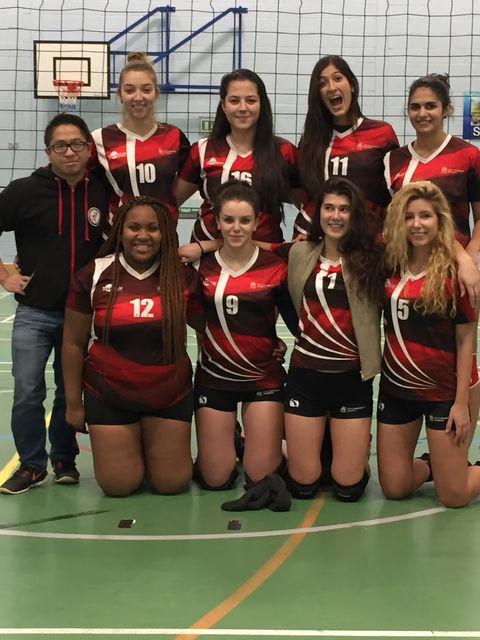
BUCS South Eastern Division 2B Women – Champions
We topped the league in which I was super happy with. We finished with a 9-1 record in the league (see league table). We had two tough teams in Middlesex 1st and Imperial 1st but we managed to beat them twice. The video match and stats helped us in the return match. The only loss we had was against Essex 2nd when we played them away. They had a decent team but we went with seven players that included no setters and only one middle player. I had to convert the middle player to a setter and rework the reception and defence system. I did dedicate half the training session (week 12) to this so they practice this adapted system. We lost the match in five sets. I did feel comfortable with what I did. I did have limited options but I knew our weakness was we didn’t have an attack machine. Our middle player is our attack machine but she had to set. We did have another player that could potentially set but since she wasn’t at training that week, I didn’t feel comfortable making a change that we never practised in training. Also, come set five, we already won two sets using that system.

BUCS South Eastern Conference Cup Women – Runners-up
We lost an agonising final against Imperial 1st in four sets. I knew in their stats from our previous two matches against them in the league that they could all hit in the teens but it felt like they were hitting better much better. We lost the first two sets mainly because of this. In the third set, I made the change to put our best defenders in. This really meant I put one outside hitter, who can defend well, as an opposite and no liberos came in. The other thing I said was to serve tougher and to hit the ball hard. This was the first time I said something that was essentially “serve and attack better” rather than a tactical change, e.g. hit line, tip more etc. This worked because we won 25-14. We defended well and I could see the extra zip on the ball. I don’t think I ever seen the hitters attack the ball so hard.
I felt there was one critical point in the match where I could have had a bigger impact. We were stuck on one rotation for 7 points when the setter at in position two and the score was 19-15 ahead. I already substituted an opposite player for the middle player,. I felt the middle player was hitting well but couldn’t get the kill. I felt comfortable with that decision. I called a time out after we couldn’t win a point. I thing I wish I could have tried was to shift the front row outside hitter, who was in position 3, to the right side and let the opposite, who was playing middle in position 4, hit left side. I knew the opposite could hit well through 4. So even if the pass wasn’t that great, we had two hitting options and the setter was better setting to the wings rather than the middle. I should have at least tried that out and if that didn’t work, sub the middle back in. I only thought of this after the time-out and I already substituted the middle back in for the opposite player. The other two things I could have done was sub the second setter in for the setter, because the second setter had a much better connection with the middle player and that could have got the kill. Also, passing wasn’t going well so I should have been more sensitive to who wasn’t passing well (live stats would have helped) and change the reception line-up so the opposite receives or I put in the libero. I one thing I think could have helped the was to do a double substitution, where the setter subs in for the opposite and the opposite for the setter. In our case, I only needed to sub in the setter for the opposite because I knew I could leave the setter in to hit as an opposite. However, I couldn’t do it because I made a substitution for the opposite already. I made the substitution earlier because I wanted a bigger attacking and blocking opposite for the front row. I subbed the bigger substitute out in the back row so we had our defence on. I was comfortable with that decision because we were cruising 13-5 at this point.
*** Update 20 May 2020 ***In the Covid-19 lockdown, I decided to rewatch and stat this match for the first time to see if I would do anything different. I pretty much think the same way as I reflected above (it could have been because I still remember). The best option was to make a double substitution that I couldn’t do and I wanted to see if the straight opposite substituion earlier in the match was warranted. Looking back, the opposite made two direct errors in a row and we were 15-8 ahead so it wasn’t the worst of calls. However, Imperial College were on fire as they made five attacks in that rotation and they did have better overall match stats (although, if we went to a fifth set, we could have surpassed them). The other sad thing that I forgotten about was the the fourth set score was actually 24-25. I remember seeing it on the scoresheet after the match and trying to find out what happened. The scoresheet person was not a volleyball player so she didn’t know 2 clear points was needed and was just going with what everybody else was doing. I think the scoreboard person was simply missing a point so we thought it was 23-25. What can you do?*** Update 20 May 2020 ***So we didn’t win the Conference Cup for a second season. I did say to the team afterwards that the Conference Cup was the icing on the team – I wish we would have won it but the league was the most important thing. Winning the league meant we get promoted to Division 1 and we would play in the Trophy Cup, where all the regional division 1 teams compete in. This is compared to the South Eastern Conference Cup where only teams in the South Eastern Division 2 and 3 could compete in.

Volleyball England Student Cup
I wanted to improve on last season and qualify for the Last 16 Finals. Like in last season’s qualifiers, we finished with a 3-1 record and like last season, our sole loss was to Royal Holloway. Unlike last season, we did finish in second place. It was a long wait for the other qualifiers to finish before I could calculate if we finished in the top three second place teams to qualify for the Last 16 Finals. Unfortunately, we were ranked fourth and out of the Last 16 Finals. If we scored one more point against Royal Holloway, we would have got in. However, by luck, one team dropped out and since we were next in line, Volleyball England asked us and we jumped at the chance.
In the Last 16 Finals, the teams were split into four groups of four. In our group, we had Kings College, Bournemouth and Nottingham. Kings was in South Eastern Division 1 while Bournemouth and Nottingham were in Premier South. We did really well in the group stages. We beat Kings and Bournemouth, both close matches. Nottingham whooped us but they had a much better team with a one or two scholarship players. It meant we finished second in our pool and we progressed into the last 8. The next day, we faced Newcastle. We lost because they were a much better team with four scholarship players. Looking back on the video, we held our own in parts of the match, mainly on putting a lot of pressure with our serving. In the losing semifinals, we played Cambridge Uni, who competed in Premier South. During the warm-up, I felt they had a good overall team but no real outstanding players that could do real damage. We lost that match 2-1. For 7th vs 8th place, we played Loughborough. I felt we could definitely beat them. We lost that match in two sets. I was quite disappointed in how we finished because we could have definitely beat Cambridge and Loughborough. I could see the team was fatigued towards the end of the weekend so if I had a bigger squad with me, we could have done better. In the end, we finished in 8th place out of the 46 women teams that entered. That’s not a bad result and we certainly put City University London on the map.

Varsity 2017
We won our match against Kingston University 1st in Varsity 2017 in 3 sets. They were simply better than them but it was another nice achievement to have under our belt.
Achievements and Records
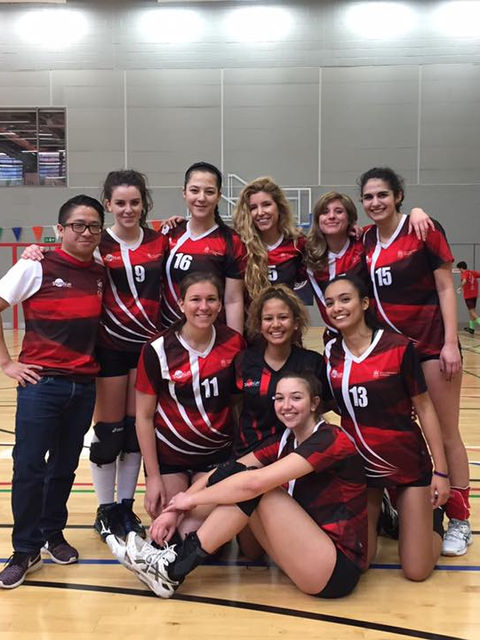
BUCS South Eastern Division 2B Champions BUCS South Eastern Conference Cup Runners Up Volleyball England Student Cup – 8th place Varsity 2017 Winners 19-7 record overall (13-2 record in BUCS) Final results (click to enlarge):


Comments