


Big Joe Turner, The Boss of the Blues (and two other Joe Turners)


Today is the birthday of Big Joe Turner (1911-1985).
If you’re like me, you may have assumed for most of your life that old blues song “Joe Turner’s Come and Gone” (and the August Wilson play named after it) has something to do with the blues singer by the same name. But you’d be wrong. The Turner in the song is a corruption of “Turney”. Joe Turney was a notorious Tennessee official renowned for managing a crooked statewide scheme called the convict lease system. It consisted of sentencing black males to seven year chain-gang hitches for offenses major, minor and non-existent, and profiting from their labors. Such practices during the Jim Crow era took the South within spitting distance of restoring slavery. If you’ve been paying the slightest bit of attention, there are places in America that come very close to perpetuating that kind of thing today. So the phrase “Big Joe Turner’s Come and Gone” basically means someone you love has been grabbed by cruel men in authority, and you may never see them again.
Joe’s position was a sinecure. He was the brother of Tennessee Governor Pete Turney (1827-1903), who had formed and led a Confederate infantry regiment in the Civil War. My great-great grandfather Calvin Stewart and his brother William both served in this regiment. Calvin, who had a newborn baby, deserted; William was seriously wounded at Gettysburg. This is where Yankees will love to gloat about their moral superiority and let themselves off the hook on race in America, so here’s where I will delight in pointing out that a) slavery existed in the Northern states nearly as long as they did in the South; b) Yankee carpetbaggers exploited blacks as well as Sothern whites in the Reconstruction Era; c) segregation of a less pervasive sort existed in the North into the late 20th century; d) as a white New Englander, I can bear testimony in the form of a thousand of examples, of racism in my part of the country, in spite of its also having been the Cradle of Abolitionism. Southern racism is different as a matter of degree, not of kind. Whether consciously or subconsciously, my fellow white people, of both the North and South, seem inclined to bury these truths about their family histories and their own pasts. It’s natural to have feelings of embarrassment or shame, but I take the stance that to allow your fear and insecurity dictate your public feelings about past and current injustices is straight-up cowardice. How are you to be trusted, if you sweep it under the rug? Everyone knows it’s under that rug.
Anyway, it’s a digression, but only an apparent one. Because this past certainly fuels and informs blues music, and that specific reference certainly adds resonance to the name Joe Turner. Every black American family named Turner was once owned by a white American family named Turner. And so on throughout the catalog of surnames. It’s what I think of every time I think of, oh, Sly Stone (Sylvester Stewart) and Ellen Stewart and Nick Stewart. Am I making you feel miserable? Good!

To compound confusion there was a third Joe Turner related to the blues! Joe Turner (1907-1990) was a stride piano player who was in Benny Carter’s band and also accompanied the likes of Adelaide Hall,Louis Armstrong, and Art Tatum. He spent the post-war years in Paris. And for that matter, there was also Big Joe Williams (1903-1982) whom we wrote about here.
As for today’s subject: the Bigger of the two Joe Turners, and the Turner of the two Big Joes, he was a highly influential figure rhythm and blues. In fact, his existence makes it hard to see what all the fuss about rock and roll was in the mid 50s. His brand of boogie-woogie and jump blues goes back to the 1930s…there’s a straight line from big band to Bill Haley and the Comets, and I’ll lay dollars to donuts your kids can’t even tell the difference. I can, but that’s a different story. It was Big Joe Turner who had the first hit record with “Shake, Rattle and Roll”, which Bill Haley essentially covered to have the bigger (whiter) hit. “Flip, Flop and Fly”, later covered by the Blues Brothers was another of his hits. But his career went all the way back to the roadhouses and night clubs of Kansas City in the 30s, and he had plenty of big band and rhythm and blues hits in the decades prior to the rock and roll craze. He continued playing until he passed away during the second blues revival in 1985.
To find out about the history of variety entertainment, consult No Applause, Just Throw Money: The Book That Made Vaudeville Famous, available at Amazon, Barnes and Noble, and wherever nutty books are sold.
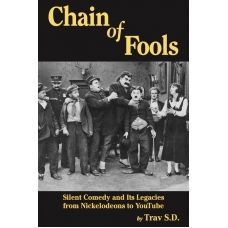
For more on silent and slapstick comedy please check out my new book: Chain of Fools: Silent Comedy and Its Legacies from Nickelodeons to Youtube, just released by Bear Manor Media, also available from amazon.com etc etc etc

Comments