


Anthony Powell: A Dance to the Music of Time


We are delighted to discover this morning that, in addition to being the Winter Solstice, December 21 was the birthday of British author Anthony Powell (1905-2000).
I first learned of this author through my late father-in-law (whose own birthday was Christmas, come to think of it), who had met him at some cultural event during his time as a congressman, and managed to befriend him. In the early ’90s, around the time of my first trip to London, J.S.M. loaned me his copy of A Question of Upbringing, the first part of Powell’s 12-volume A Dance to the Music of Time, which was published between the years 1951 and 1975. Most people seem never to heard of this extraordinary literary work (I hadn’t) though it has been included on numerous lists of “100 Best British Novels of the 20th Century” (sometimes even 50 Best) and was made into a 1997 BBC television series. Somehow Powell (pronounced “Pole”) never cracked the upper echelon of the universally adored. Who can say why?
Ha! I can. While “second rate” is too strong a dismissal, neither could you claim that his writing is the finest thing you ever read. Powell is somewhere between first and second rate, though more “lower echelon first rate” than “upper echelon second rate”, to be sure. His ambition was clearly to be the British Proust, and some called him that. To me, his work is more reminiscent of Trollope, not as psychologically penetrating or reflective as the French genius. Powell’s writing may also be compared with that of his good friend and colleague Evelyn Waugh. (It’s crazy that I’m posting on Powell long before I’ll probably get to Waugh, but I had nothing in the hopper for today, and, besides, Powell can use the attention).
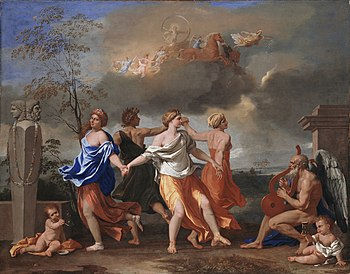
The title A Dance to the Music of Time is taken from this painting by Nicolas Poussin, done ca. 1634-36. The 12 book structure suggests a relation to epic poetry. The work covers the 50 years period between 1921 and 1971 as experienced by the narrator Nick Jenkins, who resembles Fitzgerald’s Nick Carraway in being a bit of a cipher, neither an autobiographical stand-in nor much of a player in what goes on around him. He is an observer. And of course what he observed are his times, from school days at Oxford during the ’20s amongst the Bright Young Things, the rise of socialism among intellectuals in the ’30s (Powell was a Tory), the Second World War, and the Cold War. Powell often treats his characters wryly and comically, falling in line with long British literary tradition. Historical figures are fictionalized; some of those depicted include Field Marshal Montgomery, John Galsworthy, George Orwell, V.S. Naipaul, Lord Beaverbrook, Noel Coward, and Aleister Crowley, all of whom Powell himself knew.

Powell probably never dreamt he’d live to 94, else he might have kept his Muses (or whatever they are) dancing to the music of time for several more years. I hope he liked the BBC adaptation. He’d better have, he co-wrote it! And it’s full of heavy hitters, what my wife calls “BBC all-stars”: John Gielgud, Edward Fox, Miranda Richardson, Zoe Wanamaker, Paul Rhys, Nicola Walker, James D’Arcy, Nicholas Rowe, etc. James Purefoy of Rome plays the narrator Nick.
Outside of his cycle, Powell also wrote several other single-book novels, as well as plays, and many books of memoirs, essays and letters.
Powell’s wife Lady Violet (Pakenham) Powell was also an author, as were her sisters, Lady Pansy Lamb, and Lady Mary Clive.

Comments