


A Look at Vietnam Films of the Reagan Decade

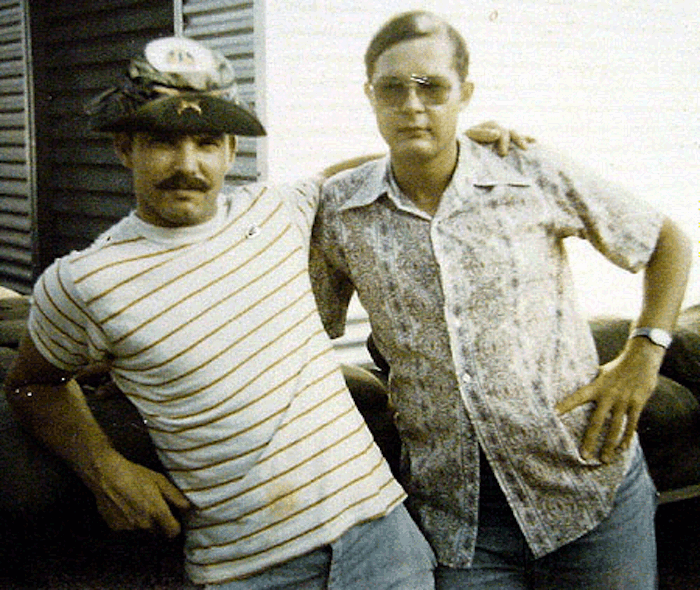
The above depicts my much older first cousin in civvies outside his barracks during his tour of Vietnam, taken in 1972. I didn’t ask permission to share it, so I won’t name him, but since I came across it, I’ve held on to it, struck by his dashing flair, and frankly his resemblance to Frederick Forest in Apocalypse Now. He’s the one on the left obviously, with the handlebar mustache. He served as an MP just as the war was winding down, stationed just outside of Saigon. My son is visiting the country as a tourist in a few weeks — what a difference a half century makes!
This post is inspired by the fact that today is the 60th anniversary of the Gulf of Tonkin Resolution, the act of political dishonesty that gave Johnson a blank check to wage war on the other side of the globe for no good (or convincing) reason anyone has ever discovered yet. I’ve long suspected that he did so essentially to balance out blowback from his Civil Rights initiatives, to counter claims that he was soft on America’s “subversive” left wing. Whatever his motives, it nearly tore this country apart in ways that we are still experiencing, more than ever, it seems. The Democratic Party never recovered from the loss of the seeming halo of invulnerability it has possessed from the time ofFDRto JFK. Carter’s was a failed Presidency; Clinton and Obama were severely hobbled in realizing their objectives by divided Congresses. Since Reagan, America’s right wing has called the tune in the national barn dance, though they delight in denying it. They won’t be satisfied ’til they’ve burnt the barn down. There are glimmers of hope that that may finally change soon, but such remains in the future.
Vietnam (the war, not the country) gave birth to domestic chaos in America. The worst thing it did was to uncouple moral clarity from duty and patriotism. There is something, let’s say, confusing about honoring troops that were misled into taking part in a project that served neither the national interest nor the cause of world stability, and in the end was abandoned, anyway. American politicians succeeded in delivering the worst of all possible worlds. The best would have been not getting involved in a war in the first place. The second best would have been solving it, either by winning it, or forging an enforceable truce, as had happened in Korea. Letting South Vietnam fall to the North, after all that had gone before, was shameful, as shameful as the war itself. If the war hadn’t been a waste up until that point, it certainly was then.
Thus any cinematic treatment of the Vietnam War that’s going to feel truthful will be about that moral fog. An action film with this war as its setting (and there are many) are an unusual case of the right being guilty of historical revisionism. Those fantasies, the ones with Chuck Norris or Sylvester Stallone or whatever are not my jam, although I certainly can understand why vets and their supporters would want the story told that way. No one wants to be told that they gave so much for nothing. The best spin I have been able to put on it, and I offer this up free to teachers who have to teach this stuff, is that Vietnam was a battle that we lost, which took place during the Cold War, which we won. Whatever one thinks about this or that aspect of the Cold War, I happen to think we were on the right side of it. If you’d like the world to have fallen to the likes of Stalin or Mao or Castro or Ho Chi Minh, you, too, are living a fantasy.
Hollywood’s old guard barely touched Vietnam, seemingly regarding it with quiet embarrassment. The primary exception being John Wayne’s 1968 hallucination The Green Berets. It fell to the New Hollywood directors, members of the Boomer counter-culture to take the subject on and attempt to grapple with such complexities as war crimes and moral dilemmas. Most of these directors had been against the war when it was happening. A notable exception was Oliver Stone, who, like John Kerry, was not only for it, but served in combat before turning against it. Prior to films about combat, there were some hit films dealing with the return of soldiers, and their difficulty in reacclimating to civilian life. The most prominent were Michael Cimino’s The Deer Hunter and Hal Ashby’sComing Home, both in 1978. The conventional wisdom was that it took a minute for Hollywood to sort out how to talk about this morass of a topic. As a consequence, like the spate of World War 2 films that came out during Vietnam we posted about here (and can thus be looked at in that context), the key Vietnam films came out during the Reagan era (roughly, give or take), and are thus a reflection of their own times as much as the ones they depict.
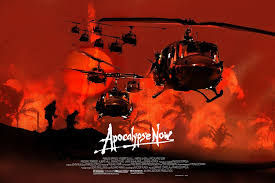
Apocalypse Now (1979)
No less an eminence than Francis Ford Coppola, fresh off his two Godfather blockbusters and the critically acclaimed The Conversation (and more relevantly Patton, which he had co-written), was the first to tackle the knotty problem head on. His method of doing so, devised by screenwriter John Milius, was savvy. He based his story on a famous work of fiction: Joseph Conrad’s Heart of Darkness, the same book that Orson Welles had intended to film as his first movie before scrapping it and moving on to Citizen Kane. It is in many ways a fantasy. And it allowed the filmmakers some plausible deniability. Any hue and cry about accuracy could be pointed back in the direction of the Conrad novel.
The fictional mission that drives the plot of Apocalypse Now is one I’m certain that both the American military and intelligence agencies would deny has ever existed at all, but I would be very surprised to learn that was indeed the case. A young special ops officer (Martin Sheen) is ordered upriver to Cambodia to assassinate a rogue Colonel (Marlon Brando) who has stopped fighting the war and become a murderous, deranged cult leader deep in the jungle. To get him there he is assigned a navy river patrol boat, most of whose crew (Frederic Forest, Albert Hall, Sam Bottoms, Laurence Fishburne) will not make it to their destination. The immortal G.D. Spradlin (who had memorably played a Senator in Godfather Part II) is the officer who gives Sheen his secret orders, and young Harrison Ford (post Star Wars and pre-Indiana Jones) as a miliary aid.
Sheen’s epic journey takes him past several different facets of the war in progress. Coppola famously has a cameo as some documentary maker or news camera person who can’t resist the urge to give the men direction as though they were characters in a Hollywood film. Robert Duvall is the nutso commander of an ex-cavalry unit that has been updated to fly in helicopters. He is the kind of man who relishes the smell of napalm and commands his men to go surfing under heavy fire before undertaking their mission to get the men and their boar into the river (to the tune of Wagner’s “Ride of the Valkyries”). His name, “Kilgore”, summons both “Kill” and “Gore”, not to mention a certain Kurt Vonnegut hero. Later segments include a scene at a U.S.O. show where real life rock impresario Bill Graham presents a bunch of sexy Playboy Bunnies, and another where a couple of characters encounter a tiger. Counterculture hero Dennis Hopper plays a news photographer who has become part of the cult. In the end, Sheen reaches his quarry, a poetry spouting, darkness loving cuckoo, and carries out his mission in manner as primitive and ritualistic as the rites carried out by our ancestors 10,000 years ago, which is pretty much the theme of the movie — that the savagery of war takes us back to that place. It is a relinquishment of reason, a return to something like an animal existence.
I am a big fan of this film. I’ve surely watched it at least a dozen times, and have absorbed all of its meta-material such as Coppola’s 2001 extended cut Apocalypse Now Redux, which includes an interesting interlude at a French plantation, remining us of the war’s origins; Porklips Now,Ernie Fosselius’s hilarious 1980 parody; and the excellent documentary Hearts of Darkness: A Filmmaker’s Apocalypse (1991), a movie that should be seen by anyone interested in the film, for its creation was an ordeal approaching the war itself: shot on location in the Philippines, bloated, expensive, and even dangerous. Bad weather destroyed sets, Martin Sheen nearly died of a heart attack, and Brando (commanding an unprecedentedly high salary), arrived on set having gained enough weight to be characterized as grossly corpulent (side show level) and with no knowledge of his part or his lines. Yet in the end the film, unlike the war, accomplished its mission.
In 1986, Coppola revisited the subject again, from a very different angle, with the home front drama Gardens of Stone (1986) starring James Caan .

More American Graffiti (1979)
This sequel to sequel to American Graffiti (also produced by Coppola) is seldom mentioned in this, or any, context, but it made a big impression on me at the time. Written and directed by Bill L. Norton it tells of the further adventures of the American Graffiti characters as the 1960s progressed. Its experimental and sometimes confusing approach was to tell their stories in different narrative threads organized around New Years Eves. The stories of Toad (Charles Martin Smith) and Joe (Bo Hopkins) take place in ‘Nam when the calendar is about to turn a page to 1965. Improbably, they are stationed in the same unit, and become buddies, united in their dislike for an abusive officer. To escape, Toad keeps trying to injure himself, and eventually decides to fake his own death, by running off into the jungle. The film informs us that he is never seen again, however, implying that he never made out alive.

Platoon (1986)
This is the film that starred a brief mini-run on the Vietnam film genre through the end of the decade. It was the breakthrough project of Oliver Stone, who up to now had been a successful screenwriter. A Vietnam vet himself, Stone had warmed up for the subject in one previous film Salvador (1986), which like Alex Cox’s Walker (1987) was one of the few films that dared to look at Ronald Reagan’s Central American policies directly. With Platoon, he sought to tell a Vietnam story of a truer nature perhaps than the over-the-top Apocalypse Now, yet still without giving way to jingoism. Casting Charlie Sheen, Martin Sheen’s son, as the star, was an eloquent stunt, a way of connecting the two films. Until then, he was known as mostly as a youth actor, like his brother Emilio Estevez, a member of the Brat Pack. The film tells the story of a young private assigned to a unit led by an ineffectual lieutenant (Mark Moses, who later played Duck on Mad Men). In what has become a dominant trope in American films (I don’t know how true it is in real life), the men with real leadership qualities are the officer’s two sergeants, each of which butt heads and lead rival factions within the unit. The good sergeant is played by Willem Defoe, the bad one by Tom Berenger, with Sheen caught between them. The fabric of the film is helped along by a terrific ensemble cast include Stone regular John C. McGinley, Kevin Dillon, Keith David, Forest Whitaker, Johnny Depp, Richard Edson, et al. In the end, Berenger’s faction commits a bunch of war crimes, and Sheen takes decisive, if problematic action.
Like Coppola, Stone also went on to make a “home front” Vietnam movie, Born on the Fourth of July (1989), which proved to be an even bigger hit with audiences than Platoon.

Full Metal Jacket (1987)
Stanley Kubrick‘s entry into the genre only became recognized as the masterpiece it is retroactively. At the time it had the misfortune to be released during a cluster of these and other Vietnam films, and was misunderstood to be derivative. There were certain tropes in the film, such as staging major action scenes to the tunes of popular top 40 songs, that made it seem as though Kubrick were aping the ideas of Coppola, Stone, et al. It had already become a cliche by this point. But Kubrick countered this criticism with two very good rebuttals: 1) He had been using music in a similar fashion in his movies for decades; and 2) Full Metal Jacket had been in the works for far longer than Platoon. It was Kubrick’s first film since The Shining, seven years earlier. Watching it today, one more readily sees this movie in the context of Kubrick’s own body of work, as opposed to the Vietnam War genre per se.
Kubrick was very interesting in exposing the dehumanizing effects of the war machine. It’s the theme of Paths of Glory (1957), Dr. Strangelove (1964), and Barry Lyndon(1975), in particular. Full Metal Jacket (1987) is structured almost as an equation: the first part in the context of basic training, the second, in the fog of combat. At the time, critics and audiences seemed confused about the film’s arc. Today it seems inconceivable anyone ever missed something so obvious.
Star Matthew Modine was eloquently cast, having previously been in two Vietnam related films, Robert Altman’sStreamers (1983, based on the play by David Rabe); and Birdy (1984), and having turned down the lead in Top Gun (1986) due to its pro-militaristic stance. In Full Metal Jacket he plays a wisecracking recruit nicknamed “Joker”. He’s the character we relate to. He seems like author’s mouthpiece, and we are reminded of Hawkeye and Trapper in M*A*S*H. He’s been drafted and we assume that he will remain above it all, as opposed to many of the gung ho characters around him who are enthusiastic about murdering people. Serving as a reporter for Stars and Stripes, he finds himself in a combat situation, and in the end, rather chillingly takes a life, something we had assumed him incapable of doing. To make sense of his behavior, you need to cast your mind back to the first half of the movie, at basic training, where (spoiler alert) a recruit who’s not quite right in the head Vincent D’Onofrio gets tired of being relentlessly tortured, snaps and murders his drill instructor (the highly entertaining R. Lee Ermey, who’d played similar roles in The Boys in Company C, Apocalypse Now, and Purple Hearts). In essence, the drill instructor had taught the young man how to kill him, and then drove him to do so. You wind up with a weird mix of schadenfreude and sympathy for the guy, and feeling guilty for wishing him harm. But the event is not surprising. Whereas, when Private Joker turns, there’s a feeling of hopelessness to it.

Good Morning, Vietnam (1987)
Barry Levenson (then best known for such things as Diner, The Natural, and Tin Men) directed this highly fictionalized telling of the wartime adventures of real-life Armed Forces Radio DJ Adrian Kronauer. To my mind, this film was the best movie vehicle Robin Williams ever had, as it allowed him to improvise stand-up material in character. Liberties were taken. Like Hiester Richard Hornberger Jr., the author the novel M*A*S*H, Kronauer has publicly clarified that he was nothing like the irreverent and rebellious character portrayed in the screen adaptation of his writings. But a story needs tension, and the fictional Kronauer’s run-ins with his military superiors played by J.T. Walsh and the much-missed Bruno Kirby are what fuel this film.
If it were purely a comedy I likely wouldn’t have included it in this post, however. In the story the Kronauer character gets too involved with some locals, one of whom proves to be a member of the Viet Cong. As in the other films we’ve mentioned, there is danger to life and limb. It’s a war film. Also in the cast, the Forest Whitaker and Richard Edson (both of whom had been in Platoon), the always loveable Robert Wuhl, and best of all, and closest to home, the great Floyd Vivino !
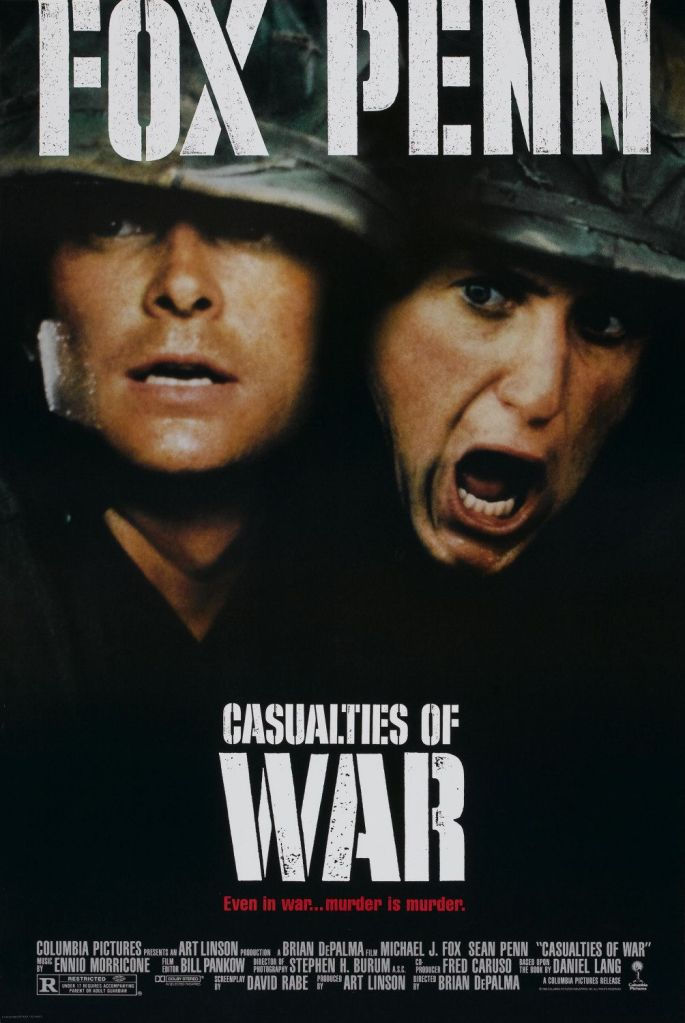
Casualties of War (1989)
Not be outdone Brian De Palma entered the Vietnam movie sweepstakes a full decade after his old cohort Coppola stepped off. At the time, I very much scorned the ad campaign for this film. See poster above. Neither Michael J. Fox nor Sean Penn had earned “just last name” status, as though they ranked with Olivier and Gielgud. It was pretentious, and dumb. At any rate, if Full Metal Jacket seemed tired, imagine how threadbare this one seemed two years later. And coming as it did amidst a string of Hitchcock rip-offs and other silly remakes by De Palma, one was apt not see it on its own terms, although it has gained in reputation since. As with Full Metal Jacket, Casualties of War was of much older vintage. And though its good guy/bad guy plot seemed derivative of Platoon, the story was based on a 1969 book about an actual war crime, known as the Incident of Hill 192. David Rabe (Streamers) developed his own script, and first interested De Palma in 1979, before Coppola had demonstrated the efficacy of the genre. They were unable to get it financed until De Palma had a massive hit with The Untouchables (1987). In addition to the two names above the title, it featured John Leguizamo, John C. Reilley, Ving Rhames, Sam Robards, et al. As I say, the film’s reputation has risen over time. For my part, I have always been more impressed by De Palma’s 2007 movie Redacted, which transplants a similar story to Iraq. Both movies lost money at the box office.
Anyway Coppola, De Palma, Kubrick…who’s missing? it is interesting to me that a couple of the major New Hollywood directors of that era conspicuously never entered this sweepstakes. For example, Spielberg’s cinematic focus in the war picture genre has been on the less controversial WW2, although Vietnam looms in the background of The Post (2017), which concerned the decision of the Washington paper to publish the Pentagon Papers. As for Martin Scorsese, though he has never been one to shy away from violence, he seemed to nibble around the actual issue of Vietnam at most. He made a black comedy short called The Big Shave a.k.a. Viet ’67 (1967) which can be taken as a metaphor for the war. He co-directed a documentary about anti-war protests called Street Scenes (1970). And of course the character of Travis Bickle in Taxi Driver (1976) was a veteran of the war. That army jacket he wears around is the tell!
There is a coda to talk of this minor Hollywood subgenre, and it is one relevant to my more abiding interest, which is film comedy. In the thick of this run of ‘Nam films, Ben Stiller got an idea for a movie that would satirize them, and the Hollywood system that produced them. It became Tropic Thunder, released in 2007. That one’s an interesting can of worms, but a topic for another day.

Comments