


A day in Kutná Hora


“A day in Kutná Hora”
Kutná Hora, Czechia (The Czech Republic). May 2018 (14 photos)
This is Part 2 of my Czechia (The Czech Republic) 2018 photo series, and also Part 15 of my Europe 2018 photo series.
Let’s leave Paris for a moment, although there were a significant number of requests in my previous post about East Paris to make a separate post about Pere Lachaise which I’ll do soon enough.
Approximately an hour to the east of Prague in the Central Bohemian Region of The Czech Republic, is the ancient silver mining city of Kutná Hora. Its historical centre is now a UNESCO world heritage site.
In the 13th century silver was discovered in the area and Kutná Hora flourished. The royal mint was established in the early 14th century during the reign of King Wenceslas II. It became the second most important town in the Kingdom of Bohemia. During the 16th century, the mines began to run dry and the town´s treasure soon became history.
Of particular note, Kutná Hora has 3 interesting churches and for about the price of a cup of coffee in Australia, I bought a ticket that gave me access to all 3 churches. Let’s visit them, shall we…

Saint Barbara´s Church (The Cathedral of Saint Barbara)

Saint Barbara’s Church is a Roman Catholic church in the style of a Gothic Cathedral. It is one of the most famous Gothic churches in central Europe. St Barbara is the patron saint of miners, which is highly appropriate for a town whose wealth was based entirely upon its silver mines. Construction took nearly 500 years. The first architect is said to be Johann Parléř (son of Petr Parléř, the architect of St. Vitus Cathedral and the Charles Bridge in Prague). The interior is full of Gothic and Renaissance paintings.

The church also has more than its fair share of beautiful stained glass windows.

After photographing so many stained glass windows, I got a bit creative with my photography. 🙂

A section of the interior. Via a narrow spiral staircase I made it up to the first floor which you get a glimpse of in the above photo.

Church of the Assumption of Our Lady and Saint John the Baptist
This is one of the most important Czech Gothic buildings and one of the oldest examples of the Baroque Gothic style.

Inside is a rather lovely spiral staircase designed by Jan Blažej Santini Aichel.
The church was built first in the High Gothic style around 1300 as the first church in the kingdom resembling French Gothic cathedrals. It was built on the place of an older church and was a part of the Cistercian’s Sedlec Abbey, which was the oldest Cistercian abbey in the Czech lands founded in 1142. The abbey was burnt down by the Hussites in 1421 and the church became a ruin for the next two centuries. In 1700 the abbot of the Sedlec Abbey decided to rebuild the old church. The reconstruction was completed in an original style called Baroque Gothic. The church was consecrated in 1708.

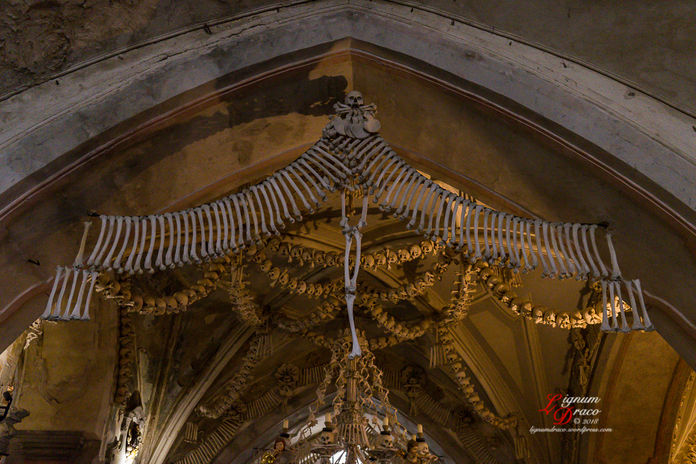
The Sedlec Ossuary (The Bone Church)
The Sedlec Ossuary is a small underground Roman Catholic chapel, located beneath the Cemetery Church of All Saints, founded in the 13th century. František Rint was commissioned in 1870 to decorate the chapel. For that he used between 40,000 – 70,000 human bones artistically arranged to form numerous decorations and furnishings for the chapel.

An enormous chandelier of bones, which contains at least one of every bone in the human body, hangs from the center of the nave with garlands of skulls draping the vault.

Detail from the coat of arms of the local aristocratic House of Schwarzenberg,


So that’s how I spent a day in Kutná Hora. Whilst there I also managed to indulge in the classic Czech dish, Svíčková, with locally brewed beer, of course. During my time in Prague it rained on only one day and that huge downpour occurred on the day I was in Kutná Hora, where there only a quick 5 minute light sprinkle. I was quite lucky with that.
…

Comments