


90. HIGHLY STRUNG


Obviously, a tennis player’s main tool is her racquet and that includes the strings as without them, the racquet is totally useless! But there is much more to racquet strings and stringing than many people realise and a match can be won or lost on the strings. It wasn’t until I spent time with players that I began to realise just how important the strings are and how essential it is for the tournament stringers to be good at their job.
When back at base, getting a racquet strung is relatively simple and straightforward. Most players will have a ‘preferred’ stringer and will rely on them to string their racquets at the preferred tension. However, when on the road, things are a little more tricky. No two stringers are the same and no two stringing machines are either – some are top of the range, electric models; others are traditional hand crank manual machines; and some are simple table top travelling contraptions that are incredibly unreliable in terms of how they calibrate the tension on the strings.
Similarly, some stringers have been stringing racquets for years and are highly experienced, but at the mid/lower end of the tour, the stringers can be somewhat hit and miss. Also there is sometimes a language barrier and stringing instructions can get lost in translation. Is the tension in pounds or kilograms? Does the string need to be pre-stretched? Do you want the gut in the mains or the crosses? Some of the most basic questions that need to be asked but, which can be difficult if the stringer doesn’t speak the same language as your player.
When at the bigger events (Grand Slams, higher level WTA/ATP), the stringing team will comprise a room of several people and they will be using the top level electric stringing machines, but when at the lower level events, there is usually only one person responsible for all racquet re-strings. This person is most often located in some (dark) corner on site and typically works the longest hours of all the tournament staff, trying to get through all the racquets that need attention.
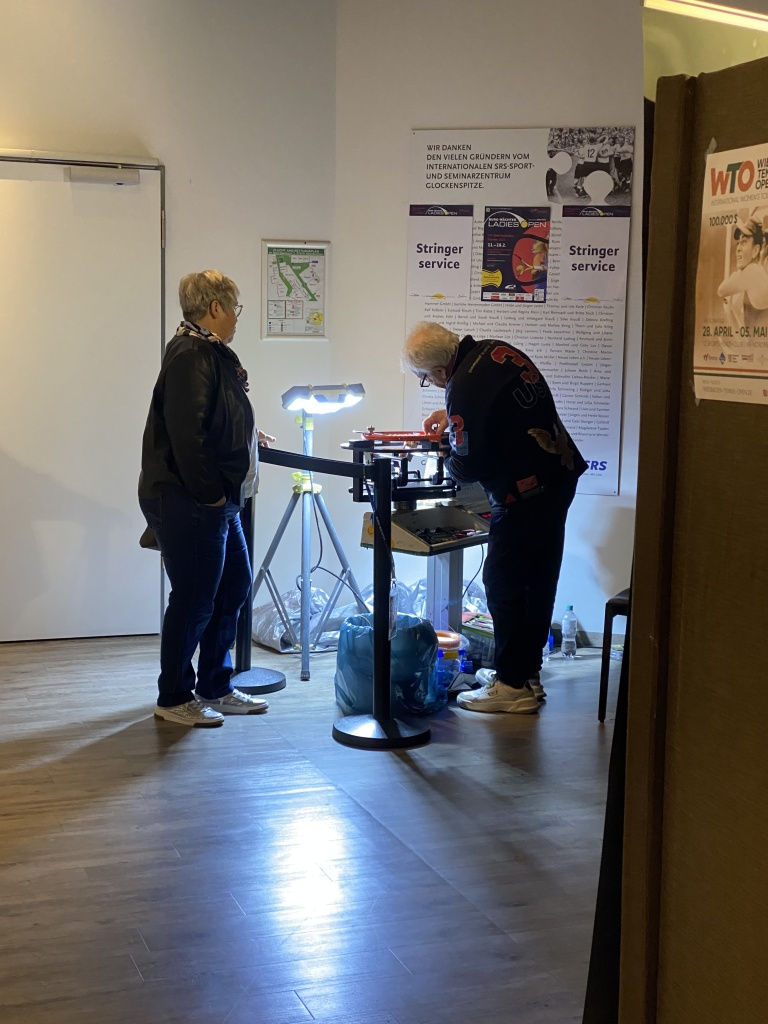
To people in the outside world, tennis strings are all the same, but this is really not the case. As I have learned over the years, there are four main types of string – polyester, multi filament, gut and synthetic gut – and each of these has different qualities and will affect how the racquet plays and performs. What might be good for one player, may be very different for another. One player might play with all one type of string whilst another will play with a mix, or hybrid, of two types of string. The strings vary enormously in price and whilst natural gut string holds its tension the best, and is the most comfortable on the arm, it is by far the most expensive (currently c.£40 a packet – one racquet) and hence not used by the majority.
Similarly, strings can be of different thickness or gauge and again each player will have a preference. The higher the gauge the thinner the string. Thinner string typically provides more power and spin, while thicker strings provide more control and durability. Each player has to work out their preferred tension of their racquet strings. Again all very different. A lower tension will give a player more power, more comfort and will open up the sweet-spot of the racquet, whilst higher tensions will give more control and require the player to generate her own power more (instead of the racquet or string doing it for her).
Factors such as air temperature and altitude can also affect the racquet strings, so players need to take account of this when traveling around the globe. In hotter climates and at higher altitude, the strings get looser more quickly and so lose tension resulting in more power but less control. Hence, a player needs to adapt and get racquets strung at a higher tension when playing tournaments in such locations.
But the issue with all of this, especially for the players at the lower/mid range of the tour, is cost. The cost of re stringing just one racquet, either back at base or whilst on the road, can cost anything in the region of £10-£25 and that doesn’t include the cost of the strings. When you consider that each player will travel with a minimum of 3 racquets (more likely 4, 5 or 6) the cost really mounts up and, whilst the higher level players freely get racquets strung before and during each tournament, the mid level players and below have to be much more conservative about when they choose to get racquets re-done. Some players wait until their strings break but in reality re-strings should be done far more frequently if the racquets are to be most effective in play. Even things like a flight (especially long haul) will affect the tension in a racquet. The weather can also have an effect – natural gut can’t be used in damp conditions for example, as it is a natural product and absorbs water and when wet the strings become soft and unplayable.
Real stringing bug bears on the tour include stringers who lose your string or give you back a reel that is tied in knots and becomes unusable. Or they break your gut string and you have to provide a second amount, which at c.£40 a go is not good. Then there are the stringers who feel the need to charge an ‘express stringing fee’ if you need your racquet quickly because you have been put first on the schedule – a factor which is not in your control. The phrase ‘taking liberties’ comes to mind!
Another bug bear is the player who puts 5 racquets in for re-string and expects them all to be done ahead of anyone else. Thankfully most stringers are fair to all players and will maybe do one or two but then move onto another players racquets before finishing the ‘bulk order’.
On the junior tour, I took to being responsible for the stringing of my player’s racquets. It saved a lot of money and it was nice to learn a new skill. There are low costing courses you can attend and the technique of re-stringing is not too difficult to grasp. At one stage I had a portable stringing machine which we took with us to all tournaments but the issues with this kind of machine are two fold – firstly they are not as accurate as stand alone machines (and the better a player gets the more critical this becomes) and secondly, some of the tools that you need to string a racquet could be deemed to be ‘dangerous’ and I was often asked at airport security, why I had them in my bag!
So, if your player plays a lot and is considering a life on the tour, you are advised to become string savvy. A poor workman may blame his tools, but in the case of tennis players, a poorly strung racquet can indeed be the reason why a player hasn’t played as well as they usually do. Hence, why some players get their racquets strung at different tensions so that they can change their ‘tool’ as a match progresses and select an alternative if the one they had strung doesn’t fee quite right.

******************************************************
If you have enjoyed this blog, please follow, share and read more at http://www.realitytennis.WordPress.com and subscribe to receive e mail notification of upcoming blogs as they are released. Follow also at:
Twitter: @realitytennis
Instagram: realitytennis
If you have similar stories to share, please feel free to e mail the author at: sallyappleton64@gmail.com

Comments