


60 Years Ago At the 1964 New York World’s Fair


Based on a talk given at the Queens Theatre, Flushing Meadows Park, April 2024.It forms a sort of book-end with my 2019 talk theater about the 1939 New York Worlds Fair, which was also held in Flushing Meadows Park.
…Believe it or not, worlds fairs grew up at around the same time as modern county fairs and state fairs. They seem like they ought to be a lot older, and certainly there have been fun fairs and village fetes and holiday bazaars and so forth for centuries. But these modern fairs, even though we associate the county and state ones with agriculture and rurality, still depend on a certain amount of leisure, and surplus, and modern business methods, and advertising. So these things don’t really get going until the mid 19th century.
The world’s fairs are remarkably similar especially to trade fairs. They are opportunities for nations and peoples and entrepreneurs and business entities to display their wares, and to do so with a lot of pride. Traditionally there is a certain spirit of friendly competition. There is an exchange of ideas and arts and good services that is the literal opposite of war. People are showing off what they have created, and it’s always the biggest, the best, the newest contraptions and machines and discoveries. And they were held in the great capitols. Initially Paris, London, Berlin, New York. Pretty quickly it was noticed that America had a lot of great capitols too and so there were a ton here, and many became famous. Philadelphia, 1876 at the nation’s Centennial. The Columbian one in Chicago in 1893, which was hugely influential. Buffalo, 1901 where McKinley was assassinated. St Louis, 1904, which inspired Meet Me in St Louis. There were two at the same time in California in 1915. And because they’re so focused on contemporary arts and sciences there has always been a strong sense of futurism, and human progress and science fiction to these worlds fairs. In the 19th century there was a vibe that we nowadays would retro-identify as “steam punk”, i.e. hot air balloons, steam-powered contraptions. 1939 was very much about electricity and radio. Television was introduced to the wider public at that fair.
A quarter century later, the 1964 Worlds Fair was no different. Indeed, I have come to think of it as the last moment when American popular cultural was looking at the future with something like optimism. John F. Kennedy was still around to break ground on this festival when the building phase was officially launched in 1962. You’ll recall that he was the guy who committed us to landing on the moon, which we accomplished. The American space program was very well represented at the ’64 Worlds Fair. It was the era when people thought the future would like The Jetsons, and soon Lost in Space, and the original Star Trek, and not like Mad Max and zombie apocalypse movies. Things were being built. Shea Stadium had just gone up The Beatles, who had just debuted on the Ed Sullivan Show 9 weeks before the Fair opened, came back and played Shea Stadium a few months later.
At the same time, just 2 or 3 months after the start of this festival, riots started breaking out all over the country, and the Gulf of Tonkin heated up the Vietnam war. You don’t need to get political, or take a side about the issues dividing people in the ‘60s to acknowledge that there were developments on the landscape sufficient to dampen any spirit of hopeful optimism. Maybe not here at the fair, and probably not if you were a child, but afterwards, and away from the fairgrounds. I can’t speak for everyone obviously but it seems to me that in a general way our society never got that spirit back. I’ve certainly never experienced in my lifetime, the idea that the future is bright and America can do anything? Not to beat a dead horse, but it seems to me that that’s value added in contemplating this festival, getting to spend some time in that fantasy bubble. And even better, some of what was predicted actually came true! Much of what they dreamed about in 1964 took longer than anticipated to become widely disseminated but did in fact eventually come to pass and it’s a worthy exercise I think to contemplate some of the inventions that make our lives easier and more exciting in our times, and remind ourselves (to editorialize) that everything isn’t terrible.
Why 1964? It had been a quarter century since the previous New York World’s Fair. But the real reason was ostensibly to honor the 300 anniversary of England seizing New York from the Dutch in 1664.
The 1964 exposition was a renegade worlds fair. In true maverick fashion it was operating outside the commonly accepted worlds fair bounds, in that it was not officially approved by the governing body of such things, the Bureau of International Expositions. Like the Olympics and the World Cup there’s an international organization that supposed to regulate such events and they have a lot of rules, which Americans just can’t stand. This fair ran afoul! Foul’s fair, and the fair’s afoul! What were the rules? There’s only supposed to be one world’s fair per country every ten years, and the U.S. had just had one in Seattle two years earlier. (That was the one that gave us the Space Needle). Also, each worlds fair is supposed to only run for a single six-month season. (This one had ran two seasons). And fairs are not supposed to charge rental fees for pavilions, but of course we did because this is New York. Basically the BIE seemed to want New York’s fair organizers to lose even more money than they eventually did. The break-even was 70 million admissions. Only 50 million admissions were sold.
80 nations participated in the 1964 New York Worlds Fair, mostly smaller and newer ones. This was one of the first international expositions held during the age of post-war decolonization. A lot of the early world’s fairs had been about competition among the leading powers, with France, the UK, Germany, and the US vying for world supremacy. This time, most of the major western nations didn’t even come, or were barely represented. France, for example, didn’t have a pavilion, though the city of Paris sent one, consisting of a bunch mannequins dressed as can-can girls. Britain sent a replica of a pub. This is not very exciting stuff from the richest nations of the world. France led the world in scuba technology at the time (Jacques Cousteau invented it, after all). They could have brought a demonstration of that. The Brits could have riffed on James Bond. Speaking of which, the Cold War also put a damper on things. None of the Communist nations came. Kruschev was busy banging his shoe on the table in 1964. At a healthy expo, one might like to have seen Russian rockets and jets competing with American rockets and jets. Space Race on parade! Of course, the U.S. space program was well represented at the fair (a couple of the rockets are still on the grounds), but Russia’s was conspicuous by its absence.
Most of the national exhibits were contributed by smaller countries, who brought examples of their heritage and culture. The African Pavilion was a cooperative project involving 24 nations, which was over a quarter of the countries who came. Belgium introduced visitors to their famous waffles. Many were inspired by the Israel Pavilion (the new nation was only 16 years old. The Six Day War was still three years away). Lithuania had a “Garden of Meditation” where visitors could sit and relax when they’re tired from exploring the other exhibits. (That may be the most Barnumseque of the exhibitions)

Vatican City sent the actual Pieta! This was clearly among the highlights of the fair for many people. It was behind glass and a conveyor people transported visitors past it, because the line was so long.
As for U.S. states, fewer than half were represented — with Alaska and West Virginia among them.
The Illinois Pavilion hosted Walt Disney’s Animatronic Abraham Lincoln,which was later moved to Disneyland. Walt very intelligently took commissions rather than buying his own exhibits. He also created several other exhibits which we will mention anon. There was also an exhibition called “Hollywood USA”, which featured a corny western shoot-out with stunt men, and sets and other movie memorabilia, including a replica of The Bounty that was moored in the nearby marina.
Corporations seemed to make a more impressive showing than either nations or states, and I guess that says something about the way the world was going, even then. Automobile culture loomed especially large.

TheFordMotor Company had exhibits designed by Walt Disney. Visitors rode in Ford automobiles past exhibits that took them from the age of dinosaurs to the future. General Motors contributed “Futurama II – Avenue of Progress” which took you on a trip to the Moon, then to underwater cities, desert farms, a container port in Antarctica, and cities of tomorrow with super high skyscrapers and moving sidewalks. Chrysler presented a car engine as big as a building and a ride on an assembly line (from the point of view of the car being assembled). Sicony Mobil sponsored a simulated driving ride with video screens that allowed you to race others from coast to coast.

Sinclair Oil hosted the fair’s most spectacular dinosaur exhibit (there were several). It was a whole park full of actual sized fiberglass dinos, some of which moved. They also had an introductary exhibition talking about the ancient earth, obviously to tell the story of where fossil fuels came from.

UniRoyal Tires brought a ferris wheel shaped like one of their tires. It now lives in Detroit. Their competitors at Goodyearwere not a part of the fair, but their presence was felt — their advertising and observational blimps hovered above and around the proceedings from the air.

Bell Aircraft brought actual demonstrator model jet packs — surely we were expecting these to be in common use by now! On the other hand, Bell Telephone brought several inventions that were science fiction at the time, but have come to pass (some have even come and gone): video phones, touch tone keypads, fax machines, and modems. They also a ride that took you “From Drumbeats to Telstar” . (Telstar is not just a cool 1962 tune by The Tornadoes, its also a communications satellite.). RCA showcased a color television studio, where you could see yourself on color television. This was before color television was common in American homes, and WAY before there were consumer grade video cameras, so it was more thrilling to visitors than young people can imagine. Dupont, brought a microwave oven — a decade or more before they were common in American homes. IBM brought computers, two decades before they were common in American homes.
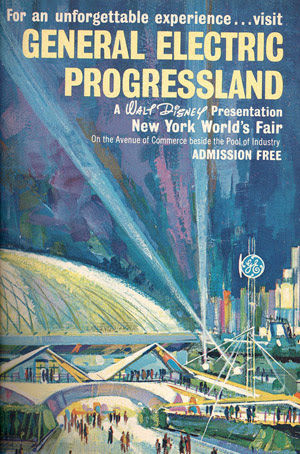
General Electric had Progressland, again designed by Disney. The audience itself rotated on a turntable called the Carousel of Progress, which took you from the Big Bang to the Age of Atomic Power. Animatronic figures told the story. Parker Pens had a booth that matched you with international pen pals, which I find charming in its simplicity and admirable in its straightforwardness. I don’t know of David Ogilvy was involved but it strikes me as his kind of thing. There’s a purity to it. It’s not sexy or flashy — just kind of old-fashioned and nice. Clairol had a booth with a special mirror that showed you how you would look with different hair colors and styles. No men were admitted, which I also love.

Pepsi sponsored one of the most famous of the fair’s exhibits: the “It’s a Small World” tribute to UNICEF, another one designed by Disney and later moved to Disneyland. Coca-Colawas also at the fair but with nothing quite so pernicious as this song. Although a few years later, they did create a very similar pop culture phenomenon with “I’d Like to Teach the World to Sing” which also featured people from all over the world holding hands and singing at the behest of a soft drink.

The fairgrounds itself featured all sorts of unique futuristic features including the 120 foot tall Unisphere, which is still standing. I hadn’t quite realized that it’s a different structure from the Perisphere from the 1939 fair, though it’s at the same location.
The fair offered amenities such as moving sidewalks, and for the truly footsore, coin-operated foot massage vibrators.

American Machine and Foundry Company offered an 8 minute mono-rail ride.

There was also a Swiss Sky Ride, a mountain style tram, which took you over the fairgrounds in 4 minutes.
The Port Authority had a Heliport for scenic helicopter rides. Now it’s a banquet hall. The Port Authority also had a scale model for one of their then upcoming projects — the World Trade Center.
Frank Capra’s last film Rendezvous in Space was created for the fair, and shown in the Space Park at the New York Hall of Science.

The New York State Pavilion featured Observation Towers, a Tent of Tomorrow, and a Theaterama, which is now the home of the Queens Theatre. On that building were several large murals commissioned by architect Phillip Johnson, from such important American artists as Roy Lichtenstein, Robert Rauschenberg, and Andy Warhol. Pop Art was very big just then! But the public did not get to see Warhol’s, unfortunately. Warhol’s mural consisted of the wanted posters of 13 of the FBI’s Most Wanted Men circa 1962. Sounds like a pretty good idea, it’s even public spirited, but when all of those pictures of murderers and bank robbers were staring out over the fairgrounds, it began to seem like a bad idea. It was Governor Nelson Rockefeller who ordered that it be taken down. After all it was the New York State Pavillion. It was his prerogative. But I can’t help noticing that it had also been Rocky who had ordered the painting-over of Diego Rivera’s socialist mural in the lobby of 30 Rock. Was that just his thing, taking down art?
At the amphitheater where Billy Rose’s Aquacade had been at the ’39 fair, there was a musical called Wonder World. These musical extravaganza shows seem mostly to have failed. The second year the big pools in the amphitheater became part of Florida State Pavilion and was used for a water skiing show, which was very successful.
Another structure built for the fair, the Singer Bowl became home of US open after Forest Hills washed out. There was also a dedicated race track for Hell Drivers, an auto thrill show
I wish I had gotten to see Walters International Wax Museum. It had started in Paris, then Lou and Manny Walter brought it to Seattle Worlds Fair, then New York’s. Afterwards, they moved ot to what was to be a permanent home in Los Angeles. By 1967 it had gone under and collections sold off.
And Sid and Marty Krofft put on a show! Les Poupees de Paris. A puppet extravaganza, with 250 puppets. It had a Paris theme, with scantily clad show girls. This was four years before they broke into TV with The Banana Splits and then HR Pufnstuf and a whole constellation of other shows.

The Underground World Home was a luxurious bomb shelter! I guess the Cold War WAS well represented! I’m more inclined to approve the message propagated by General Foods, which was:

Ah for just a little of the spirit of 1964!

Comments